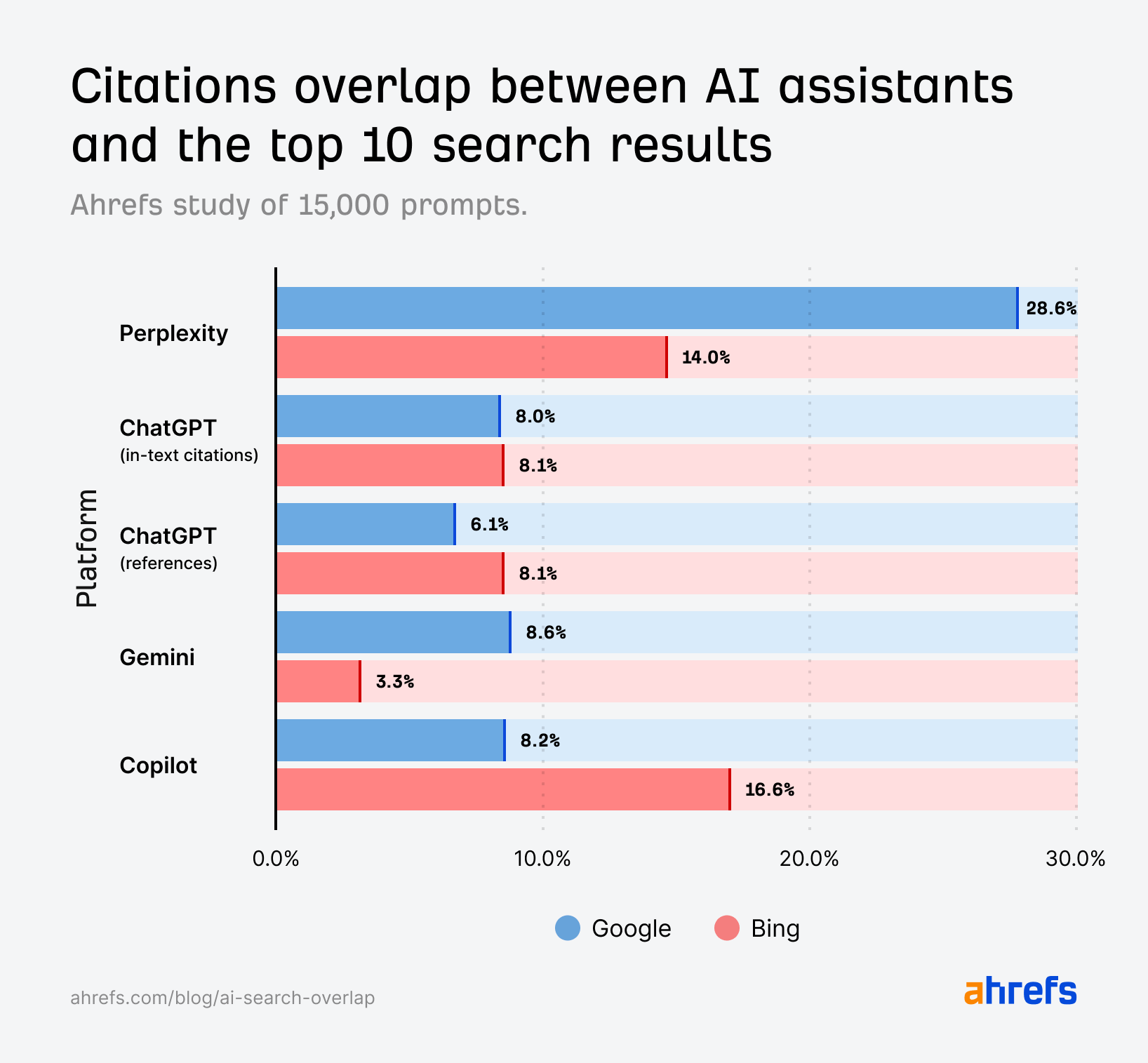
In a dataset of 15,000 prompts, we found that—on average—only 12% of links cited by ChatGPT, Gemini, and Copilot appear in Google’s top 10 results for the same prompt.
Perplexity is the outlier: nearly 1 in 3 of its citations point to pages that rank in the top 10 for the target query.
We analyzed four AI assistants—ChatGPT, Gemini, Copilot, and Perplexity—to measure how often the URLs they cite or reference overlap with what Google or Bing ranks for the same query.
On average, the citation overlap between AI assistants and Google and Bing’s top 10 stands at 11%.
((Google AI overlap total + Bing AI overlap total) / 10) = 10.96%
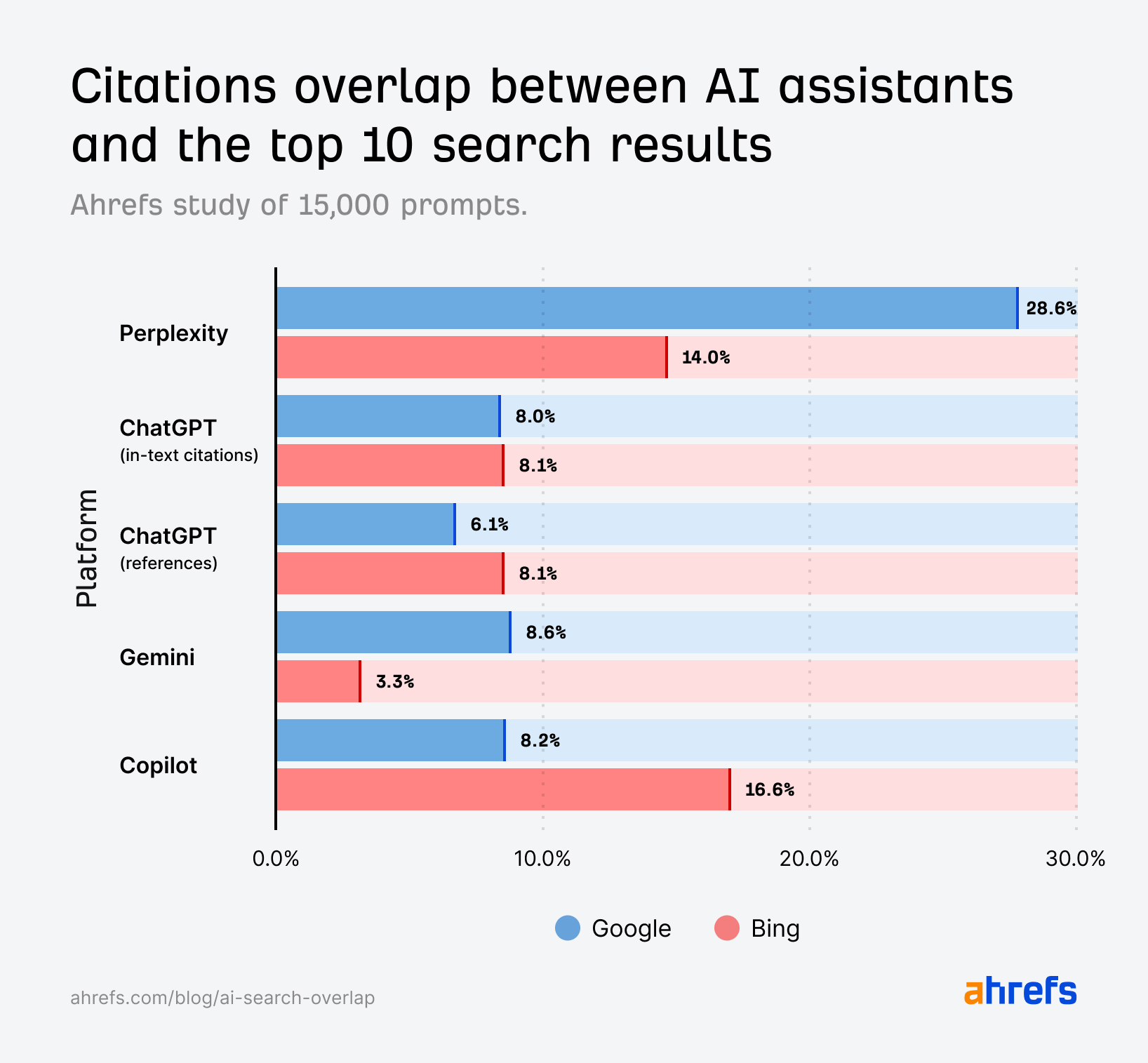
Further down, we look at this broken down by individual search engine.
Example queries included:
- “How much does it cost to install a security camera?”
- “How to get enough protein when you can’t eat dairy?”
- “What is the cheapest full comprehensive insurance?”
- “¿Cuál es el mejor suplemento para la recuperación muscular?”
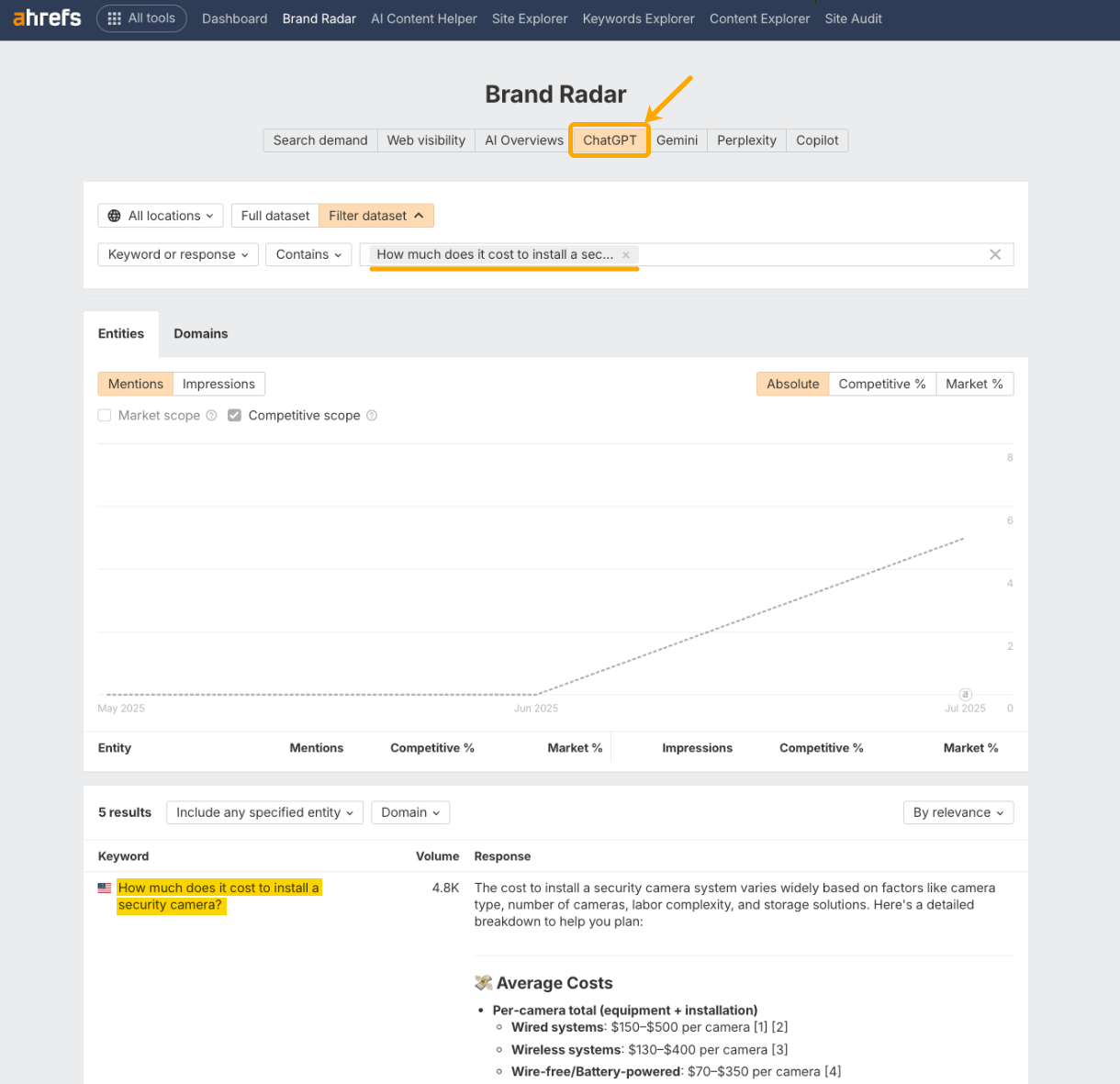
Xibeijia then extracted every visible citation returned for each question across both search and AI indices.
In the search dataset, she recorded the ranking positions of the cited URLs—then categorized them based on whether they appeared in the top 10, or top 100 results.
The AI assistants tested include ChatGPT (both in-text citations and bottom-of-response references), Gemini, Copilot, and Perplexity.
According to research carried out by our data scientist, Xibeijia Guan, just 12% of citations in AI assistants also rank in Google’s top 10, on average.
((28.6 + 8 + 6.1 + 8.6 + 8.2) / 5) = 11.9%
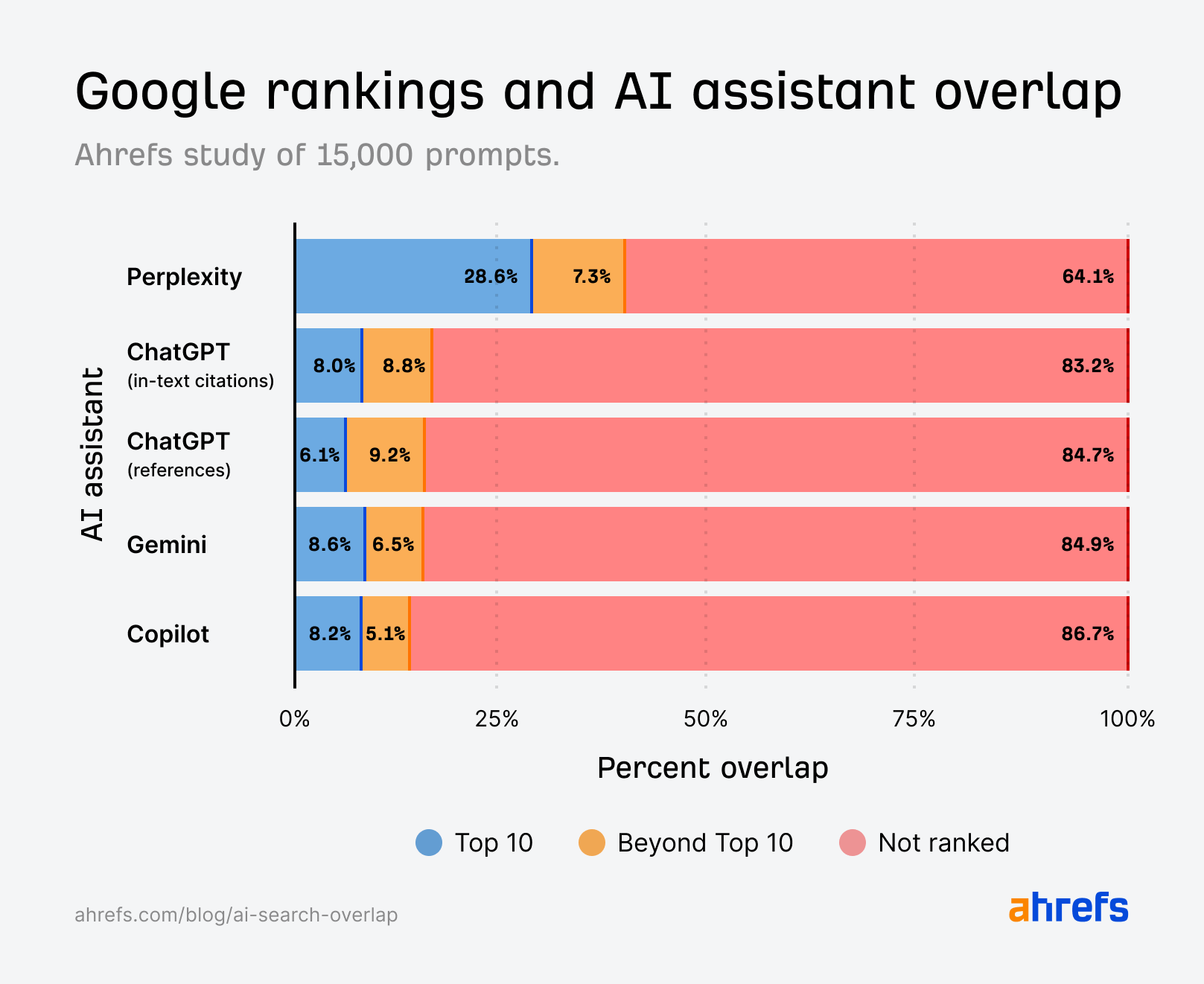
80% of those citations don’t rank anywhere in Google for the original query—80% is essentially the average of all the “red” columns in the chart above.
The overlap between AI and search citations is smaller than we anticipated, but we have a couple of theories as to why that might be.
We’ll get into them a little later on.
Perplexity aligns closest to Google
Perplexity is an AI assistant that was literally built to cite—its goal is to support nearly every statement with a source.
Perplexity is the world’s first answer engine. It searches the internet in real time to deliver fast, clear answers to any question—with sources and citations included…Every answer comes with clickable citations, making it easy to verify the information and dig deeper if you want.
Perplexity Team, Oct 2024
ChatGPT and Gemini, on the other hand, don’t always link out.
Their citation process is very much query-dependent, and their internal systems trigger searches based on different criteria.
ChatGPT, for example, seems to use something called the sonic classifier—if the prompt “probability” exceeds a certain threshold (i.e. if the response is less easy to “predict” based on training data), then ChatGPT will perform a web search.
Perplexity consistently favors content that ranks well in Google, with 28.6% of its cited URLs landing in the top 10.
For the other AI assistants, that number hovers around 8%—and more than 80% of their citations come from pages that don’t rank at all for the target query.
Since Perplexity focuses heavily on citations, it seems logical that its results would align closely with Google’s.
But, unlike Gemini and other AI assistants, Perplexity doesn’t draw on Google or Bing’s index. In fact, it has its own search index, based on its crawler: perplexitybot.
AI assistants—even those that draw on Google and Bing—appear to query search indexes in a fundamentally different way. This explains why we’re seeing minimal crossover.
Perplexity still remains one of the most SEO-aligned AI assistants, while ChatGPT and Gemini show the least overlap.
For example, a page that ranks around #6 for “how to descale a coffee machine,” “cleaning a Nespresso machine,” and “remove limescale from coffee maker” might be cited over one that ranks #1 for only one of those.
In fact, it’s possible that AI assistants may never search for the actual prompt that the user inputs—instead it just acts as a catalyst for other fan-out queries.
This is why eventual citations won’t always rank for the original prompt.
Personalization can also play a role: the exact same search query run through AI can lead to wholly different citations, due to factors like the user’s prompt or conversation history.
All of this may explain why AI citations don’t always mirror the SERPs.
Tip
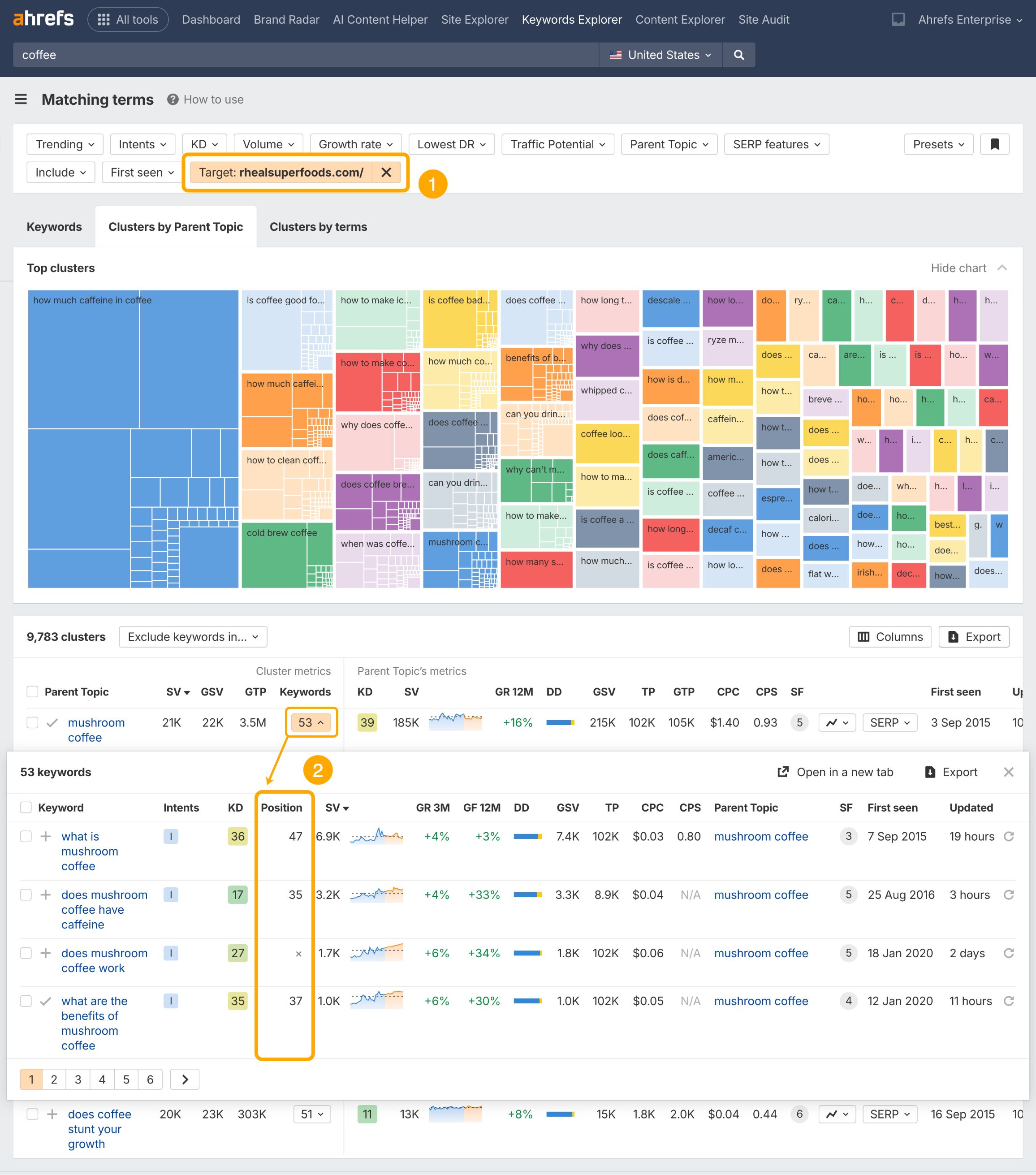
You can optimize for multiple, long-tail query variations using Parent Topics in Ahrefs Keyword Explorer.
Just search a keyword, head to the Matching Terms or Related Terms report, and check out the Parent Topics on the left, or hit the Clusters by Parent Topic tab.
Then hit the Questions tab for long-tail queries to target in your content…
And to see how much ownership you have over existing long-tail query permutations, add a Target filter for your domain.
Similar Posts
How to Track Website Metrics With One Free, Privacy-Friendly Tool
There are plenty of website metrics out there, and just as many tools to track them. So, to clear up the confusion, I’ll show you the key metrics that really matter, explain how to make sense of them, and show you how to do it all with one free, privacy-friendly tool that’s ready for the AI age….
Steal 21+ of Our Best SEO & Content Marketing Templates
It doesn’t matter whether you’re just starting out in SEO, or you’re decades-deep—these battle-tested content marketing templates will give you a headstart on your next project. I’ve been in marketing for coming up to ten years now (*internal scream at the passing of time*) and, while I like to think I have a bit of…
AI Overviews Cite AI-Generated Content More Than Human Writing
AI Overviews are AI-generated content, which means they can contain hallucinations. Google uses “grounding” to improve their accuracy, but according to our research, AI Overviews are more likely to cite AI-generated content than human-written content. Here’s what we found: Keywords Explorer and extracted the top three cited links. 1.9 million URLs in total, of which we…
Should You Use a Hyphen in a Domain Name? Advantages and Disadvantages of URL Dashes
Can a hyphen in a domain name affect SEO? No. But should you use dashes in URLs? Depends. Find out all you need to know. So, you’ve picked the perfect business name only to find the matching domain isn’t available. Cue the never-ending ‘hyphen in domain name’ debate. Whether or not you should put a…
The Ultimate 82-Point Checklist for SEO & AI Visibility
Get the week’s best marketing content You don’t need another debate about whether optimizing for AI counts as SEO. You need to know what to actually do. This checklist combines proven SEO essentials with the new steps that matter for AI search. No fluff, no fuss. It will help you strengthen your SEO foundation, adapt to…