Brand mentions are to AI search what backlinks are to traditional SEO. Links tell Google who to trust; mentions tell AI systems who you are.
Auditing your brand’s mentions is how you uncover:
- How the public sees your brand
- What misinformation might be feeding AI systems
- Which topics and entities are most strongly connected to you
Think of it as backlink auditing for the AI era. Instead of just analyzing links, you’re digging into the narratives and contexts that shape how both search engines and AI models present your brand.
Brand Radar make this straightforward. In the Overview > Web Pages tab, search for your brand and record key metrics, including:
- Number of unique pages mentioning you
- Estimated organic traffic to those pages
- How many referring domains link to those pages
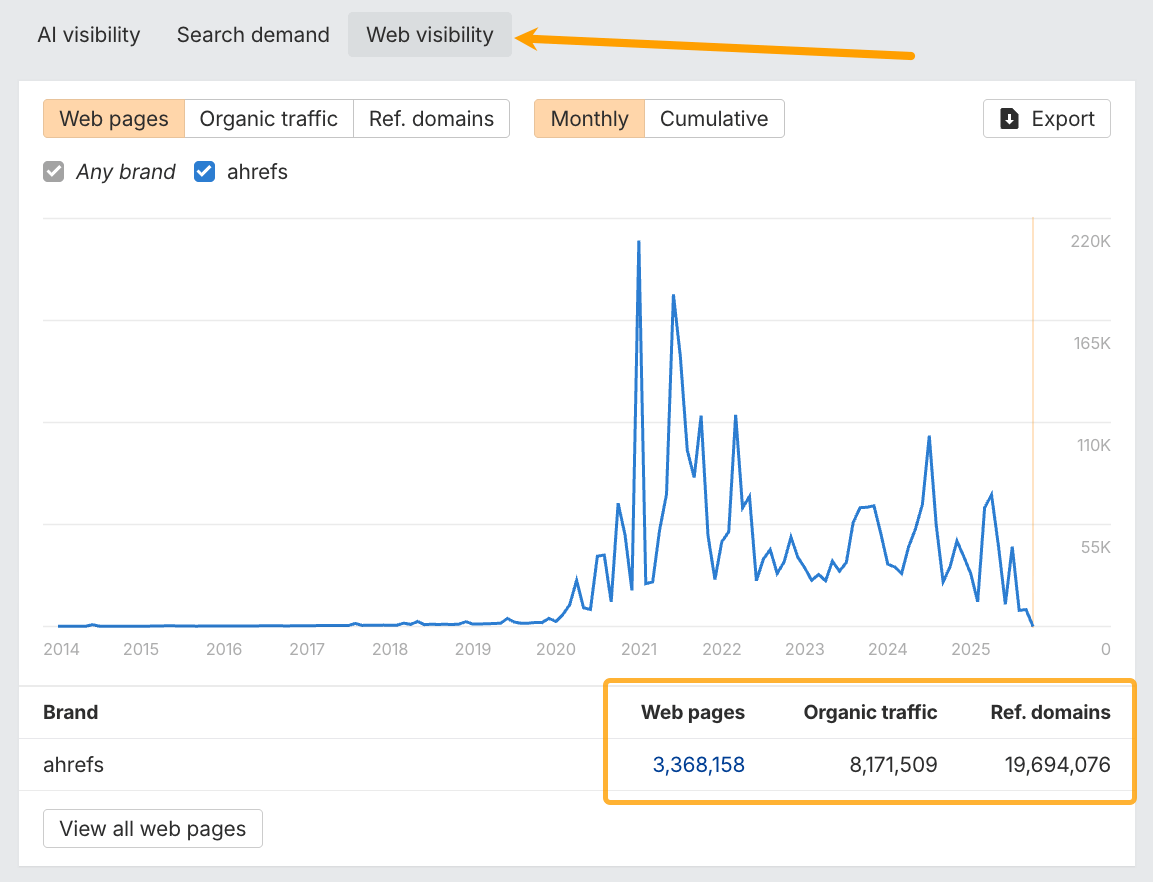
From there, compare cumulative and month-by-month data.
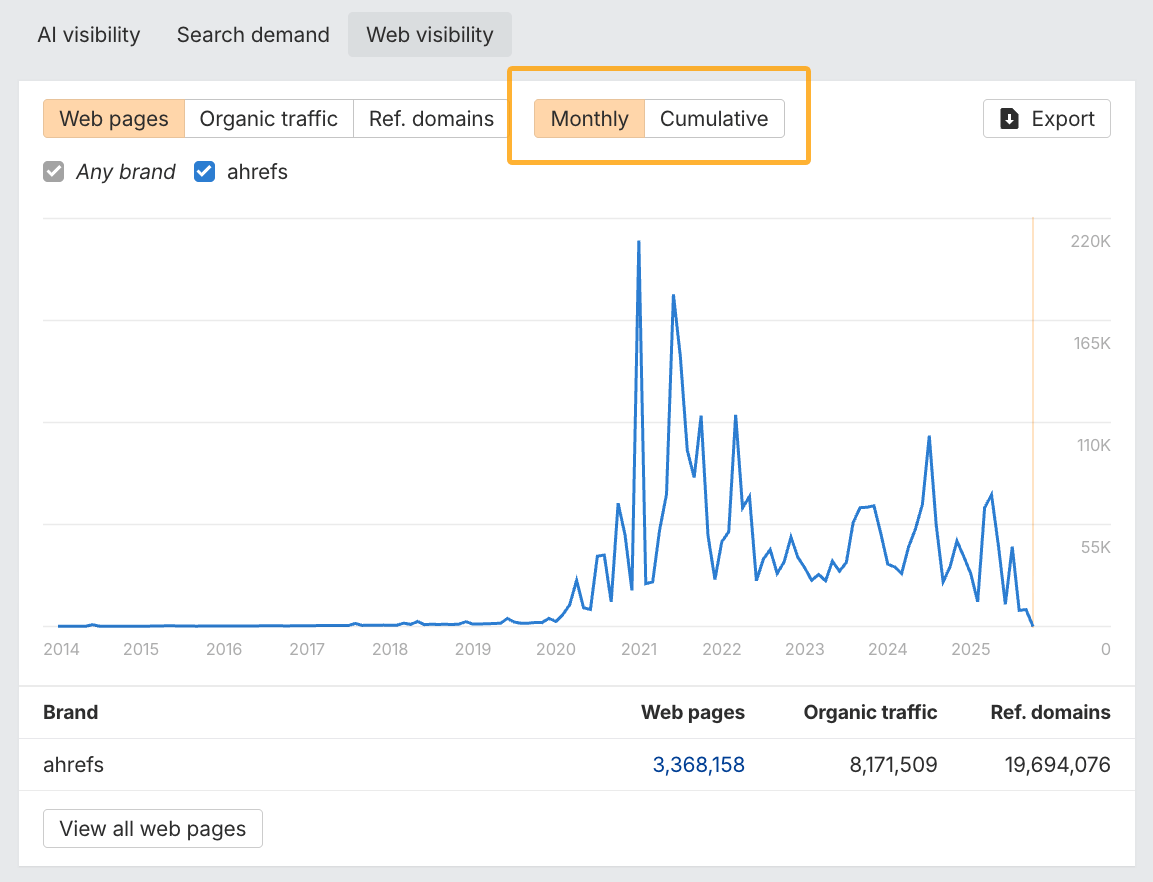
This lets you:
- Track your mention acquisition rate (similar to link velocity in backlink audits)
- Correlate spikes in mentions with marketing campaigns, product launches, or PR events
- Identify long-term growth or decline trends in visibility
A strong benchmark gives you a baseline for measuring future progress and a clearer picture of how your brand is actually perceived online.
advanced search operators to filter the data however you like.
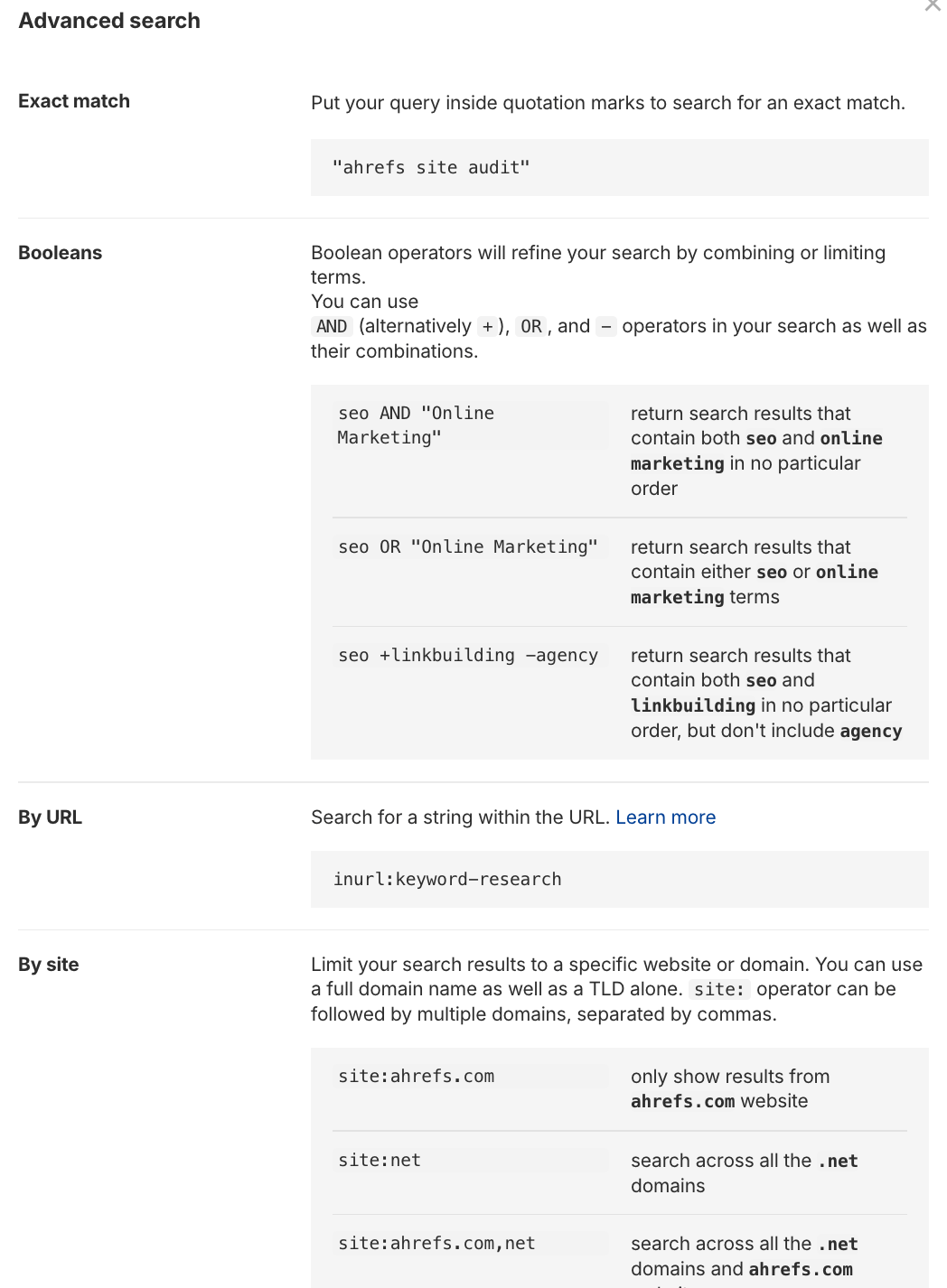
I prefer to remove mentions on my website and filter only to show mentions that also discuss my core topics.
When reviewing your brand mentions around the web, ask yourself questions like:
- What is the predominant sentiment? Are most mentions positive, negative, or neutral?
- Which brand elements show up most often? Do sub-brands, executives, or signature frameworks get more attention than the main brand?
- What types of publications mention you? News sites, industry blogs, community forums, or social platforms?
- Which formats generate stronger mentions? Case studies, product comparisons, thought-leadership articles, etc.?
- Which topics are you most often paired with? What other entities or themes consistently appear alongside your brand?
- Do mentions align with performance lifts? For example, do spikes in mentions correlate with traffic, rankings, or AI response visibility?
By asking these questions, you’ll see not just who is mentioning you, but how those mentions shape the narratives AI search platforms are most likely to surface and include in their responses.
make a copy of this template.
Add your exported data to columns B–H, ensuring they are aligned correctly. Then manually fill in the date in column A.
Every quarter, repeat this process and paste the latest data at the end. After a few entries, the pivot table will look something like this:
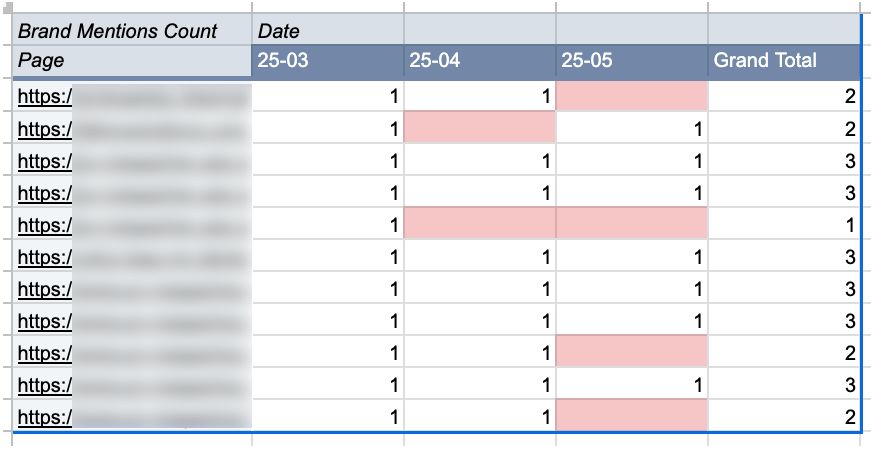
I like to highlight the empty cells so I can more easily see when mentions drop off over time. Then, verify what changed.
You can use tools like Wayback Machine or Ahrefs’ Page Inspect to compare pages with lost mentions and assess what changed.
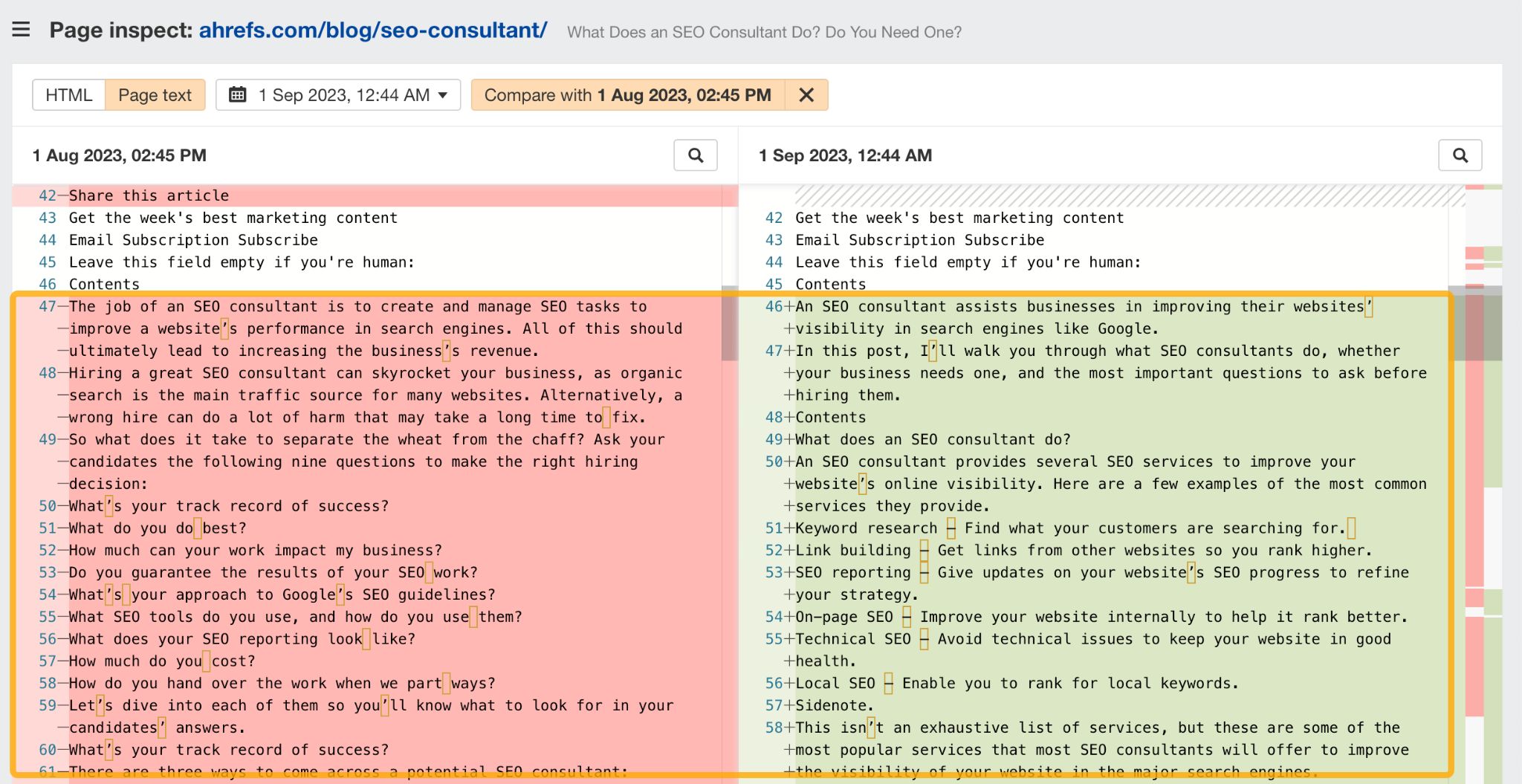
Then, prioritize the mentions you can likely recover or that are on high-traffic, authoritative pages.
Reach out to the publisher and see if you can reclaim the lost mention.
link prospecting process for this. For every promising mention you think you can improve, add it to a prospect list (feel free to use this template).
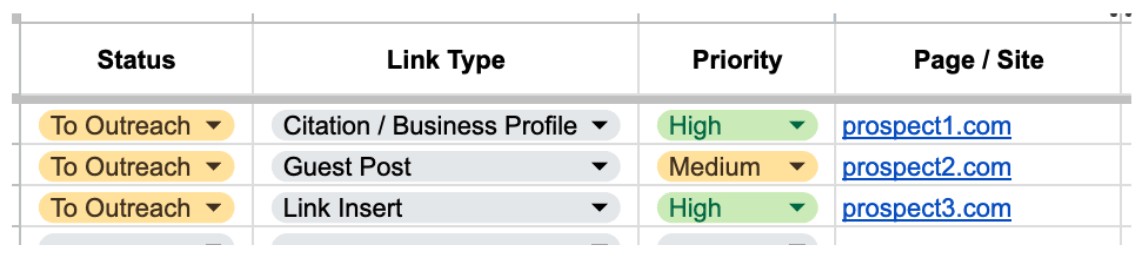
Then, reach out to the publisher.
Tailor your outreach to the situation. For instance, suggest a branded anchor instead of generic text, or see if they’ll be open to mentioning your brand alongside an existing link.
Hallucinated URLs on your site that don’t exist
Inaccurate claims from UGC sites like Reddit, repeated as fact
Mentions on low-quality sites that misrepresent your brand
In isolation, these are not a big issue. Taken altogether, these can add up to a negative pattern over time, influencing responses about your brand.
When misinformation takes hold, it not only risks confusing users but also trains AI systems to describe your brand inaccurately.
To fix this, start with any assets you control or have access to, and update them immediately. For instance, if some old directory listings or business citations have outdated information, log in and update them.
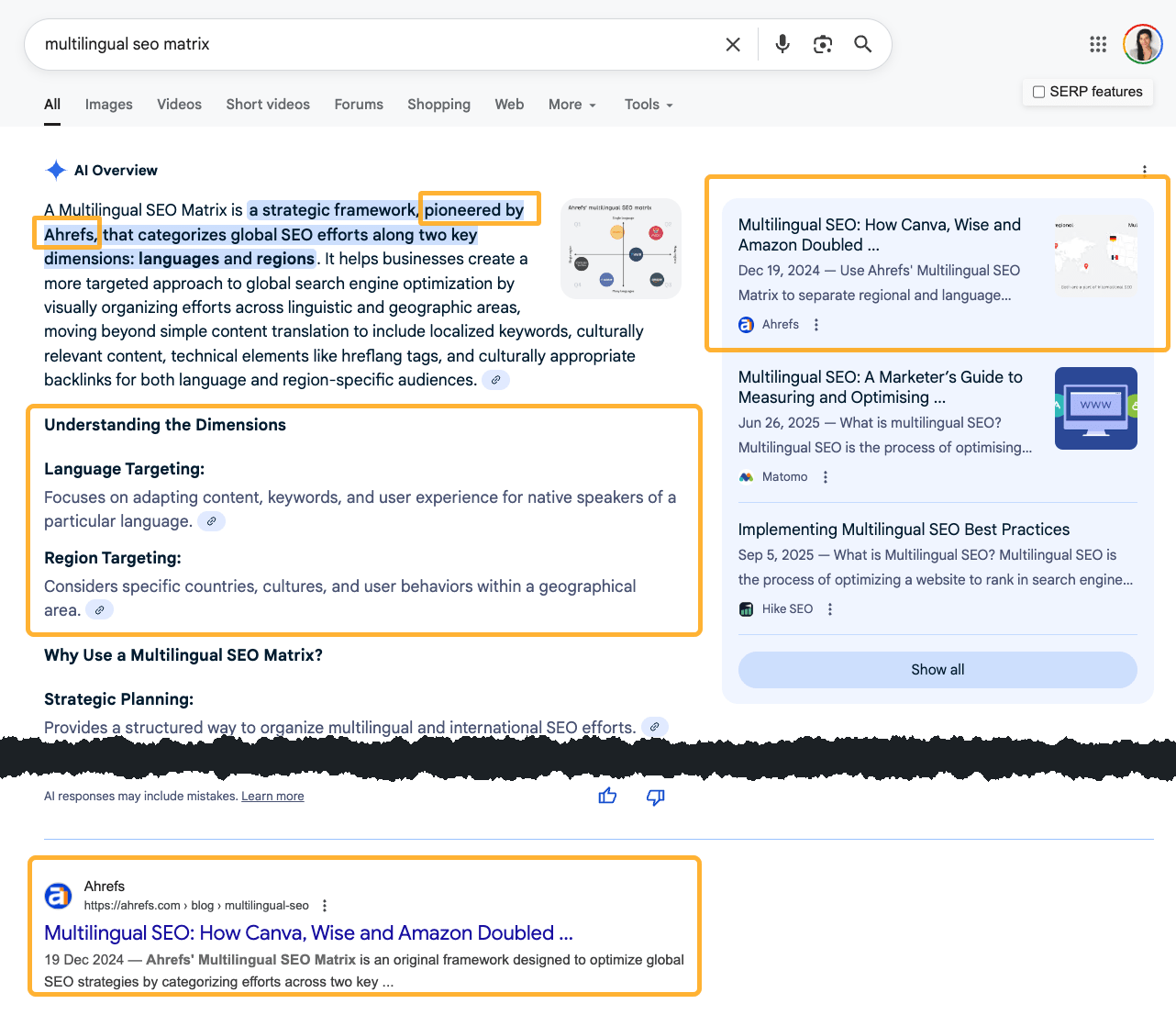
If some content on your website is unclear, edit it. For example, I noticed AI responses were frequently hallucinating about Ahrefs’ Multilingual SEO Matrix. I wrote about it here.
After discovering this issue, I updated the post with clearer content, properly defining the matrix as a standalone concept. Now Google prioritizes our post in the AI response, citation, and organic position one.
If the asset is external, try outreach to the publisher and request that they correct the misinformation in their content.
In severe cases (such as deliberate misinformation or negative SEO campaigns), legal action may be necessary to protect your brand.
make a copy here). The only difference is adding each brand’s name in column A in the Raw Data tab.
Here’s what that will look like once you’ve added data for some sites:
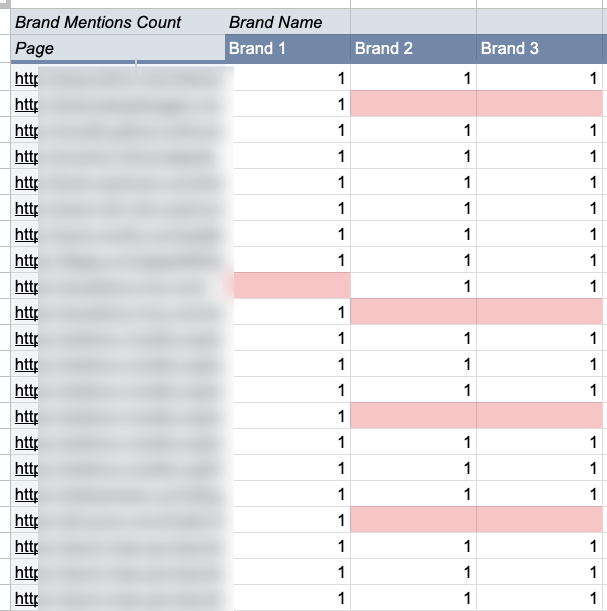
The empty cells indicate gaps in web mentions. Start by looking for posts that mention multiple competitors but not you. These are likely to be your quick wins.
Then, dig into how competitors secured their strongest mentions:
- Content formats: Are their mentions tied to blog posts, case studies, or original research that you could replicate in your own niche?
- Publications: Do certain sites or authors reference them repeatedly? Building relationships with the same outlets could open doors for you.
- Campaigns: Did a product launch, viral idea, or signature framework drive a wave of mentions? Understanding these triggers can inform your own marketing.
- Outreach channels: Guest posts, partnerships, or collaborative content may be fueling their visibility.
By reverse engineering competitor mentions, you go beyond closing gaps. You also discover which strategies are most effective in your industry and how to adapt them for your own brand.
Similar Posts
How to Do an Actually Useful PPC Competitive Analysis Using AI
A competitive PPC (Pay Per Click) analysis is all about seeing what your competitors are doing with their paid ads on platforms like Google Ads, so you can do it better. It helps you uncover which keywords they’re spending money on, what their ads and landing pages look like, and how much budget they might…
8.64% of AI Overviews Appear Outside Position #1 (And as Low as Position #6)
Get the week’s best marketing content AI Overviews aren’t always in the first position in the SERPs. For example, here’s an AI Overview in the 2nd position. See where AI Overviews appear outside of position 1 You can use the SERP features filter along with the Position filter to find some of the AI Overviews outside…
Is ChatGPT Really Powered by Google? 118,931 Fan-Out Queries Analyzed
Given OpenAI’s close relationship with Microsoft, many expect that ChatGPT’s retrieval-augmented generation (RAG) process would use Bing. However, over the past months, some SEOs discovered that ChatGPT may have secretly pivoted to using Google instead. These were all one-off experiments. So, I wondered if it was possible for us to find out the ‘truth’ using data…
What Are Secondary Keywords? (And How to Use Them)
Most pages that rank #1 for a keyword don’t just rank for that one term. They rank for hundreds—sometimes thousands—of related keywords. Secondary keywords are how you capture that extra traffic. They’re the supporting terms that help your page rank for more searches without creating separate content for each variation. In this guide, you’ll learn…
Link Masking: A Guide to What Link Cloaking Is, How To Mask URLs In 5 Steps
URLs are vital to your online brand identity. But when and how should you be using link masking? Allow us to explain. Table of Contents Link masking is used by heaps of websites to show content on the web under a different URL than the one that actually hosts it. There are tonnes of reasons…
Top 40 Fastest-Growing Cybersecurity Companies
The cybersecurity industry is growing fast, with both new and established players competing for attention. Many new AI-led security innovations are also sweeping the market. Using Ahrefs’ website growth data, we’ve found the 40 fastest-growing cybersecurity companies of 2025 based on estimated year-over-year (YoY) organic traffic growth. We analyzed 4,300+ global cybersecurity companies and filtered…
- Number of unique pages mentioning you
- Estimated organic traffic to those pages
- How many referring domains link to those pages
From there, compare cumulative and month-by-month data.
This lets you:
- Track your mention acquisition rate (similar to link velocity in backlink audits)
- Correlate spikes in mentions with marketing campaigns, product launches, or PR events
- Identify long-term growth or decline trends in visibility
A strong benchmark gives you a baseline for measuring future progress and a clearer picture of how your brand is actually perceived online.
advanced search operators to filter the data however you like.
I prefer to remove mentions on my website and filter only to show mentions that also discuss my core topics.
When reviewing your brand mentions around the web, ask yourself questions like:
- What is the predominant sentiment? Are most mentions positive, negative, or neutral?
- Which brand elements show up most often? Do sub-brands, executives, or signature frameworks get more attention than the main brand?
- What types of publications mention you? News sites, industry blogs, community forums, or social platforms?
- Which formats generate stronger mentions? Case studies, product comparisons, thought-leadership articles, etc.?
- Which topics are you most often paired with? What other entities or themes consistently appear alongside your brand?
- Do mentions align with performance lifts? For example, do spikes in mentions correlate with traffic, rankings, or AI response visibility?
By asking these questions, you’ll see not just who is mentioning you, but how those mentions shape the narratives AI search platforms are most likely to surface and include in their responses.
make a copy of this template.
Add your exported data to columns B–H, ensuring they are aligned correctly. Then manually fill in the date in column A.
Every quarter, repeat this process and paste the latest data at the end. After a few entries, the pivot table will look something like this:
I like to highlight the empty cells so I can more easily see when mentions drop off over time. Then, verify what changed.
You can use tools like Wayback Machine or Ahrefs’ Page Inspect to compare pages with lost mentions and assess what changed.
Then, prioritize the mentions you can likely recover or that are on high-traffic, authoritative pages.
Reach out to the publisher and see if you can reclaim the lost mention.
link prospecting process for this. For every promising mention you think you can improve, add it to a prospect list (feel free to use this template).
Then, reach out to the publisher.
Tailor your outreach to the situation. For instance, suggest a branded anchor instead of generic text, or see if they’ll be open to mentioning your brand alongside an existing link.
Hallucinated URLs on your site that don’t exist
Inaccurate claims from UGC sites like Reddit, repeated as fact
Mentions on low-quality sites that misrepresent your brand
In isolation, these are not a big issue. Taken altogether, these can add up to a negative pattern over time, influencing responses about your brand.
When misinformation takes hold, it not only risks confusing users but also trains AI systems to describe your brand inaccurately.
To fix this, start with any assets you control or have access to, and update them immediately. For instance, if some old directory listings or business citations have outdated information, log in and update them.
If some content on your website is unclear, edit it. For example, I noticed AI responses were frequently hallucinating about Ahrefs’ Multilingual SEO Matrix. I wrote about it here.
After discovering this issue, I updated the post with clearer content, properly defining the matrix as a standalone concept. Now Google prioritizes our post in the AI response, citation, and organic position one.
If the asset is external, try outreach to the publisher and request that they correct the misinformation in their content.
In severe cases (such as deliberate misinformation or negative SEO campaigns), legal action may be necessary to protect your brand.
make a copy here). The only difference is adding each brand’s name in column A in the Raw Data tab.
Here’s what that will look like once you’ve added data for some sites:
The empty cells indicate gaps in web mentions. Start by looking for posts that mention multiple competitors but not you. These are likely to be your quick wins.
Then, dig into how competitors secured their strongest mentions:
- Content formats: Are their mentions tied to blog posts, case studies, or original research that you could replicate in your own niche?
- Publications: Do certain sites or authors reference them repeatedly? Building relationships with the same outlets could open doors for you.
- Campaigns: Did a product launch, viral idea, or signature framework drive a wave of mentions? Understanding these triggers can inform your own marketing.
- Outreach channels: Guest posts, partnerships, or collaborative content may be fueling their visibility.
By reverse engineering competitor mentions, you go beyond closing gaps. You also discover which strategies are most effective in your industry and how to adapt them for your own brand.
Similar Posts
How to Do an Actually Useful PPC Competitive Analysis Using AI
A competitive PPC (Pay Per Click) analysis is all about seeing what your competitors are doing with their paid ads on platforms like Google Ads, so you can do it better. It helps you uncover which keywords they’re spending money on, what their ads and landing pages look like, and how much budget they might…
8.64% of AI Overviews Appear Outside Position #1 (And as Low as Position #6)
Get the week’s best marketing content AI Overviews aren’t always in the first position in the SERPs. For example, here’s an AI Overview in the 2nd position. See where AI Overviews appear outside of position 1 You can use the SERP features filter along with the Position filter to find some of the AI Overviews outside…
Is ChatGPT Really Powered by Google? 118,931 Fan-Out Queries Analyzed
Given OpenAI’s close relationship with Microsoft, many expect that ChatGPT’s retrieval-augmented generation (RAG) process would use Bing. However, over the past months, some SEOs discovered that ChatGPT may have secretly pivoted to using Google instead. These were all one-off experiments. So, I wondered if it was possible for us to find out the ‘truth’ using data…
What Are Secondary Keywords? (And How to Use Them)
Most pages that rank #1 for a keyword don’t just rank for that one term. They rank for hundreds—sometimes thousands—of related keywords. Secondary keywords are how you capture that extra traffic. They’re the supporting terms that help your page rank for more searches without creating separate content for each variation. In this guide, you’ll learn…
Link Masking: A Guide to What Link Cloaking Is, How To Mask URLs In 5 Steps
URLs are vital to your online brand identity. But when and how should you be using link masking? Allow us to explain. Table of Contents Link masking is used by heaps of websites to show content on the web under a different URL than the one that actually hosts it. There are tonnes of reasons…
Top 40 Fastest-Growing Cybersecurity Companies
The cybersecurity industry is growing fast, with both new and established players competing for attention. Many new AI-led security innovations are also sweeping the market. Using Ahrefs’ website growth data, we’ve found the 40 fastest-growing cybersecurity companies of 2025 based on estimated year-over-year (YoY) organic traffic growth. We analyzed 4,300+ global cybersecurity companies and filtered…
I prefer to remove mentions on my website and filter only to show mentions that also discuss my core topics.
When reviewing your brand mentions around the web, ask yourself questions like:
- What is the predominant sentiment? Are most mentions positive, negative, or neutral?
- Which brand elements show up most often? Do sub-brands, executives, or signature frameworks get more attention than the main brand?
- What types of publications mention you? News sites, industry blogs, community forums, or social platforms?
- Which formats generate stronger mentions? Case studies, product comparisons, thought-leadership articles, etc.?
- Which topics are you most often paired with? What other entities or themes consistently appear alongside your brand?
- Do mentions align with performance lifts? For example, do spikes in mentions correlate with traffic, rankings, or AI response visibility?
By asking these questions, you’ll see not just who is mentioning you, but how those mentions shape the narratives AI search platforms are most likely to surface and include in their responses.
make a copy of this template.
Add your exported data to columns B–H, ensuring they are aligned correctly. Then manually fill in the date in column A.
Every quarter, repeat this process and paste the latest data at the end. After a few entries, the pivot table will look something like this:
I like to highlight the empty cells so I can more easily see when mentions drop off over time. Then, verify what changed.
You can use tools like Wayback Machine or Ahrefs’ Page Inspect to compare pages with lost mentions and assess what changed.
Then, prioritize the mentions you can likely recover or that are on high-traffic, authoritative pages.
Reach out to the publisher and see if you can reclaim the lost mention.
link prospecting process for this. For every promising mention you think you can improve, add it to a prospect list (feel free to use this template).
Then, reach out to the publisher.
Tailor your outreach to the situation. For instance, suggest a branded anchor instead of generic text, or see if they’ll be open to mentioning your brand alongside an existing link.
Hallucinated URLs on your site that don’t exist
Inaccurate claims from UGC sites like Reddit, repeated as fact
Mentions on low-quality sites that misrepresent your brand
In isolation, these are not a big issue. Taken altogether, these can add up to a negative pattern over time, influencing responses about your brand.
When misinformation takes hold, it not only risks confusing users but also trains AI systems to describe your brand inaccurately.
To fix this, start with any assets you control or have access to, and update them immediately. For instance, if some old directory listings or business citations have outdated information, log in and update them.
If some content on your website is unclear, edit it. For example, I noticed AI responses were frequently hallucinating about Ahrefs’ Multilingual SEO Matrix. I wrote about it here.
After discovering this issue, I updated the post with clearer content, properly defining the matrix as a standalone concept. Now Google prioritizes our post in the AI response, citation, and organic position one.
If the asset is external, try outreach to the publisher and request that they correct the misinformation in their content.
In severe cases (such as deliberate misinformation or negative SEO campaigns), legal action may be necessary to protect your brand.
make a copy here). The only difference is adding each brand’s name in column A in the Raw Data tab.
Here’s what that will look like once you’ve added data for some sites:
The empty cells indicate gaps in web mentions. Start by looking for posts that mention multiple competitors but not you. These are likely to be your quick wins.
Then, dig into how competitors secured their strongest mentions:
- Content formats: Are their mentions tied to blog posts, case studies, or original research that you could replicate in your own niche?
- Publications: Do certain sites or authors reference them repeatedly? Building relationships with the same outlets could open doors for you.
- Campaigns: Did a product launch, viral idea, or signature framework drive a wave of mentions? Understanding these triggers can inform your own marketing.
- Outreach channels: Guest posts, partnerships, or collaborative content may be fueling their visibility.
By reverse engineering competitor mentions, you go beyond closing gaps. You also discover which strategies are most effective in your industry and how to adapt them for your own brand.
Similar Posts
How to Do an Actually Useful PPC Competitive Analysis Using AI
A competitive PPC (Pay Per Click) analysis is all about seeing what your competitors are doing with their paid ads on platforms like Google Ads, so you can do it better. It helps you uncover which keywords they’re spending money on, what their ads and landing pages look like, and how much budget they might…
8.64% of AI Overviews Appear Outside Position #1 (And as Low as Position #6)
Get the week’s best marketing content AI Overviews aren’t always in the first position in the SERPs. For example, here’s an AI Overview in the 2nd position. See where AI Overviews appear outside of position 1 You can use the SERP features filter along with the Position filter to find some of the AI Overviews outside…
Is ChatGPT Really Powered by Google? 118,931 Fan-Out Queries Analyzed
Given OpenAI’s close relationship with Microsoft, many expect that ChatGPT’s retrieval-augmented generation (RAG) process would use Bing. However, over the past months, some SEOs discovered that ChatGPT may have secretly pivoted to using Google instead. These were all one-off experiments. So, I wondered if it was possible for us to find out the ‘truth’ using data…
What Are Secondary Keywords? (And How to Use Them)
Most pages that rank #1 for a keyword don’t just rank for that one term. They rank for hundreds—sometimes thousands—of related keywords. Secondary keywords are how you capture that extra traffic. They’re the supporting terms that help your page rank for more searches without creating separate content for each variation. In this guide, you’ll learn…
Link Masking: A Guide to What Link Cloaking Is, How To Mask URLs In 5 Steps
URLs are vital to your online brand identity. But when and how should you be using link masking? Allow us to explain. Table of Contents Link masking is used by heaps of websites to show content on the web under a different URL than the one that actually hosts it. There are tonnes of reasons…
Top 40 Fastest-Growing Cybersecurity Companies
The cybersecurity industry is growing fast, with both new and established players competing for attention. Many new AI-led security innovations are also sweeping the market. Using Ahrefs’ website growth data, we’ve found the 40 fastest-growing cybersecurity companies of 2025 based on estimated year-over-year (YoY) organic traffic growth. We analyzed 4,300+ global cybersecurity companies and filtered…
Add your exported data to columns B–H, ensuring they are aligned correctly. Then manually fill in the date in column A.
Every quarter, repeat this process and paste the latest data at the end. After a few entries, the pivot table will look something like this:
I like to highlight the empty cells so I can more easily see when mentions drop off over time. Then, verify what changed.
You can use tools like Wayback Machine or Ahrefs’ Page Inspect to compare pages with lost mentions and assess what changed.
Then, prioritize the mentions you can likely recover or that are on high-traffic, authoritative pages.
Reach out to the publisher and see if you can reclaim the lost mention.
link prospecting process for this. For every promising mention you think you can improve, add it to a prospect list (feel free to use this template).
Then, reach out to the publisher.
Tailor your outreach to the situation. For instance, suggest a branded anchor instead of generic text, or see if they’ll be open to mentioning your brand alongside an existing link.
Hallucinated URLs on your site that don’t exist
Inaccurate claims from UGC sites like Reddit, repeated as fact
Mentions on low-quality sites that misrepresent your brand
In isolation, these are not a big issue. Taken altogether, these can add up to a negative pattern over time, influencing responses about your brand.
When misinformation takes hold, it not only risks confusing users but also trains AI systems to describe your brand inaccurately.
To fix this, start with any assets you control or have access to, and update them immediately. For instance, if some old directory listings or business citations have outdated information, log in and update them.
If some content on your website is unclear, edit it. For example, I noticed AI responses were frequently hallucinating about Ahrefs’ Multilingual SEO Matrix. I wrote about it here.
After discovering this issue, I updated the post with clearer content, properly defining the matrix as a standalone concept. Now Google prioritizes our post in the AI response, citation, and organic position one.
If the asset is external, try outreach to the publisher and request that they correct the misinformation in their content.
In severe cases (such as deliberate misinformation or negative SEO campaigns), legal action may be necessary to protect your brand.
make a copy here). The only difference is adding each brand’s name in column A in the Raw Data tab.
Here’s what that will look like once you’ve added data for some sites:
The empty cells indicate gaps in web mentions. Start by looking for posts that mention multiple competitors but not you. These are likely to be your quick wins.
Then, dig into how competitors secured their strongest mentions:
- Content formats: Are their mentions tied to blog posts, case studies, or original research that you could replicate in your own niche?
- Publications: Do certain sites or authors reference them repeatedly? Building relationships with the same outlets could open doors for you.
- Campaigns: Did a product launch, viral idea, or signature framework drive a wave of mentions? Understanding these triggers can inform your own marketing.
- Outreach channels: Guest posts, partnerships, or collaborative content may be fueling their visibility.
By reverse engineering competitor mentions, you go beyond closing gaps. You also discover which strategies are most effective in your industry and how to adapt them for your own brand.
Similar Posts
How to Do an Actually Useful PPC Competitive Analysis Using AI
A competitive PPC (Pay Per Click) analysis is all about seeing what your competitors are doing with their paid ads on platforms like Google Ads, so you can do it better. It helps you uncover which keywords they’re spending money on, what their ads and landing pages look like, and how much budget they might…
8.64% of AI Overviews Appear Outside Position #1 (And as Low as Position #6)
Get the week’s best marketing content AI Overviews aren’t always in the first position in the SERPs. For example, here’s an AI Overview in the 2nd position. See where AI Overviews appear outside of position 1 You can use the SERP features filter along with the Position filter to find some of the AI Overviews outside…
Is ChatGPT Really Powered by Google? 118,931 Fan-Out Queries Analyzed
Given OpenAI’s close relationship with Microsoft, many expect that ChatGPT’s retrieval-augmented generation (RAG) process would use Bing. However, over the past months, some SEOs discovered that ChatGPT may have secretly pivoted to using Google instead. These were all one-off experiments. So, I wondered if it was possible for us to find out the ‘truth’ using data…
What Are Secondary Keywords? (And How to Use Them)
Most pages that rank #1 for a keyword don’t just rank for that one term. They rank for hundreds—sometimes thousands—of related keywords. Secondary keywords are how you capture that extra traffic. They’re the supporting terms that help your page rank for more searches without creating separate content for each variation. In this guide, you’ll learn…
Link Masking: A Guide to What Link Cloaking Is, How To Mask URLs In 5 Steps
URLs are vital to your online brand identity. But when and how should you be using link masking? Allow us to explain. Table of Contents Link masking is used by heaps of websites to show content on the web under a different URL than the one that actually hosts it. There are tonnes of reasons…
Top 40 Fastest-Growing Cybersecurity Companies
The cybersecurity industry is growing fast, with both new and established players competing for attention. Many new AI-led security innovations are also sweeping the market. Using Ahrefs’ website growth data, we’ve found the 40 fastest-growing cybersecurity companies of 2025 based on estimated year-over-year (YoY) organic traffic growth. We analyzed 4,300+ global cybersecurity companies and filtered…
Then, reach out to the publisher.
Tailor your outreach to the situation. For instance, suggest a branded anchor instead of generic text, or see if they’ll be open to mentioning your brand alongside an existing link.
Hallucinated URLs on your site that don’t exist
Inaccurate claims from UGC sites like Reddit, repeated as fact
Mentions on low-quality sites that misrepresent your brand
In isolation, these are not a big issue. Taken altogether, these can add up to a negative pattern over time, influencing responses about your brand.
When misinformation takes hold, it not only risks confusing users but also trains AI systems to describe your brand inaccurately.
To fix this, start with any assets you control or have access to, and update them immediately. For instance, if some old directory listings or business citations have outdated information, log in and update them.
If some content on your website is unclear, edit it. For example, I noticed AI responses were frequently hallucinating about Ahrefs’ Multilingual SEO Matrix. I wrote about it here.
After discovering this issue, I updated the post with clearer content, properly defining the matrix as a standalone concept. Now Google prioritizes our post in the AI response, citation, and organic position one.
If the asset is external, try outreach to the publisher and request that they correct the misinformation in their content.
In severe cases (such as deliberate misinformation or negative SEO campaigns), legal action may be necessary to protect your brand.
make a copy here). The only difference is adding each brand’s name in column A in the Raw Data tab.
Here’s what that will look like once you’ve added data for some sites:
The empty cells indicate gaps in web mentions. Start by looking for posts that mention multiple competitors but not you. These are likely to be your quick wins.
Then, dig into how competitors secured their strongest mentions:
- Content formats: Are their mentions tied to blog posts, case studies, or original research that you could replicate in your own niche?
- Publications: Do certain sites or authors reference them repeatedly? Building relationships with the same outlets could open doors for you.
- Campaigns: Did a product launch, viral idea, or signature framework drive a wave of mentions? Understanding these triggers can inform your own marketing.
- Outreach channels: Guest posts, partnerships, or collaborative content may be fueling their visibility.
By reverse engineering competitor mentions, you go beyond closing gaps. You also discover which strategies are most effective in your industry and how to adapt them for your own brand.
Similar Posts
How to Do an Actually Useful PPC Competitive Analysis Using AI
A competitive PPC (Pay Per Click) analysis is all about seeing what your competitors are doing with their paid ads on platforms like Google Ads, so you can do it better. It helps you uncover which keywords they’re spending money on, what their ads and landing pages look like, and how much budget they might…
8.64% of AI Overviews Appear Outside Position #1 (And as Low as Position #6)
Get the week’s best marketing content AI Overviews aren’t always in the first position in the SERPs. For example, here’s an AI Overview in the 2nd position. See where AI Overviews appear outside of position 1 You can use the SERP features filter along with the Position filter to find some of the AI Overviews outside…
Is ChatGPT Really Powered by Google? 118,931 Fan-Out Queries Analyzed
Given OpenAI’s close relationship with Microsoft, many expect that ChatGPT’s retrieval-augmented generation (RAG) process would use Bing. However, over the past months, some SEOs discovered that ChatGPT may have secretly pivoted to using Google instead. These were all one-off experiments. So, I wondered if it was possible for us to find out the ‘truth’ using data…
What Are Secondary Keywords? (And How to Use Them)
Most pages that rank #1 for a keyword don’t just rank for that one term. They rank for hundreds—sometimes thousands—of related keywords. Secondary keywords are how you capture that extra traffic. They’re the supporting terms that help your page rank for more searches without creating separate content for each variation. In this guide, you’ll learn…
Link Masking: A Guide to What Link Cloaking Is, How To Mask URLs In 5 Steps
URLs are vital to your online brand identity. But when and how should you be using link masking? Allow us to explain. Table of Contents Link masking is used by heaps of websites to show content on the web under a different URL than the one that actually hosts it. There are tonnes of reasons…
Top 40 Fastest-Growing Cybersecurity Companies
The cybersecurity industry is growing fast, with both new and established players competing for attention. Many new AI-led security innovations are also sweeping the market. Using Ahrefs’ website growth data, we’ve found the 40 fastest-growing cybersecurity companies of 2025 based on estimated year-over-year (YoY) organic traffic growth. We analyzed 4,300+ global cybersecurity companies and filtered…
In isolation, these are not a big issue. Taken altogether, these can add up to a negative pattern over time, influencing responses about your brand.
When misinformation takes hold, it not only risks confusing users but also trains AI systems to describe your brand inaccurately.
To fix this, start with any assets you control or have access to, and update them immediately. For instance, if some old directory listings or business citations have outdated information, log in and update them.
If some content on your website is unclear, edit it. For example, I noticed AI responses were frequently hallucinating about Ahrefs’ Multilingual SEO Matrix. I wrote about it here.
After discovering this issue, I updated the post with clearer content, properly defining the matrix as a standalone concept. Now Google prioritizes our post in the AI response, citation, and organic position one.
If the asset is external, try outreach to the publisher and request that they correct the misinformation in their content.
In severe cases (such as deliberate misinformation or negative SEO campaigns), legal action may be necessary to protect your brand.
make a copy here). The only difference is adding each brand’s name in column A in the Raw Data tab.
Here’s what that will look like once you’ve added data for some sites:
The empty cells indicate gaps in web mentions. Start by looking for posts that mention multiple competitors but not you. These are likely to be your quick wins.
Then, dig into how competitors secured their strongest mentions:
- Content formats: Are their mentions tied to blog posts, case studies, or original research that you could replicate in your own niche?
- Publications: Do certain sites or authors reference them repeatedly? Building relationships with the same outlets could open doors for you.
- Campaigns: Did a product launch, viral idea, or signature framework drive a wave of mentions? Understanding these triggers can inform your own marketing.
- Outreach channels: Guest posts, partnerships, or collaborative content may be fueling their visibility.
By reverse engineering competitor mentions, you go beyond closing gaps. You also discover which strategies are most effective in your industry and how to adapt them for your own brand.
Similar Posts
How to Do an Actually Useful PPC Competitive Analysis Using AI
A competitive PPC (Pay Per Click) analysis is all about seeing what your competitors are doing with their paid ads on platforms like Google Ads, so you can do it better. It helps you uncover which keywords they’re spending money on, what their ads and landing pages look like, and how much budget they might…
8.64% of AI Overviews Appear Outside Position #1 (And as Low as Position #6)
Get the week’s best marketing content AI Overviews aren’t always in the first position in the SERPs. For example, here’s an AI Overview in the 2nd position. See where AI Overviews appear outside of position 1 You can use the SERP features filter along with the Position filter to find some of the AI Overviews outside…
Is ChatGPT Really Powered by Google? 118,931 Fan-Out Queries Analyzed
Given OpenAI’s close relationship with Microsoft, many expect that ChatGPT’s retrieval-augmented generation (RAG) process would use Bing. However, over the past months, some SEOs discovered that ChatGPT may have secretly pivoted to using Google instead. These were all one-off experiments. So, I wondered if it was possible for us to find out the ‘truth’ using data…
What Are Secondary Keywords? (And How to Use Them)
Most pages that rank #1 for a keyword don’t just rank for that one term. They rank for hundreds—sometimes thousands—of related keywords. Secondary keywords are how you capture that extra traffic. They’re the supporting terms that help your page rank for more searches without creating separate content for each variation. In this guide, you’ll learn…
Link Masking: A Guide to What Link Cloaking Is, How To Mask URLs In 5 Steps
URLs are vital to your online brand identity. But when and how should you be using link masking? Allow us to explain. Table of Contents Link masking is used by heaps of websites to show content on the web under a different URL than the one that actually hosts it. There are tonnes of reasons…
Top 40 Fastest-Growing Cybersecurity Companies
The cybersecurity industry is growing fast, with both new and established players competing for attention. Many new AI-led security innovations are also sweeping the market. Using Ahrefs’ website growth data, we’ve found the 40 fastest-growing cybersecurity companies of 2025 based on estimated year-over-year (YoY) organic traffic growth. We analyzed 4,300+ global cybersecurity companies and filtered…
Here’s what that will look like once you’ve added data for some sites:
The empty cells indicate gaps in web mentions. Start by looking for posts that mention multiple competitors but not you. These are likely to be your quick wins.
Then, dig into how competitors secured their strongest mentions:
- Content formats: Are their mentions tied to blog posts, case studies, or original research that you could replicate in your own niche?
- Publications: Do certain sites or authors reference them repeatedly? Building relationships with the same outlets could open doors for you.
- Campaigns: Did a product launch, viral idea, or signature framework drive a wave of mentions? Understanding these triggers can inform your own marketing.
- Outreach channels: Guest posts, partnerships, or collaborative content may be fueling their visibility.
By reverse engineering competitor mentions, you go beyond closing gaps. You also discover which strategies are most effective in your industry and how to adapt them for your own brand.
Similar Posts
How to Do an Actually Useful PPC Competitive Analysis Using AI
A competitive PPC (Pay Per Click) analysis is all about seeing what your competitors are doing with their paid ads on platforms like Google Ads, so you can do it better. It helps you uncover which keywords they’re spending money on, what their ads and landing pages look like, and how much budget they might…
8.64% of AI Overviews Appear Outside Position #1 (And as Low as Position #6)
Get the week’s best marketing content AI Overviews aren’t always in the first position in the SERPs. For example, here’s an AI Overview in the 2nd position. See where AI Overviews appear outside of position 1 You can use the SERP features filter along with the Position filter to find some of the AI Overviews outside…
Is ChatGPT Really Powered by Google? 118,931 Fan-Out Queries Analyzed
Given OpenAI’s close relationship with Microsoft, many expect that ChatGPT’s retrieval-augmented generation (RAG) process would use Bing. However, over the past months, some SEOs discovered that ChatGPT may have secretly pivoted to using Google instead. These were all one-off experiments. So, I wondered if it was possible for us to find out the ‘truth’ using data…
What Are Secondary Keywords? (And How to Use Them)
Most pages that rank #1 for a keyword don’t just rank for that one term. They rank for hundreds—sometimes thousands—of related keywords. Secondary keywords are how you capture that extra traffic. They’re the supporting terms that help your page rank for more searches without creating separate content for each variation. In this guide, you’ll learn…
Link Masking: A Guide to What Link Cloaking Is, How To Mask URLs In 5 Steps
URLs are vital to your online brand identity. But when and how should you be using link masking? Allow us to explain. Table of Contents Link masking is used by heaps of websites to show content on the web under a different URL than the one that actually hosts it. There are tonnes of reasons…
Top 40 Fastest-Growing Cybersecurity Companies
The cybersecurity industry is growing fast, with both new and established players competing for attention. Many new AI-led security innovations are also sweeping the market. Using Ahrefs’ website growth data, we’ve found the 40 fastest-growing cybersecurity companies of 2025 based on estimated year-over-year (YoY) organic traffic growth. We analyzed 4,300+ global cybersecurity companies and filtered…
Similar Posts
How to Do an Actually Useful PPC Competitive Analysis Using AI
A competitive PPC (Pay Per Click) analysis is all about seeing what your competitors are doing with their paid ads on platforms like Google Ads, so you can do it better. It helps you uncover which keywords they’re spending money on, what their ads and landing pages look like, and how much budget they might…
8.64% of AI Overviews Appear Outside Position #1 (And as Low as Position #6)
Get the week’s best marketing content AI Overviews aren’t always in the first position in the SERPs. For example, here’s an AI Overview in the 2nd position. See where AI Overviews appear outside of position 1 You can use the SERP features filter along with the Position filter to find some of the AI Overviews outside…
Is ChatGPT Really Powered by Google? 118,931 Fan-Out Queries Analyzed
Given OpenAI’s close relationship with Microsoft, many expect that ChatGPT’s retrieval-augmented generation (RAG) process would use Bing. However, over the past months, some SEOs discovered that ChatGPT may have secretly pivoted to using Google instead. These were all one-off experiments. So, I wondered if it was possible for us to find out the ‘truth’ using data…
What Are Secondary Keywords? (And How to Use Them)
Most pages that rank #1 for a keyword don’t just rank for that one term. They rank for hundreds—sometimes thousands—of related keywords. Secondary keywords are how you capture that extra traffic. They’re the supporting terms that help your page rank for more searches without creating separate content for each variation. In this guide, you’ll learn…
Link Masking: A Guide to What Link Cloaking Is, How To Mask URLs In 5 Steps
URLs are vital to your online brand identity. But when and how should you be using link masking? Allow us to explain. Table of Contents Link masking is used by heaps of websites to show content on the web under a different URL than the one that actually hosts it. There are tonnes of reasons…
Top 40 Fastest-Growing Cybersecurity Companies
The cybersecurity industry is growing fast, with both new and established players competing for attention. Many new AI-led security innovations are also sweeping the market. Using Ahrefs’ website growth data, we’ve found the 40 fastest-growing cybersecurity companies of 2025 based on estimated year-over-year (YoY) organic traffic growth. We analyzed 4,300+ global cybersecurity companies and filtered…