Just how stable are AI Overviews? If you manage to get your brand mentioned or cited in them, can you take the rest of the month off? Or do you have to fight for ongoing visibility?
To find the answers, our data scientist, Xibeijia Guan, analyzed over 43,000 keywords—each with at least 16 recorded AI Overviews—over the course of a month.
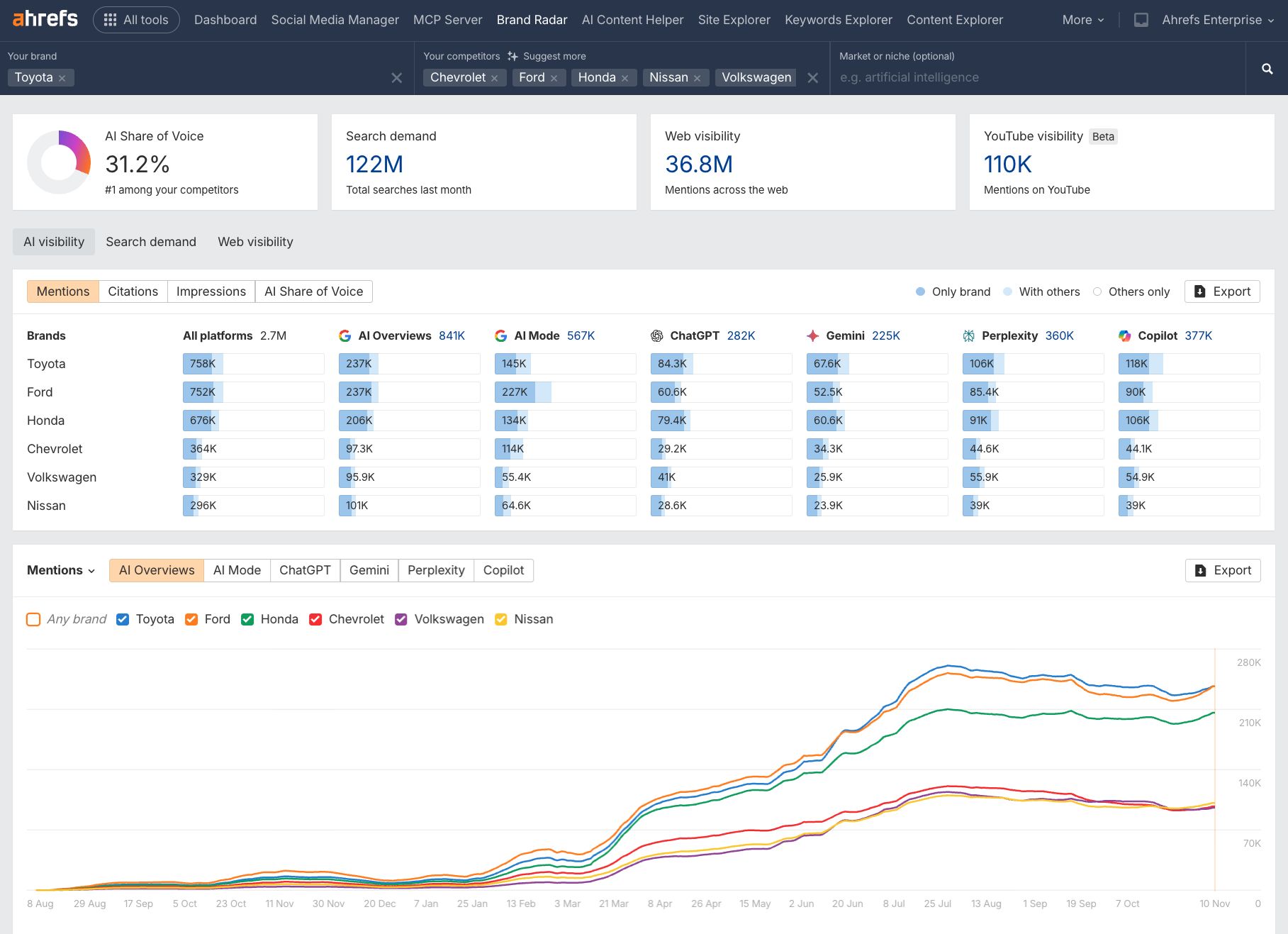
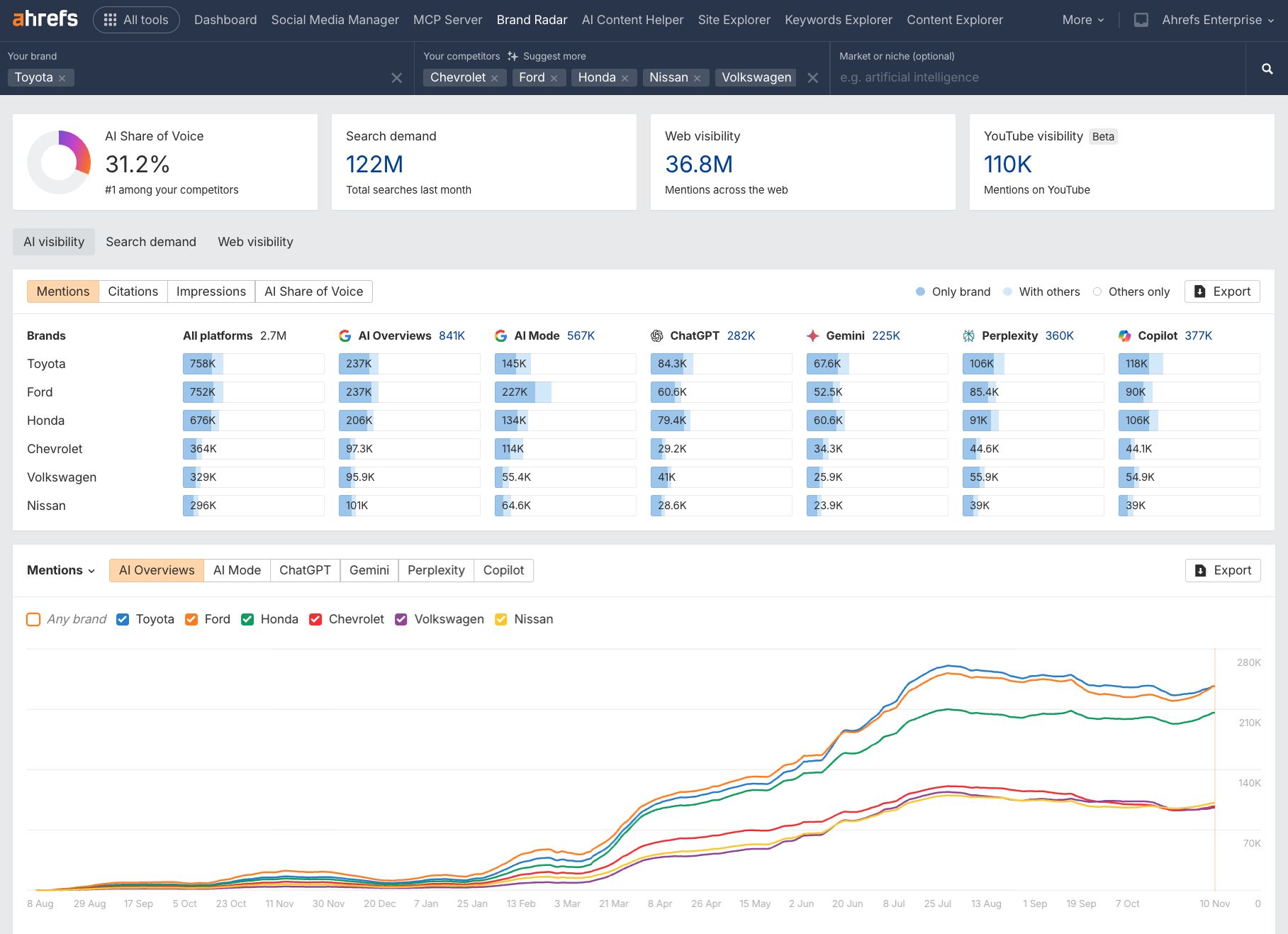
She extracted this data from Brand Radar, our new AI visibility tool that tracks hundreds of millions of prompts and queries across seven different AI assistants.
The results reveal a surprising paradox in how Google’s AI operates—a constant state of change on the surface, but a deep, underlying stability.
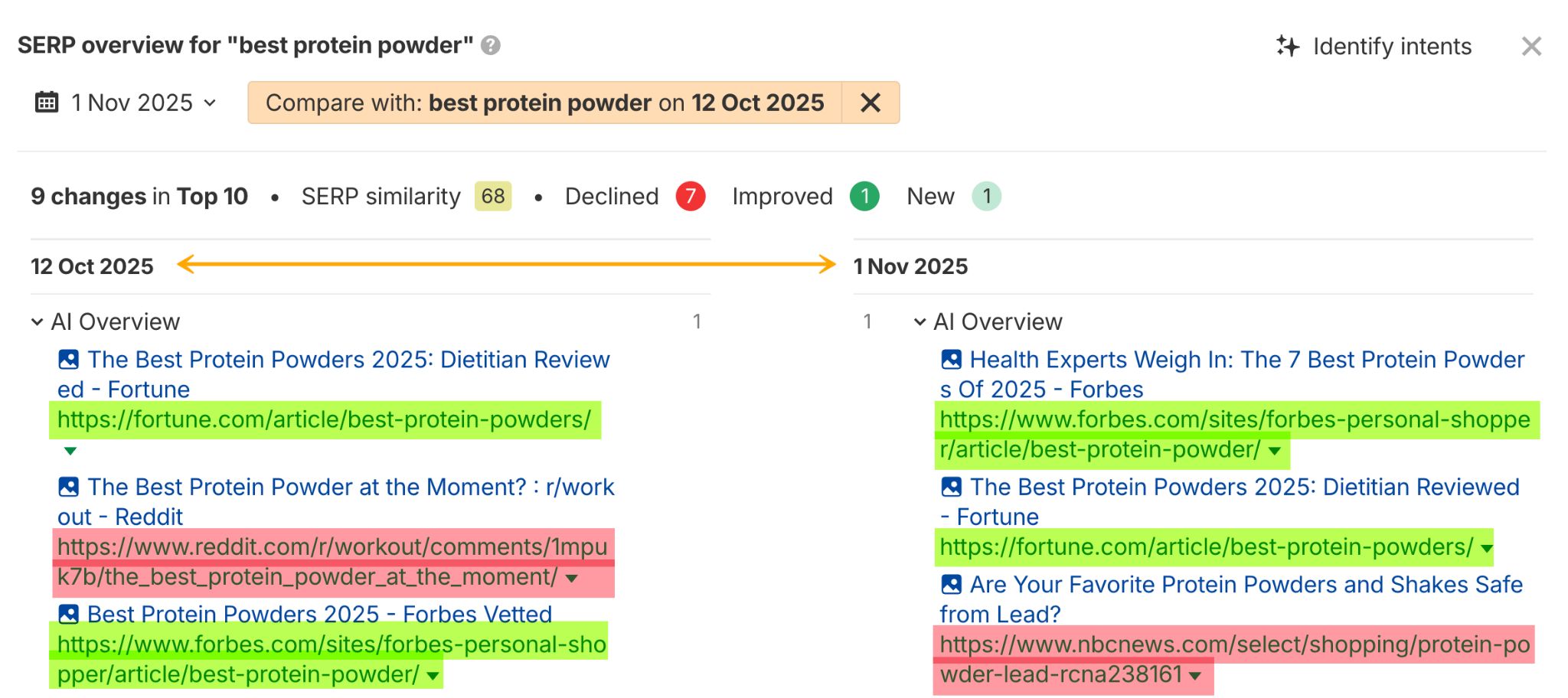
Forbes and Fortune showed up consistently between October and November, but the third URL changed.
Initially, a Reddit comment about protein powders took second place, but a month later it was replaced by Fortune’s “best” list, and a new article from NBC on “protein shake safety” entered the third spot.
Here’s one more example for the query “renter’s insurance”—each AI Overview was captured just a week apart.
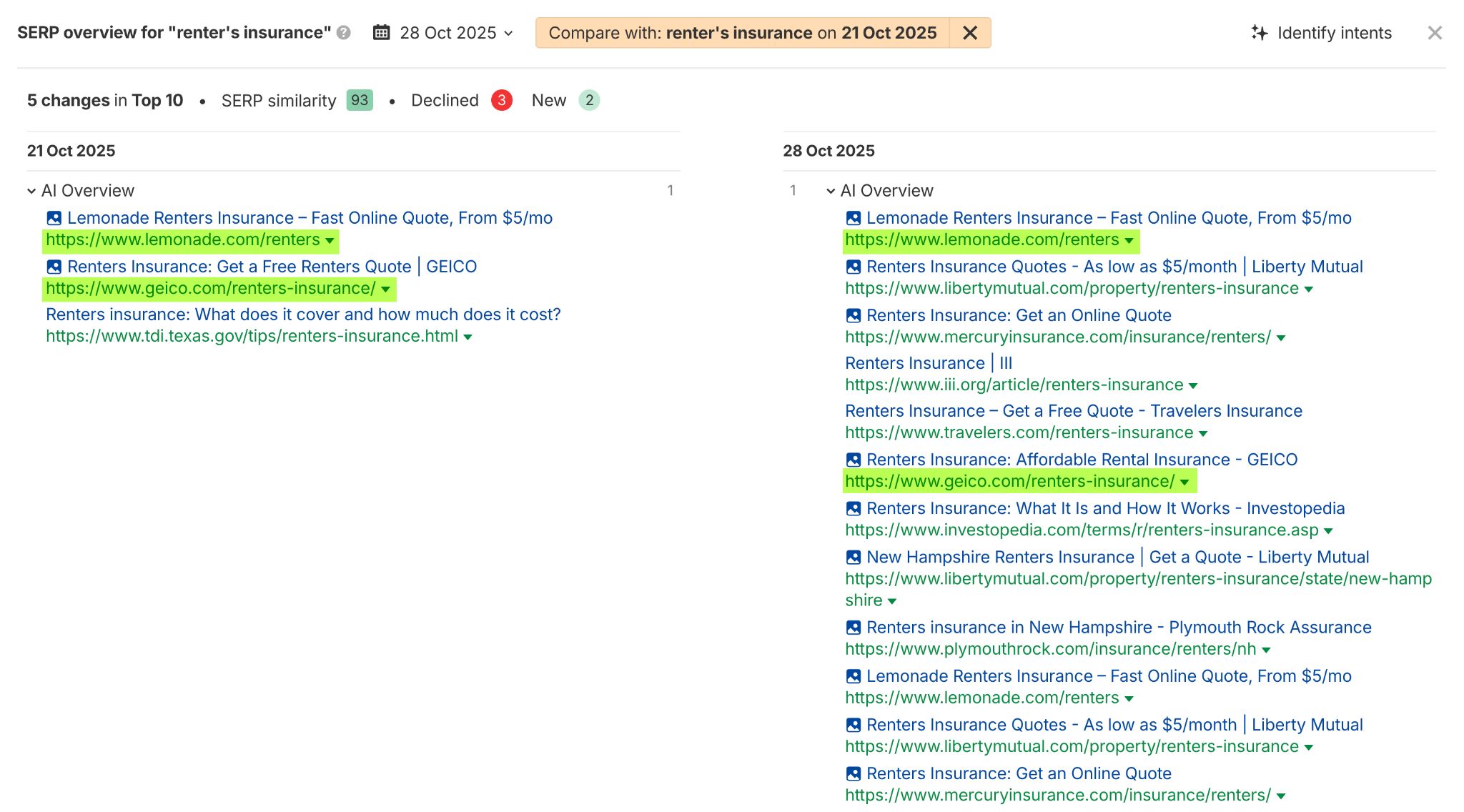
The first AI Overview returned three citations, but only two of those carried over to the second capture, where a further ten citations joined the list.
It’s clear that AI Overview visibility doesn’t follow the same consistency patterns as traditional search rankings.
Your brand can be cited today, and gone tomorrow.
Further reading
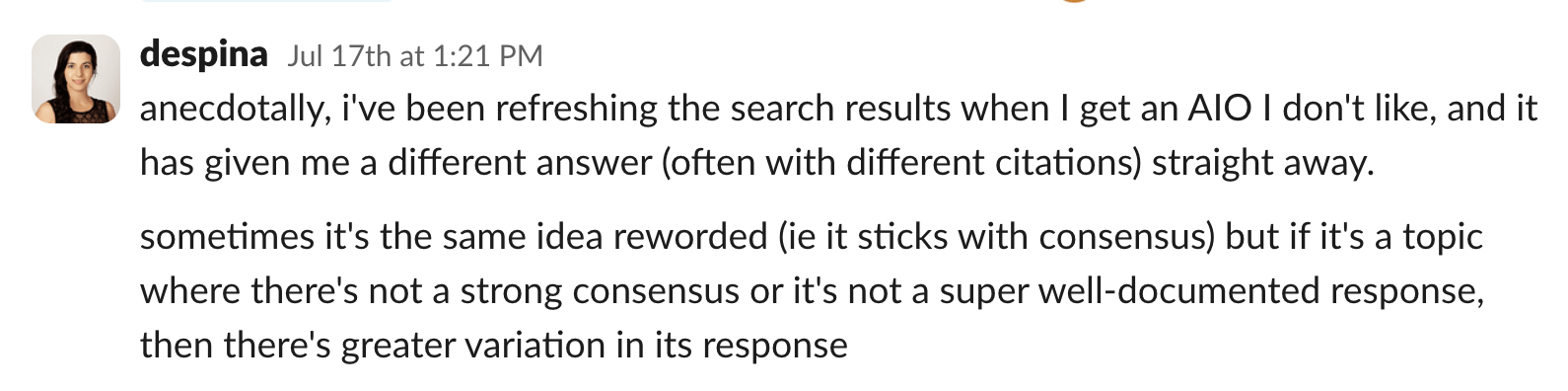
In fact, his hypothesis sparked this whole study…
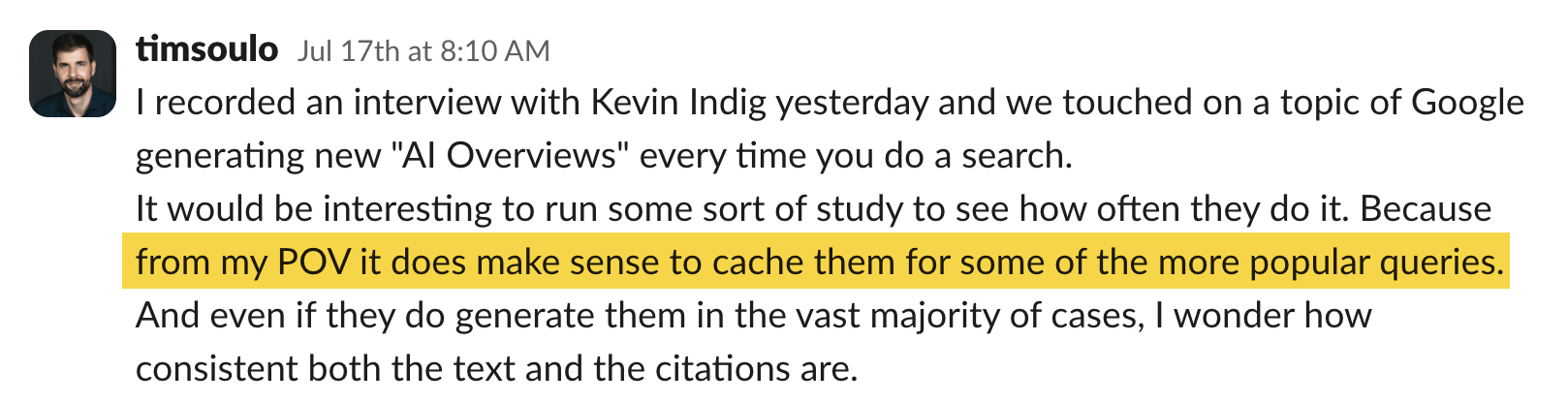
But the findings disprove this.
Firstly, we’d expect to see far more stability across AI Overview content if some were being cached.
But, as we already know, consecutive AI Overviews showed different content 7 out of 10 times.
Secondly, Xibeijia measured the actual relationship between a keyword’s search volume and its AI Overview change rate, and found a Spearman correlation of -0.014.
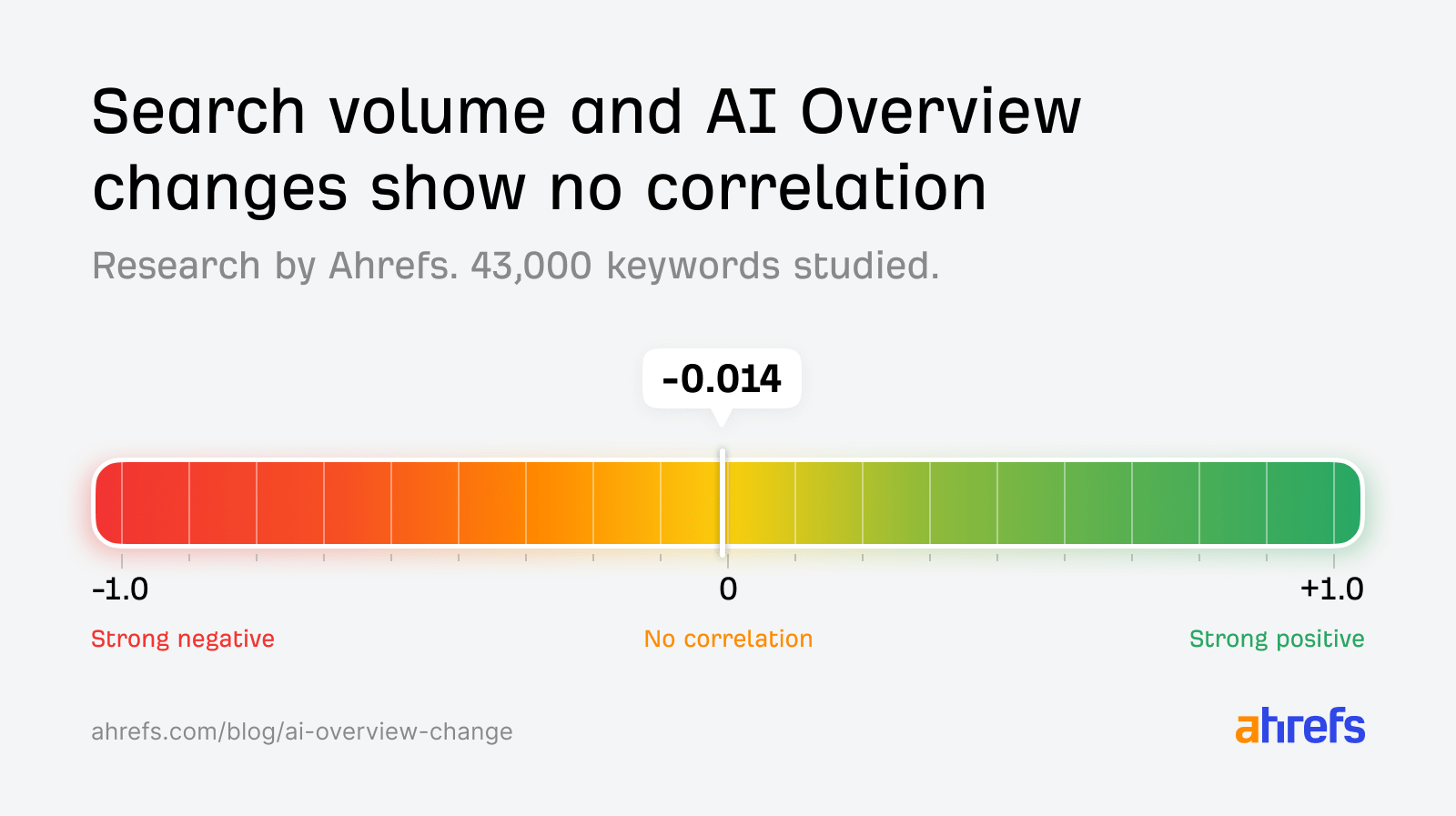
A correlation this close to zero indicates there is likely no relationship between the two variables—hugely popular search queries are just as likely to have their AI Overview text change as very niche ones.
So, it’s unlikely Google caches popular AI Overviews—at least based on our data.
Wrapping up
AI Overviews are both dynamic and stable at the same time.
The surface details, like the exact wording, URLs cited, and entities mentioned all switch constantly—but the underlying meaning and the core topics stay the same.
This changes how we can think about AI-generated search results.
They’re not static like traditional search results, but they’re not random either.
While you should expect your brand mentions and citations in AI Overviews to be volatile, there’s still a way to show up consistently.
Rather than focusing on individual prompts or queries, you need to become an authority on the themes associated with your core topics.
You can understand which themes AI ties to your brand using Ahrefs Brand Radar.
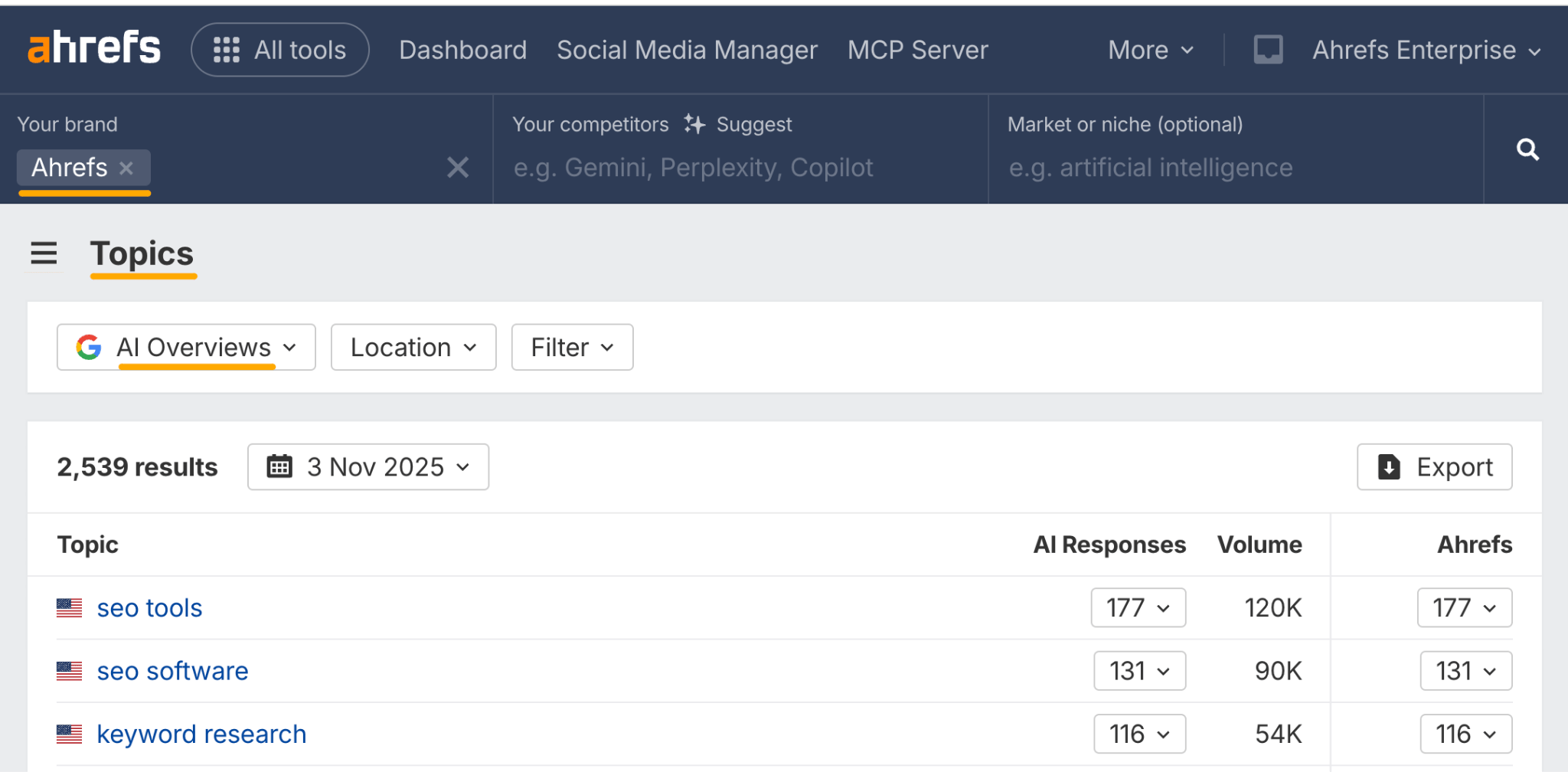
Just drop in your brand, and head to the “Topics” report. This will show you which themes individual AI responses ladder up to.
For example, Ahrefs is most closely linked to the topics of “SEO tools” and “SEO software” in AI Overview responses.
Tracking AI visibility over a volume of answers will also help you see past the variance of AI responses.
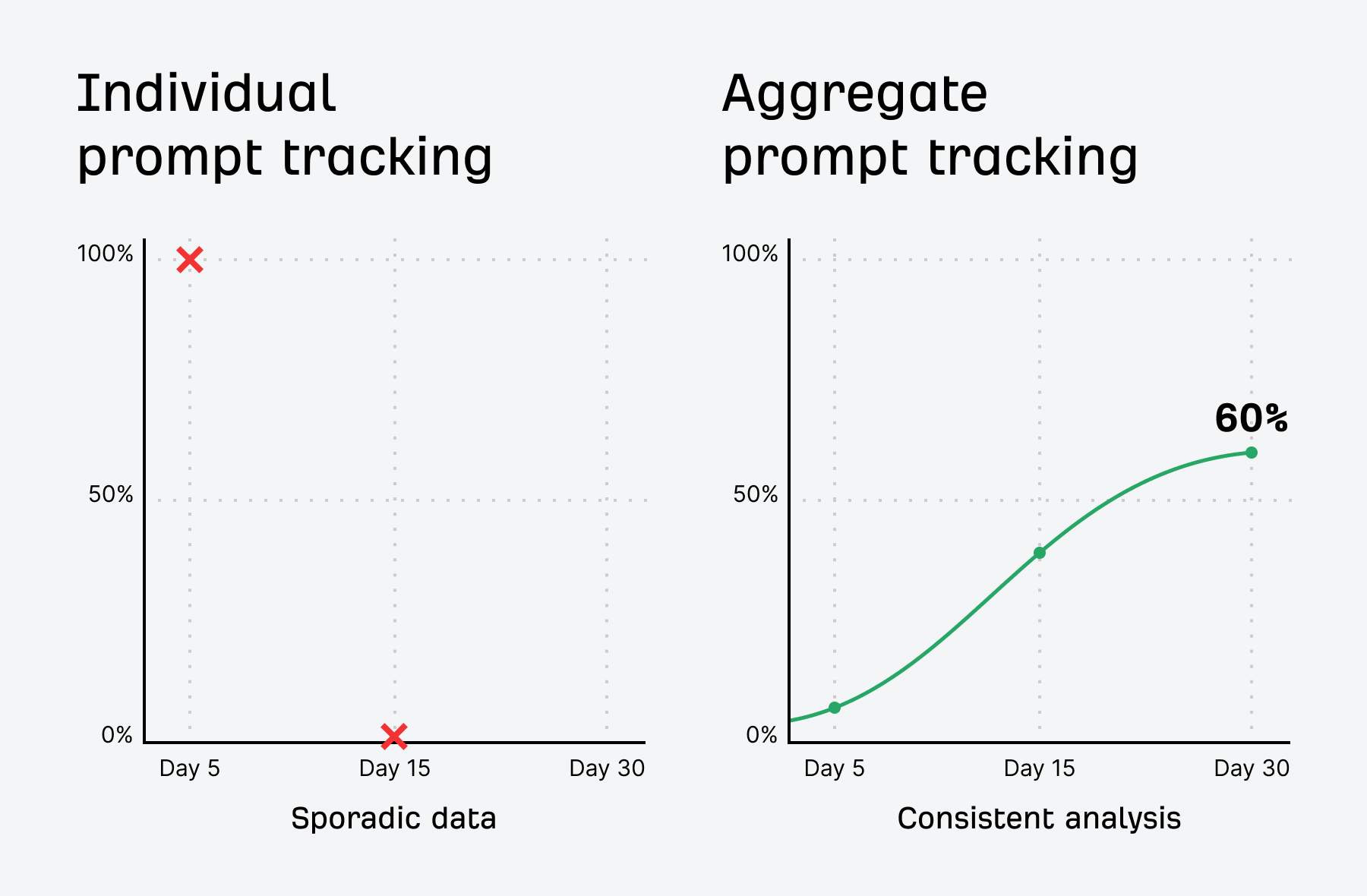
By focusing on aggregated visibility and AI Share of Voice, you can:
- See if AI consistently ties you to a category—not just if you appeared once.
- Track trends over time—not just snapshots.
- Learn how your brand is positioned against competitors—not just mentioned.
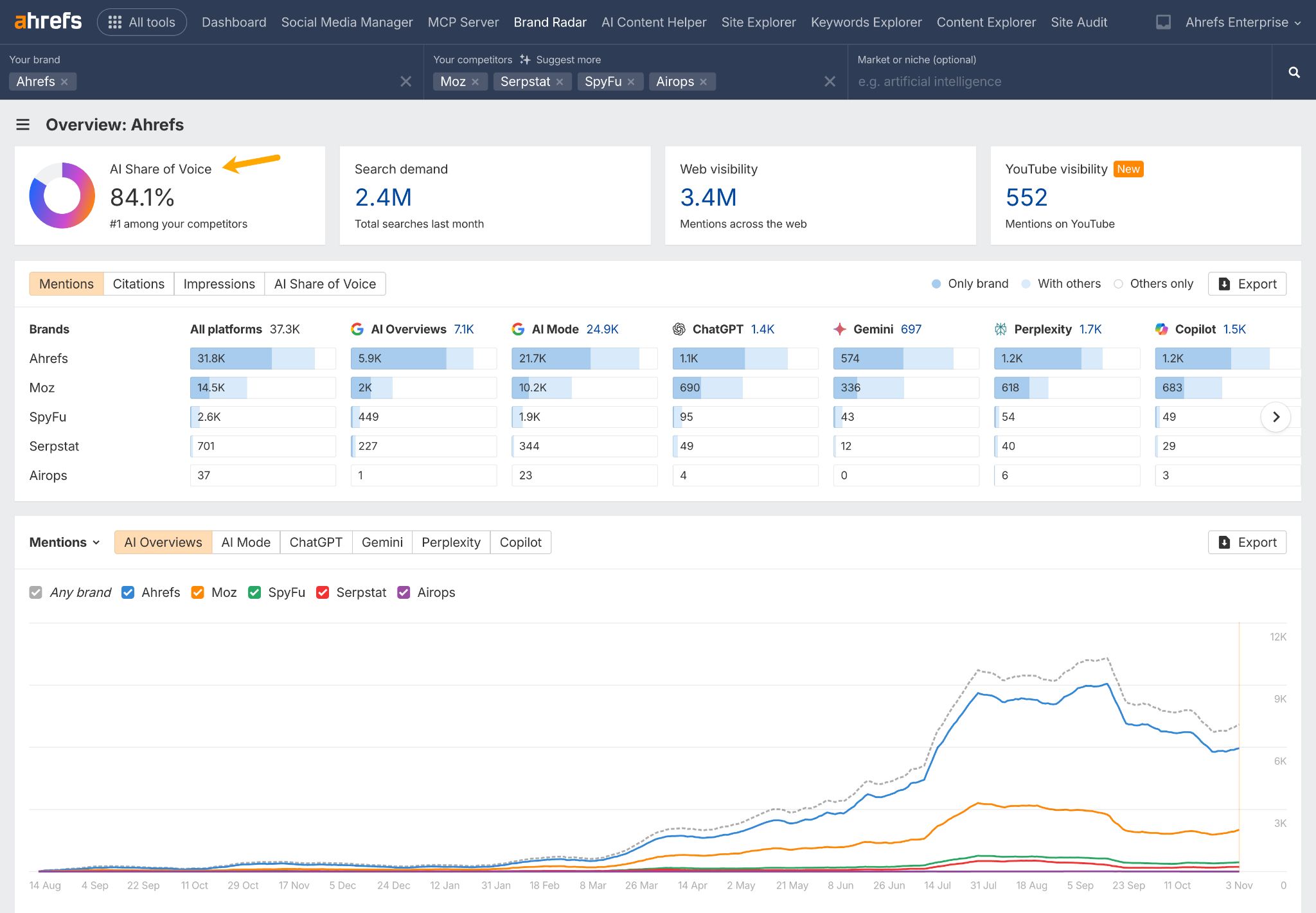
Winning the topic, not the query, is the best way to stay visible—even when AI answers are changing daily.
Similar Posts
The Lean Guide to Product Research
Ever had a brilliant product idea but felt stuck, unsure if anyone would actually buy it? You’re not alone. Many aspiring entrepreneurs believe that product research is a complex and expensive process reserved for big companies with huge budgets. The good news is that’s no longer true. Today, anyone with an internet connection can uncover…
The Best AI Content Optimization Tools for 2025
Content optimization tools make writing and ranking top-quality content a whole lot easier. That goes double for the latest generation of AI-powered tools. Great optimization tools can identify missing topics and keywords, suggest and refine headers and titles, generate meta-data, and show tons of useful information about your competitors’ articles. If you aren’t using an…
What Are Referring Domains? A Guide to Referring Domains vs Backlinks + SEO Impact
New to the world of referring domains? Let’s take a look at what they are and how you can use them. Know as much about referring domains as you do about the amount of water on Mars? Well, for any business with an online presence, getting traffic to your website, upping engagement, and building brand…
What is Domain Privacy Protection & Do I Need It? A Guide to Protecting Information
In this article, we explore what domain privacy protection is and why it matters. You’re busy securing your domain. It’s the name you’ve always wanted, so you’re super excited. Then, you notice the option to add domain privacy protection. Wait… say what, now? Domain privacy protection? Well, domain privacy protection is just what it says…
I Reviewed the Best AI Image Generators for 2025
I tested the most popular AI image generators to discover their greatest strengths and weaknesses. At Ahrefs, we have a team of extremely skilled (and very human) designers, but not everyone has that luxury. I wanted to know: are AI image generators useful for spinning up quick social media posts, creating blog post graphics, or…