AI tools make it easier than ever to create content at scale, but they’ve also made it harder than ever to stand out. When everyone uses similar tools and targets the same keywords, your brand becomes the differentiator.
Brand marketing is more important to SEO than ever before.
- Search engines now understand brands as entities, not just keywords. They connect your brand to your industry and offerings to surface you in relevant searches beyond exact matches.
- Google and ChatGPT increasingly favor brand signals. Branded searches show more comprehensive results than generic queries, and they both trust established brands more.
- LLMs learn from consistent brand patterns across the web. Uniform messaging across channels helps AI models understand what your brand represents and when to recommend it.
The problem? All of this requires brand consistency. Most teams don’t have a documented brand guide to maintain this consistency, leaving content creators (and AI tools) without clear direction.
Here’s how to create one that improves your visibility in both search and AI results.
Getting started with your brand guide for SEO
Download our free Brand Identity for SEO Template to manually build your brand guide. Useful for new brands without a website or before a website redesign.
Or, use AI Content Helper’s Brand Kit to generate one automatically from your website and existing content.
schema markup
You’ll need to share these details internally (for your team) and externally (for the media) to mention you consistently.
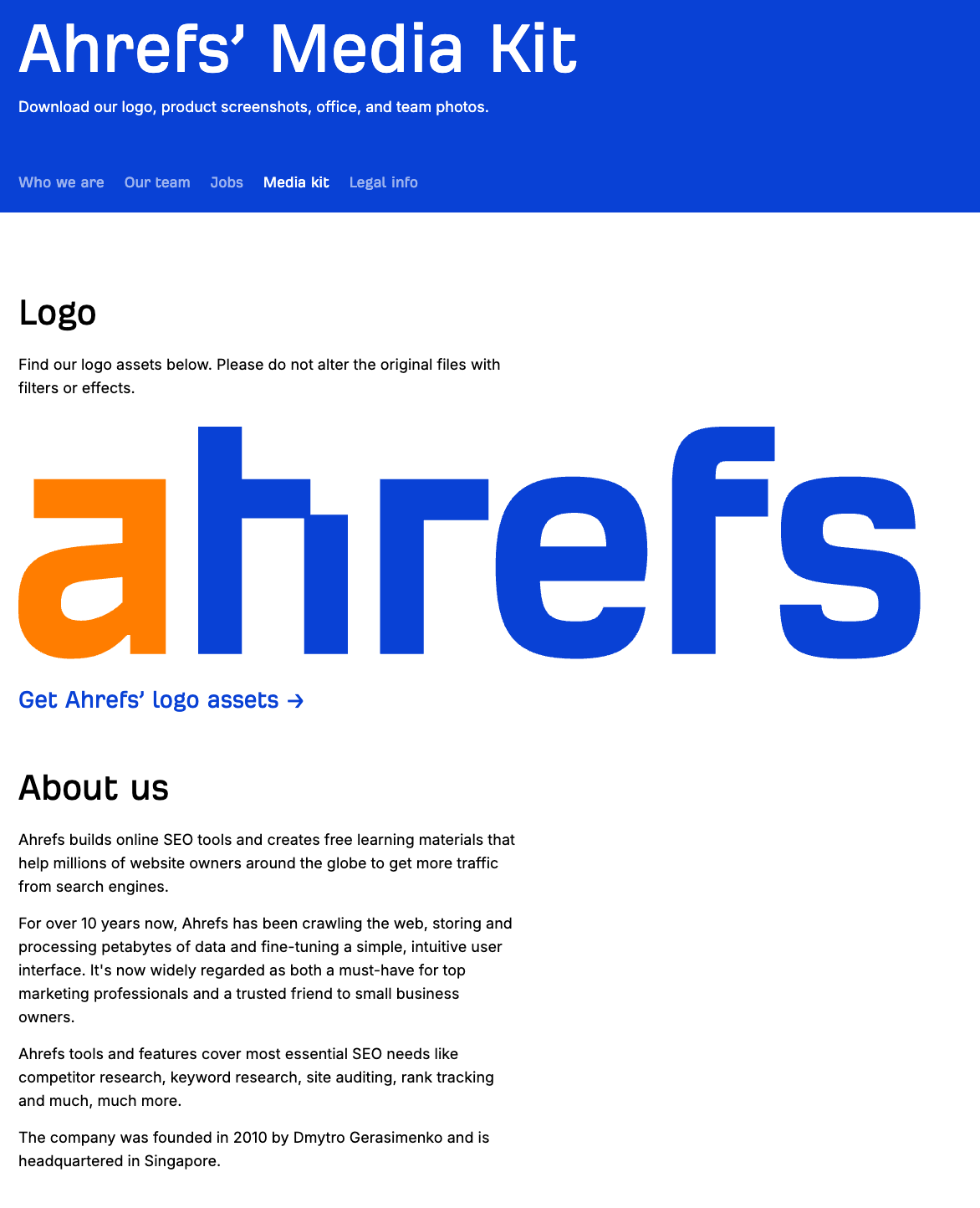
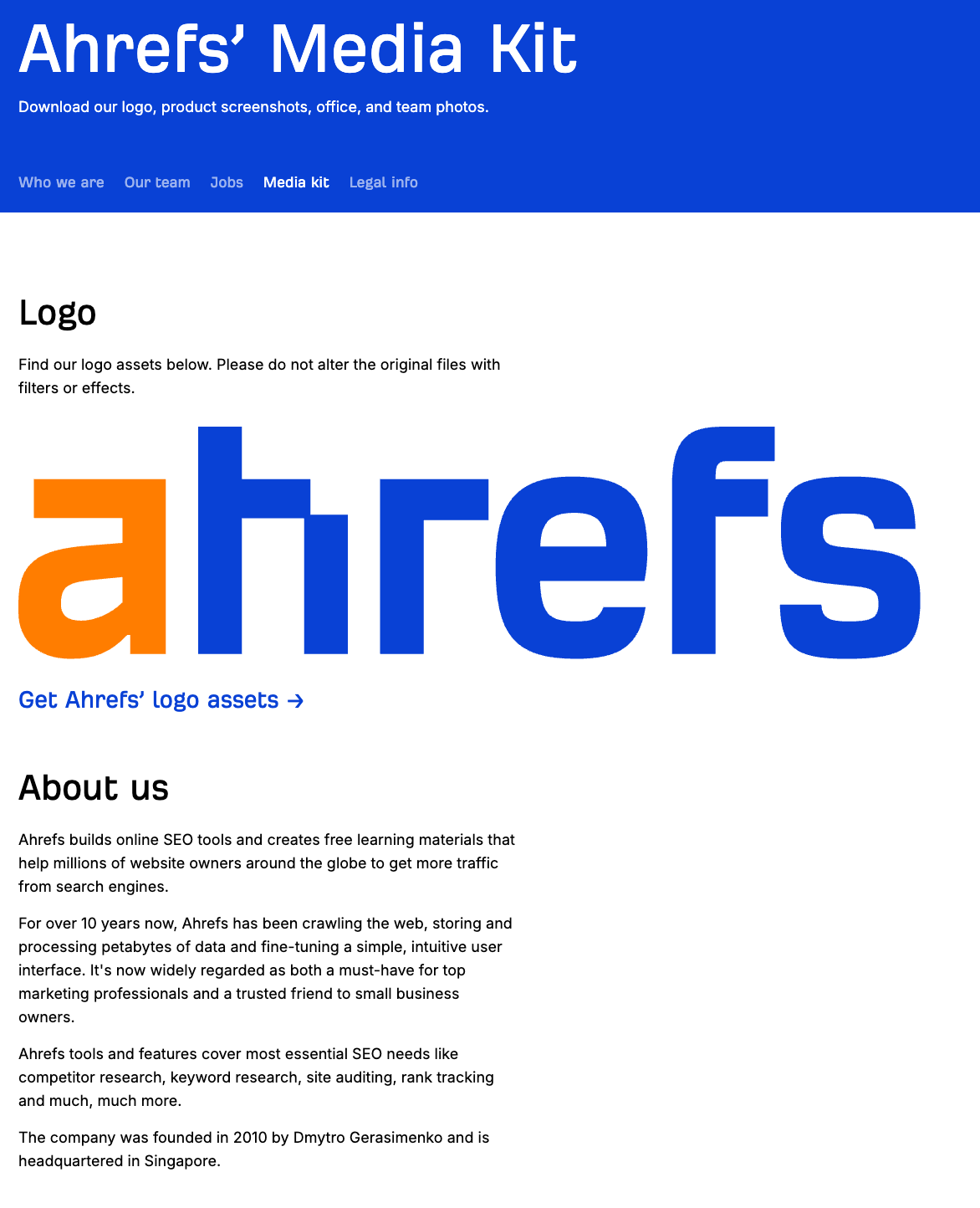
For example, here’s Ahrefs’ media kit, where we make it easy for others to reference our brand the same way we do.
2. Brand voice and personality
What it is: How your brand communicates. It includes the personality traits, tone, and specific language choices that make your content sound distinctly like you.
This includes what your brand is and isn’t, words to avoid, and your position on the formal-to-casual spectrum.
Why it matters for SEO: Consistent voice across all touchpoints is crucial for establishing brand authority. It differentiates you from competitors targeting the same keywords. It also helps AI tools and human writers stay on-brand without constant oversight, reducing revision cycles and improving content quality at scale.
How to document it:
- List 3-5 personality traits that define your brand with examples of what they mean in practice. For instance, “data-driven” means you support claims with statistics and research, while “practical” means you skip theory for actionable steps.
- Use the “We ARE / We AREN’T” framework to clarify boundaries (e.g., “We are direct and educational / We aren’t hype-driven or guru-ish”)
- Create a list of words and phrases to avoid (common offenders: AI-isms like “delve” and “unlock,” competitor-specific terms like proprietary framework names or trademarked phrases, overused jargon)
- Note your tone preferences using descriptors like professional, conversational, humorous, serious, motivating, and specify when to use each (e.g., conversational for blog posts, professional for whitepapers).
- Include 2-3 example sentences showing your voice in action
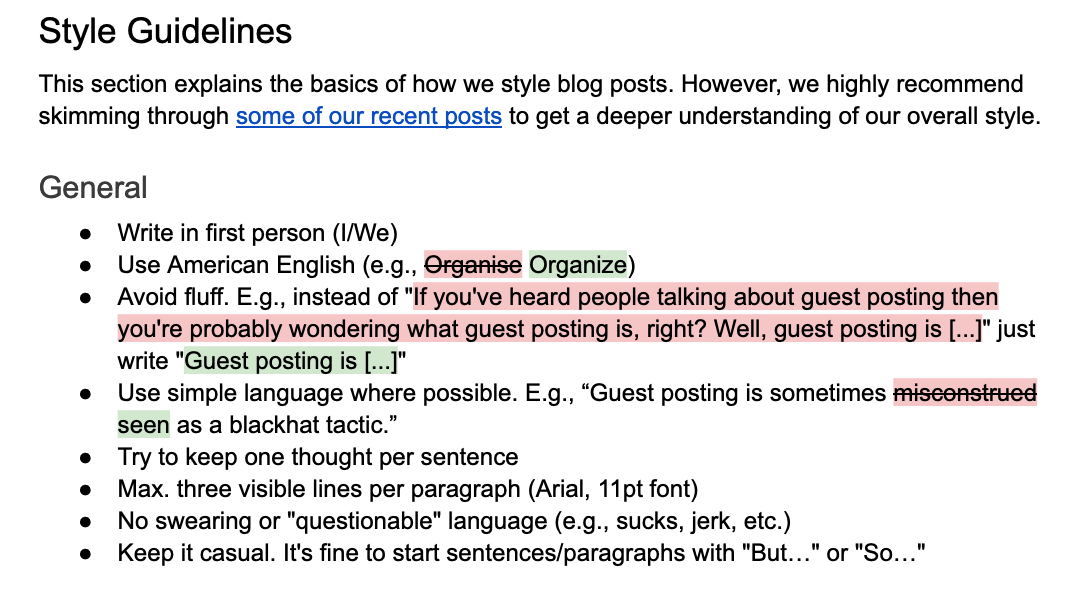
For instance, here’s a snapshot of Ahrefs’ tone of voice guide that our internal team all use when creating content.
Pro tip
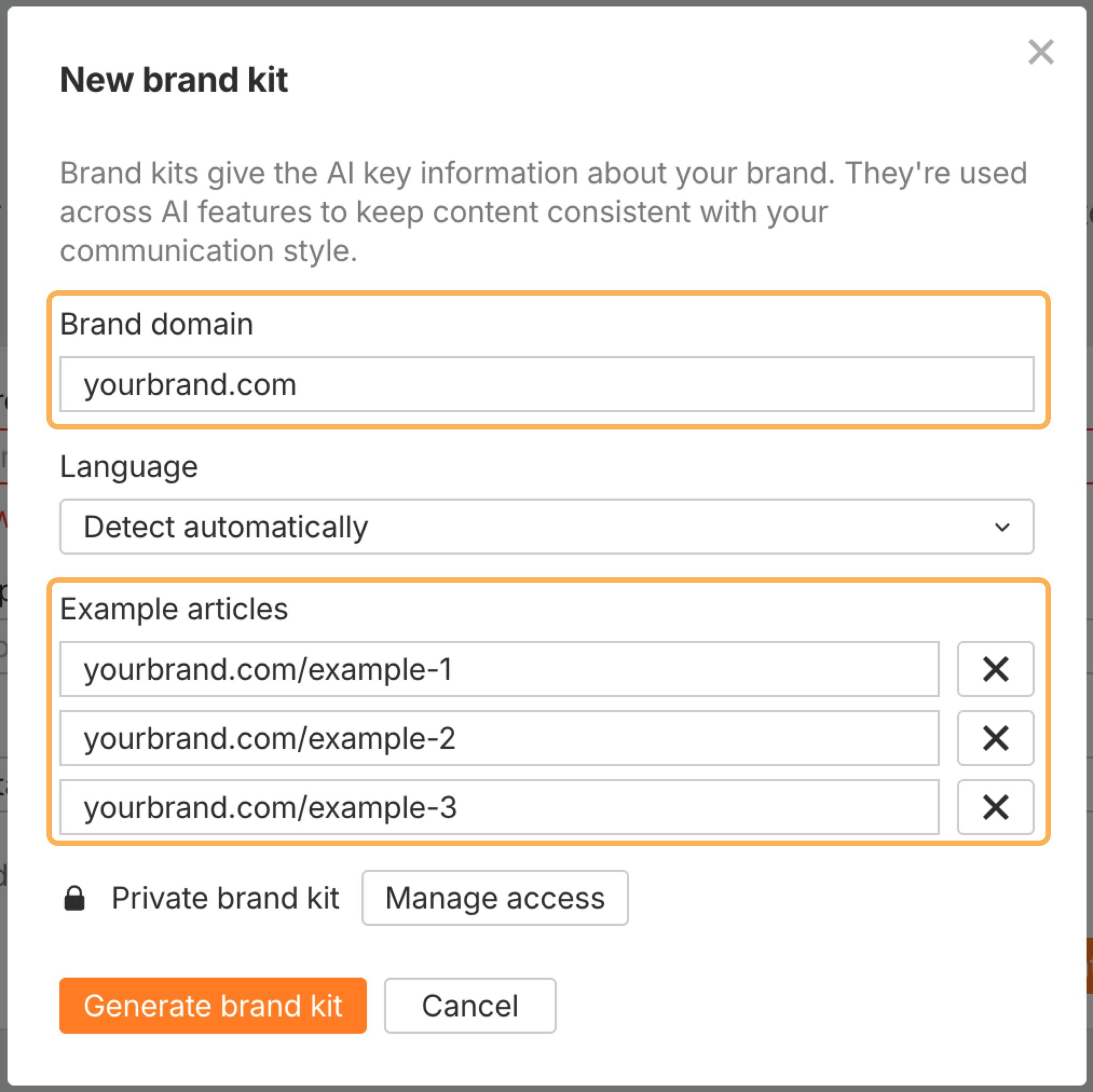
You can automate much of this brand voice documentation using Ahrefs’ Brand Kit in AI Content Helper. It analyzes your existing content to identify your tone, personality traits, and writing patterns, then applies those rules automatically when generating new content.
3. Target audience and search personas
What it is: Profiles of the people actively searching for solutions like yours. These aren’t necessarily your current customers.
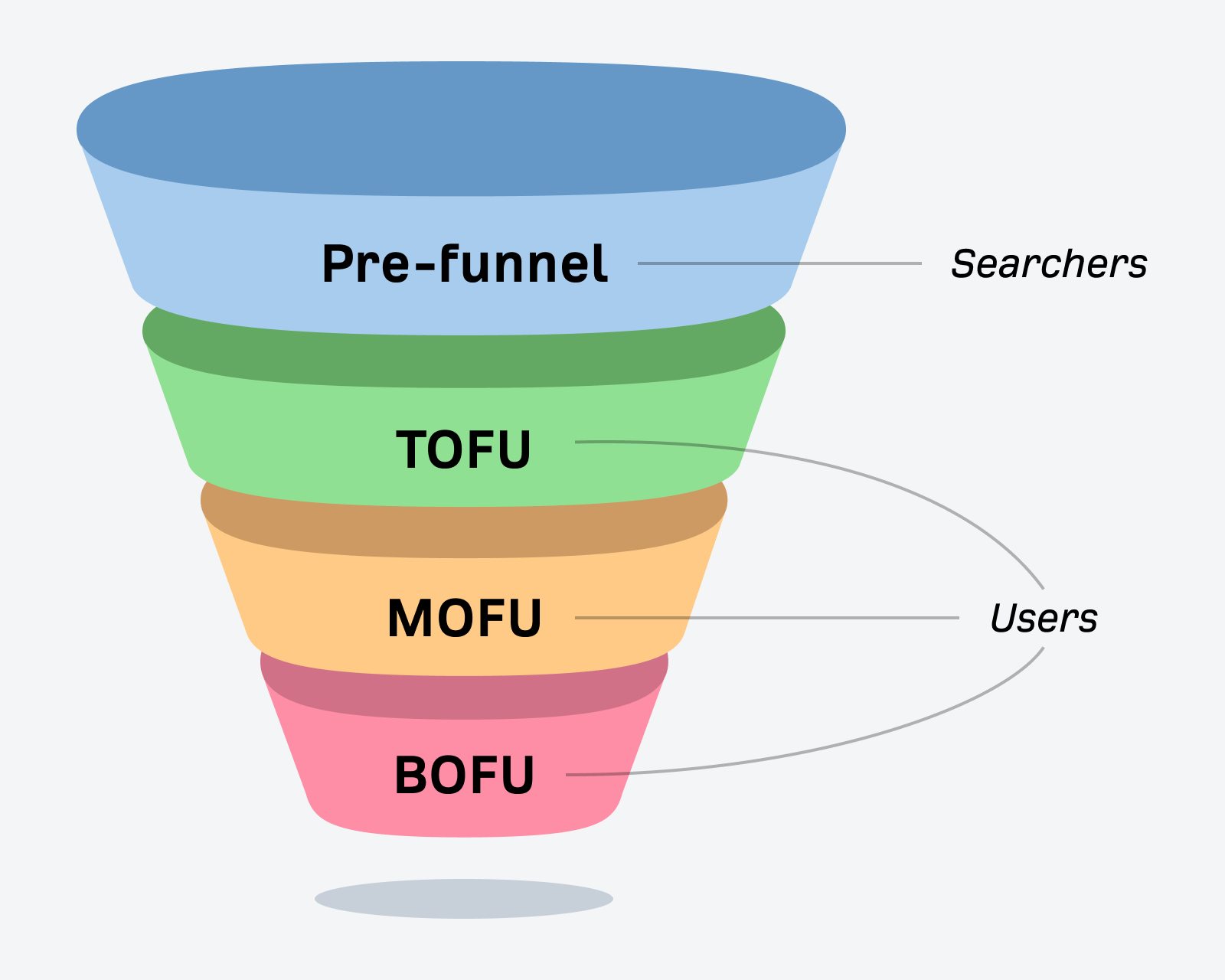
Search personas focus on who’s looking for answers before they even know your brand exists, what problems trigger their searches, and what information they need at each stage of their journey.
Why it matters for SEO: Search personas differ from buyer personas because they capture pre-purchase behavior.
Understanding them helps you create content that matches search intent, choose the right keywords, and appear in the places your audience actually looks for information (which might not be your website yet).
This is especially important as we move further into the “search everywhere” era of SEO and optimize for more touchpoints in the “messy middle”. For instance, consider all these touchpoints in my journey to buy a laser cutter:
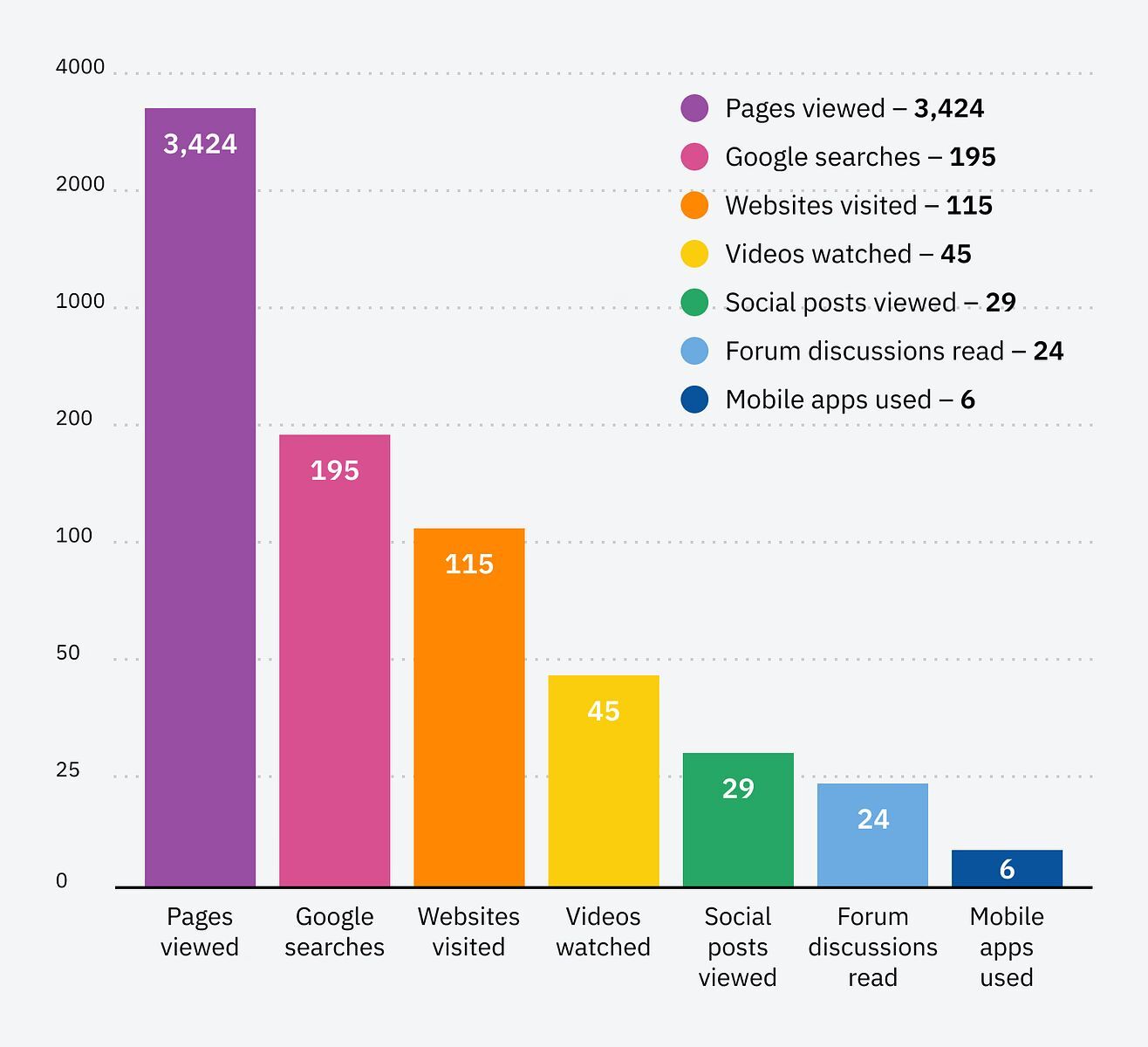
Similarly, you need to understand your audience’s touchpoints.
How to document it:
- Create 2-3 search persona profiles based on common search patterns, not demographics
- List sample search queries each persona uses at different stages in the funnel (awareness, consideration, decision)
- Note their pain points, questions, and what triggers them to start searching
- Include their preferred platforms (Google, YouTube, Reddit, ChatGPT, etc.)
- Document their expertise level to guide content depth and terminology
Further reading
4. Unique selling points (USPs) and differentiation
What it is: The specific features, benefits, and proof points that set your brand apart from competitors.
This includes your core USPs, guarantees, awards, certifications, and any proprietary technology or processes that make you different.
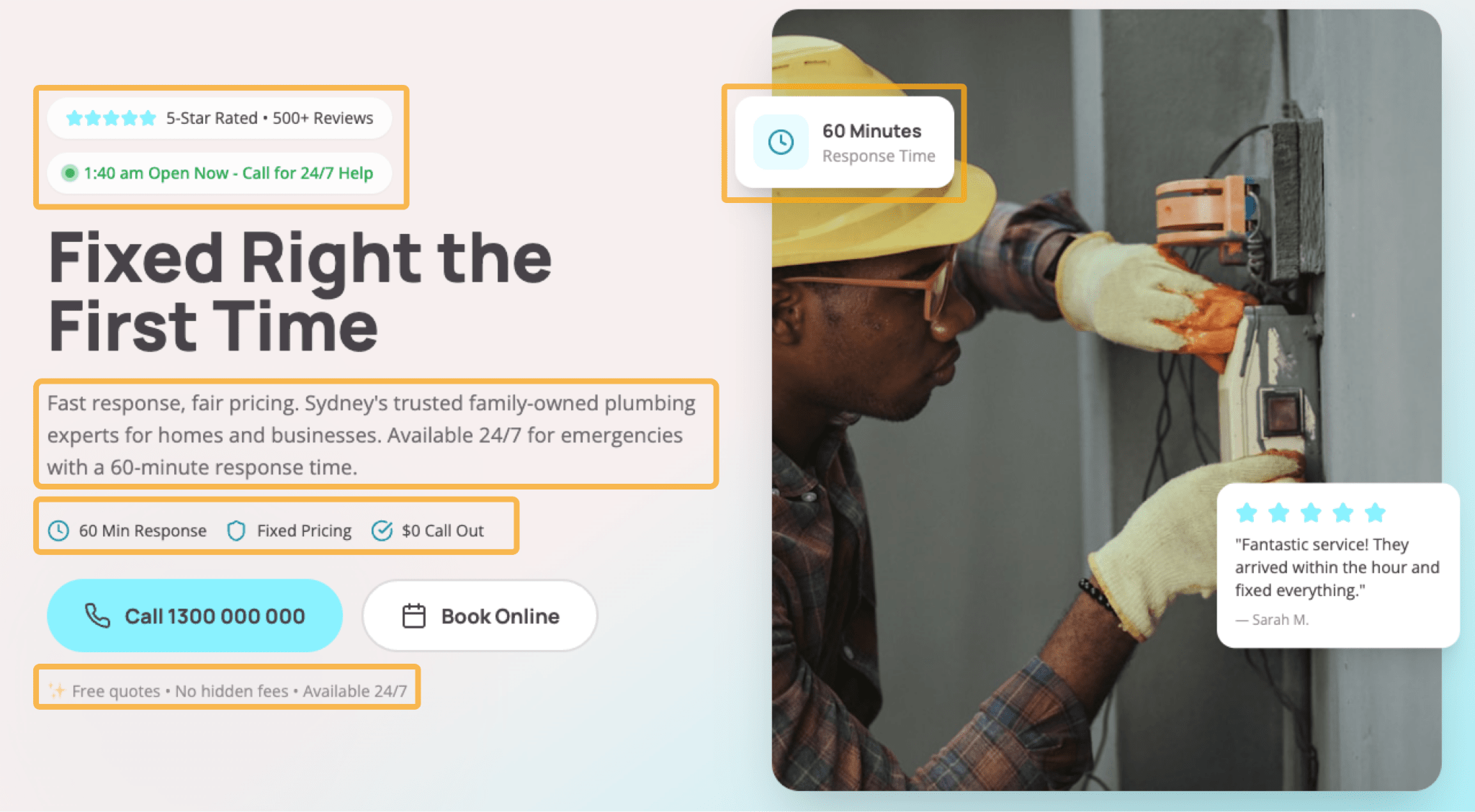
Why it matters for SEO: USPs provide ready-made content for landing pages and create natural opportunities for internal linking.
They also strengthen your E-E-A-T signals (experience, expertise, authority, trust) and help search engines and AI understand what makes your brand uniquely relevant for specific queries.
How to document it:
Every business is in business for a reason. If you have customers and cash flow, you’re doing something that makes you the best choice in your area or industry. The trick is digging deep enough to find it.
I once worked with a turf company that thought they “just sold grass.” Boring, right?
Until we discovered they’d revolutionized a fire-resistant grass variety that survived some of the worst bushfires in recent history. A local pub was the only building on the block with a healthy lawn because of this company’s product. That made the news. That’s a brand story.
Sometimes your USP is solving the thing people hate most about your industry. “The Clean Plumber” started their business around not being messy. Simple, memorable, differentiating.
You can do this for your brand, too.
- List what makes customers choose you over competitors (talk to your sales team, read reviews, ask customers directly)
- For each USP, explain how and why you deliver it. Don’t just say “committed to quality,” show what your quality looks like compared to others
- Include supporting data, certifications, case studies, or news coverage
- Note which USPs matter most for specific products, services, or customer segments
- Document exact wording for taglines and key claims to use consistently across content
Example of USPs for SEO
USP: Fire-resistant turf variety that survived [Region] bushfires
How we deliver: Proprietary growing method developed over 15 years
Proof: Featured in [News Outlet], only lawn that survived on [Street Name]
Where to use: Homepage hero, about page, product pages, case studies, local SEO content
Keywords to target: “fire-resistant grass [region],” “bushfire-proof lawn, ” “heat-resistant turf”
5. Products, services, and offerings
What it is: A complete catalog of what you sell, including product names, descriptions, key features, technical specifications, and which offerings are most popular or profitable.
This section ensures everyone refers to your products and services consistently across all content.
Why it matters for SEO: Products are entities separate from your organization. They have their own IDs in knowledge graphs, such as Google’s Shopping Graph, and merchant centers in ChatGPT.
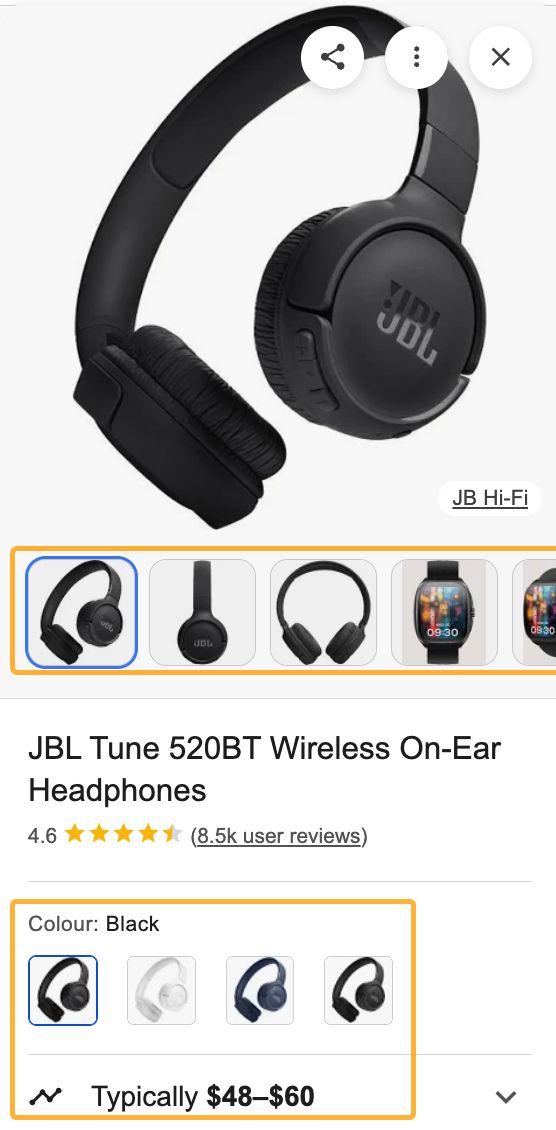
For example, Google shows product cards for many commercial queries that list the product’s photos and key attributes like available colors, sizes, and price:
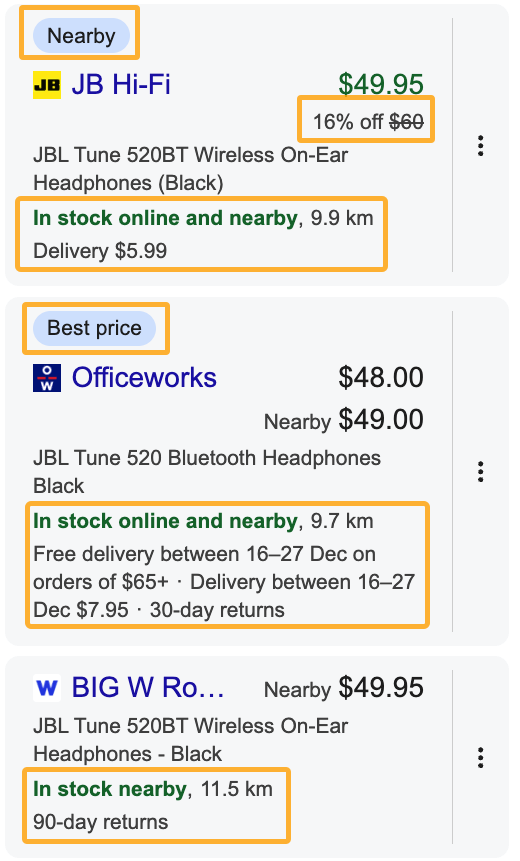
It also shows retailers near the searcher who have the item in stock, can deliver it quickly, and/or are running a discount or offering the lowest price:
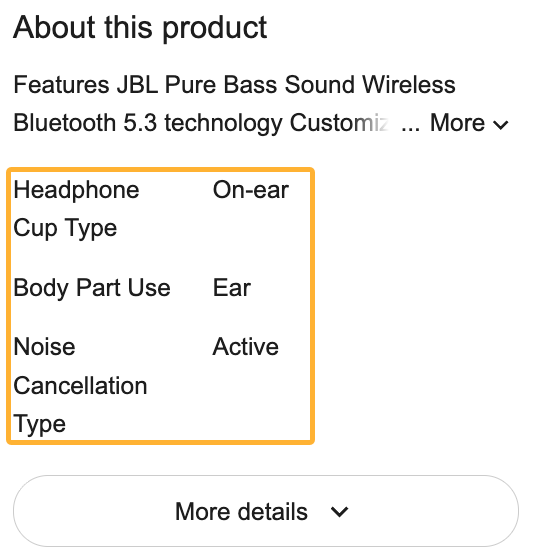
If relevant to the product, tech specs may also be visible. These can also be USPs in disguise. They’re searchable details that help you rank for specific, long-tail queries and differentiate from competitors:
Along with aggregate reviews pulled in from multiple retailers around the web:
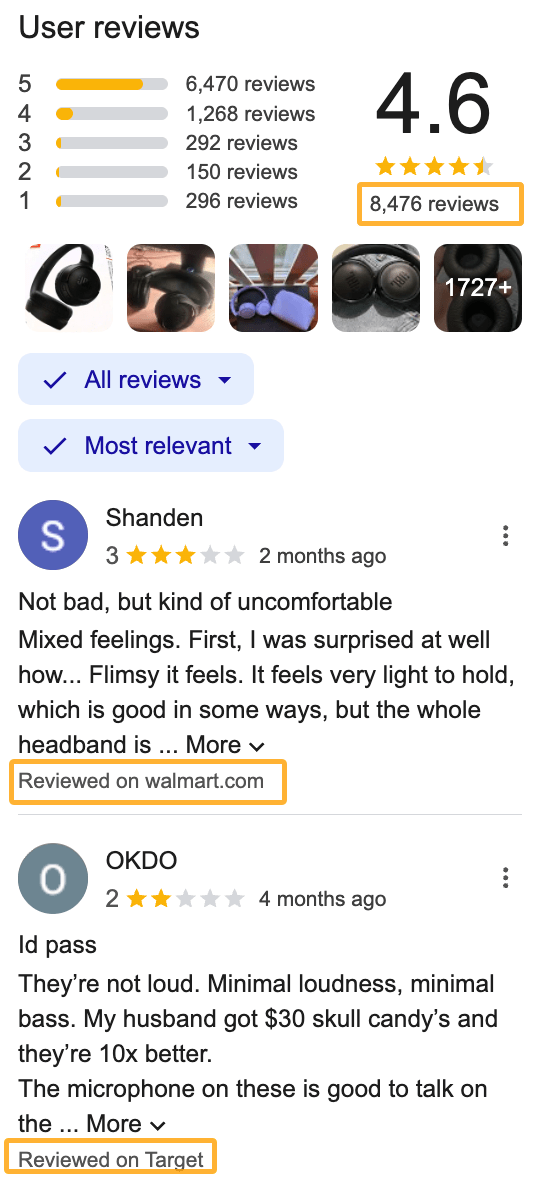
Consistent product naming, descriptions, and technical specs help Google and AI systems that maintain product graphs to understand and reference your offerings correctly.
How to document it:
- Create a list or table with official product/service names and one-line descriptions
- Note the most popular or highest-converting offerings (prioritize content for these)
- Include technical specs, dimensions, materials, certifications, or other specific attributes that people search for
- List relevant use cases, industries, or customer segments for each offering
- Add keyword variations people use when searching for each product or service
Pro Tip
Not sure what specs and attributes of your products or services people care about? Check out Ahrefs’ Keywords Explorer.
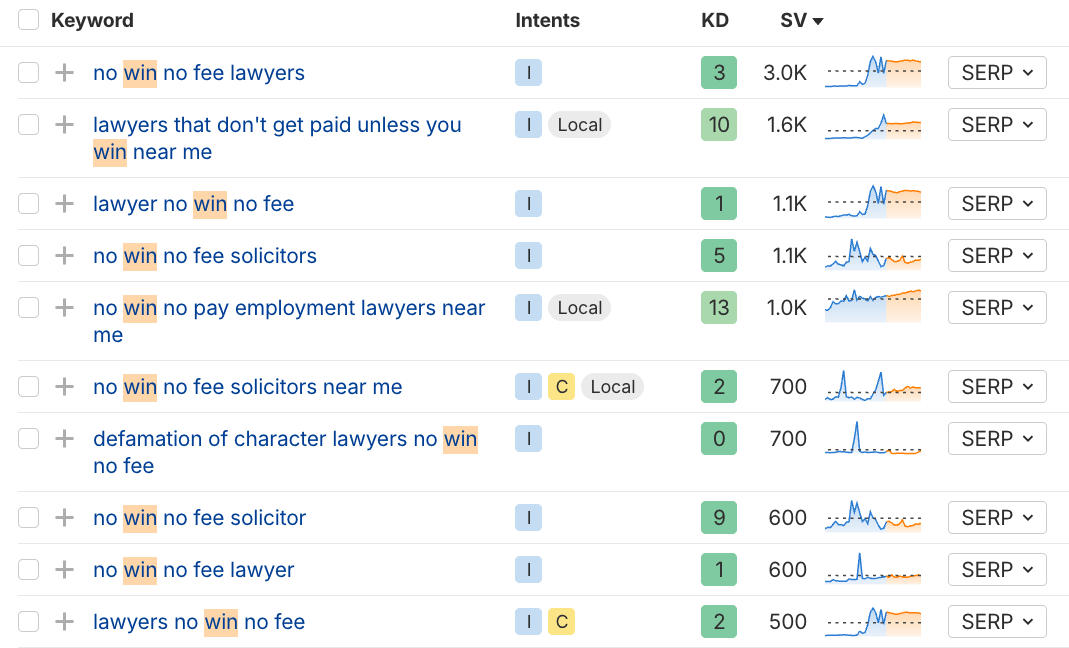
Enter your main product or service category, and then look at the long-tail keywords with descriptive words and modifiers. For example, when looking for lawyers, many people value a firm’s ability to win without it racking up major expenses in the process:
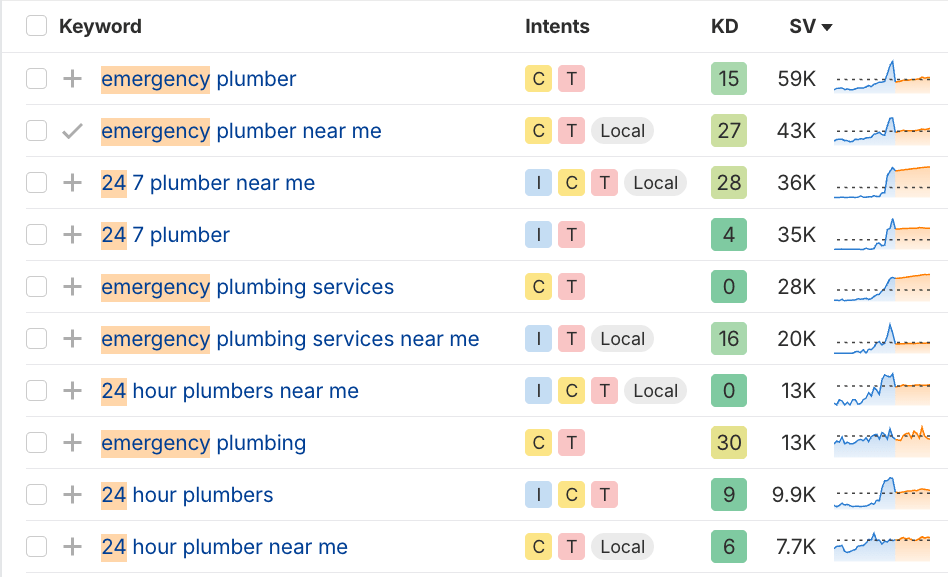
For a plumbing service, they value a plumber who can help them at any time during an emergency:
You get the idea.
Look for the features and attributes that matter most to your brand and include them in your brand guide as points of differentiation for each product or service you offer.
6. Competitors and positioning
What it is: A list of your direct competitors in search, how you compare to them, and what makes you different.
This includes their strengths, common customer complaints, and your relative price positioning in the market.
Why it matters for SEO: Understanding your competitive landscape informs your comparison content strategy, helps you identify keyword gaps, and ensures your brand voice doesn’t accidentally mimic competitors.
It also guides messaging in competitive spaces where multiple brands target the same keywords.
How to document it:
- List 3-5 main competitors in your space
- Note what they do well (learn from their strengths). For example, “Competitor A has excellent video tutorials” or “Competitor B’s onboarding is seamless.”
- Document common customer complaints or pain points with competitors (opportunities for you to differentiate)
- Include your price positioning relative to the market (premium, mid-range, budget-friendly)
- Add specific ways you’re different in head-to-head comparisons. For example, “We offer 24/7 support while competitors only offer business hours” or “Our tool includes X feature that competitors charge extra for.”
Not sure which competitors to include? Use Ahrefs’ competitive intelligence features to find your organic competitors:
- Enter your domain in Site Explorer
- Go to “Organic Competitors”
- Review the list of sites ranking for similar keywords
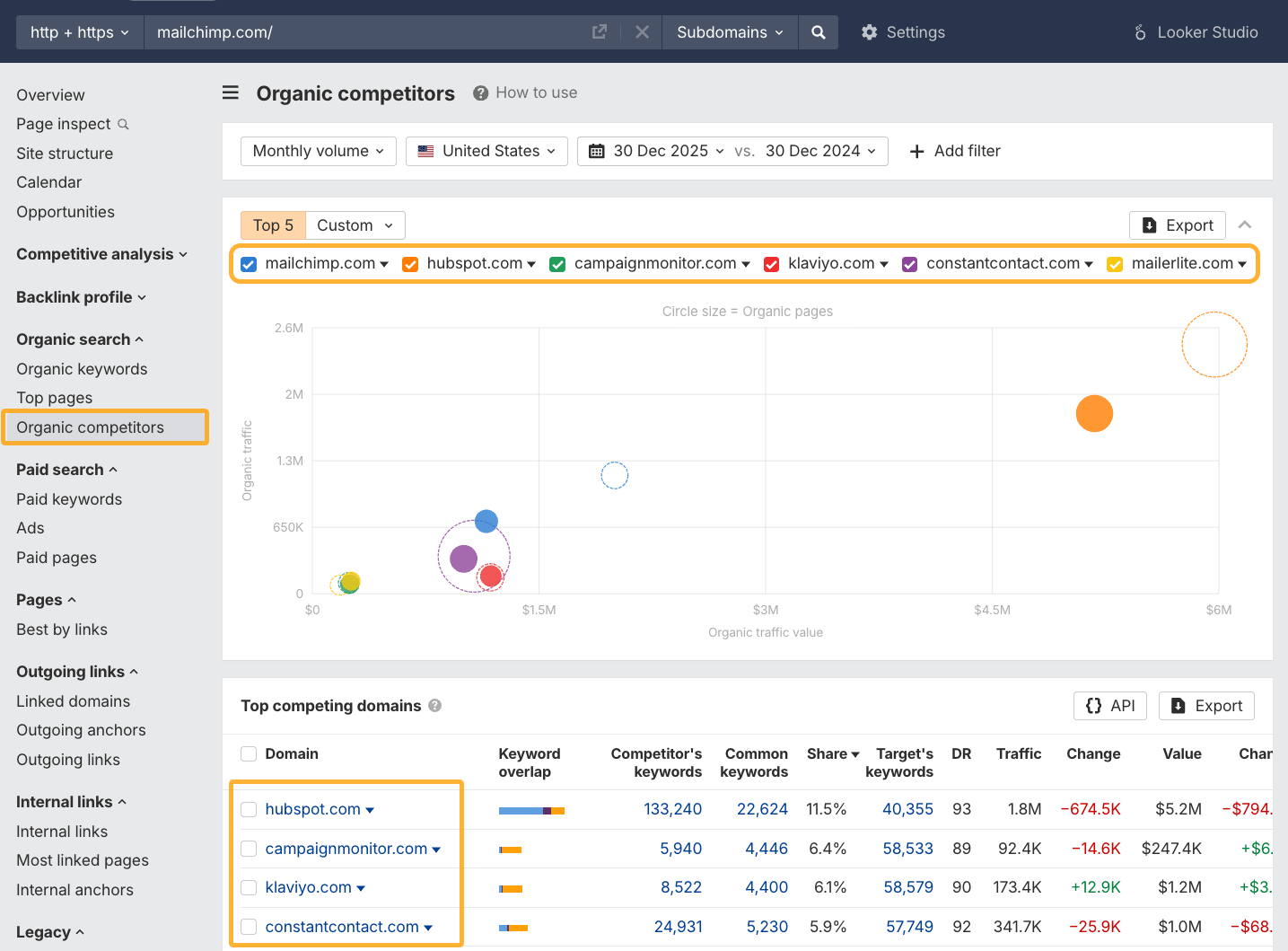
This shows you who’s actually competing for your search visibility, not just who you think your competitors are.
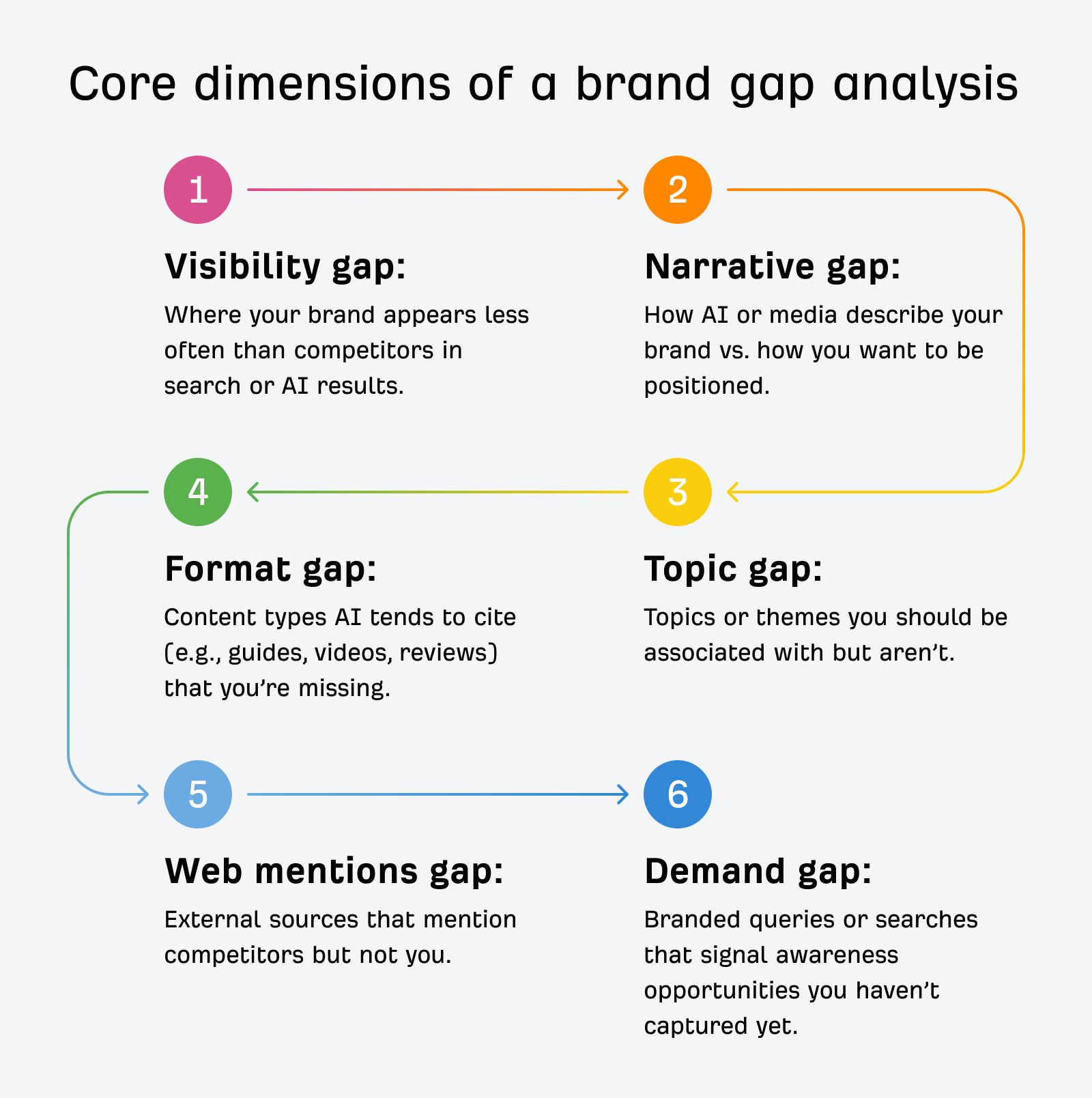
Want to go deeper? Run a brand gap analysis to find gaps in your brand positioning, messaging, market perception, and visibility compared to competitors while protecting your branded search results.
7. Content structure and page design guidelines
What it is: The structural and design rules that ensure consistency across your content. This includes how you organize information, format headings, structure page layouts, place CTAs, handle internal links, and present visuals. In a nutshell, it’s the UX and technical SEO framework that makes your content work well for both users and search engines without sacrificing brand consistency.
Sidenote.
This point matters most to SEO teams that need to collaborate with UX designers or are working on client sites that have established design templates and layouts in place. It’s about merging the technical requirements of on-page SEO with what’s possible within the website’s existing design.
Why it matters for SEO: Consistent page structure creates predictable user experience signals that search engines reward. It also ensures proper on-page SEO elements (title tags, meta descriptions, heading hierarchy), maintains E-E-A-T signals across content, and helps with crawlability and indexation.
This is especially important when creating core webpages, brand pages, and landing pages that require more formatting than blog posts typically do.
As more teams use AI tools for content creation, documented formatting rules become even more critical. AI requires these guidelines upfront to generate on-brand content that requires minimal editing. For instance, you can provide wireframes:
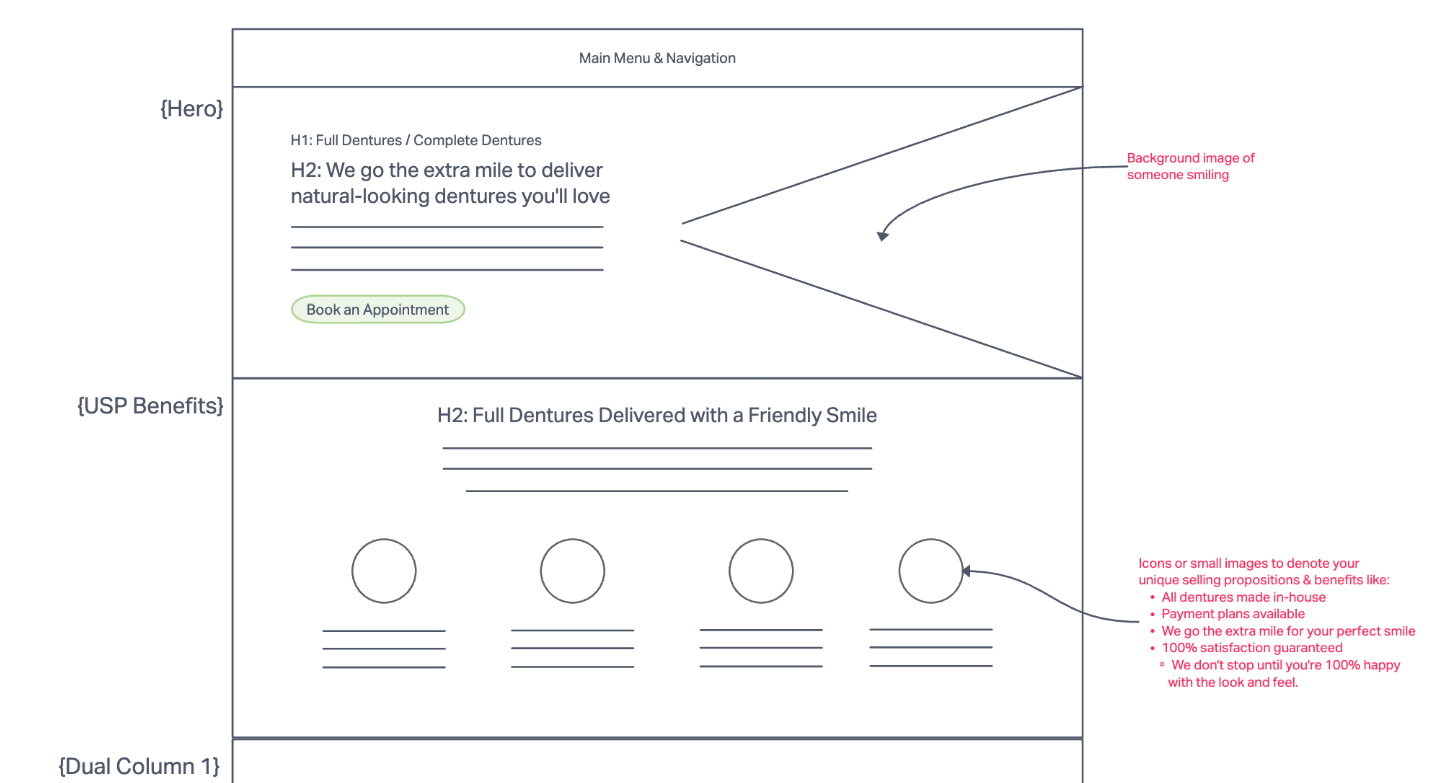
Or an idea of content length and features for each section.
When working with UX teams, documented content rules also prevent a disconnect between design and final content.
How to document it:
- Define your standard page structure (heading hierarchy, intro placement, CTA locations, content block order)
- Create formulas for on-page SEO elements: title tags (60 chars), meta descriptions (155 chars), H1 structure
- Document internal linking strategy: priority pages to link to, anchor text patterns, contextual vs navigational links
- Specify visual standards: image dimensions, screenshot styles, chart/graph formatting, video placement
- Include page templates or wireframes for core page types (product pages, landing pages, blog posts, category pages)
For a deeper dive into aligning content structure with user experience and technical SEO requirements, check out our guide on UX and SEO.
questionnaire template to identify your brand identity, USPs, and voice.
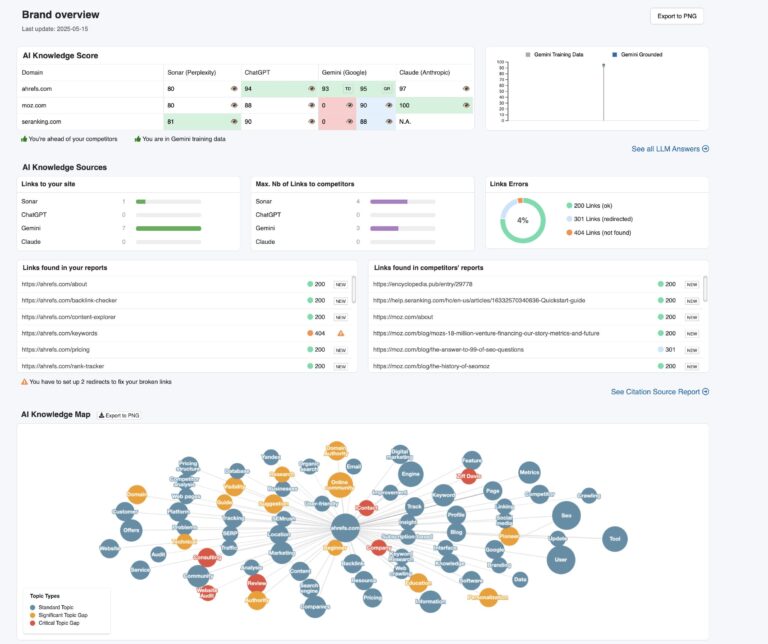
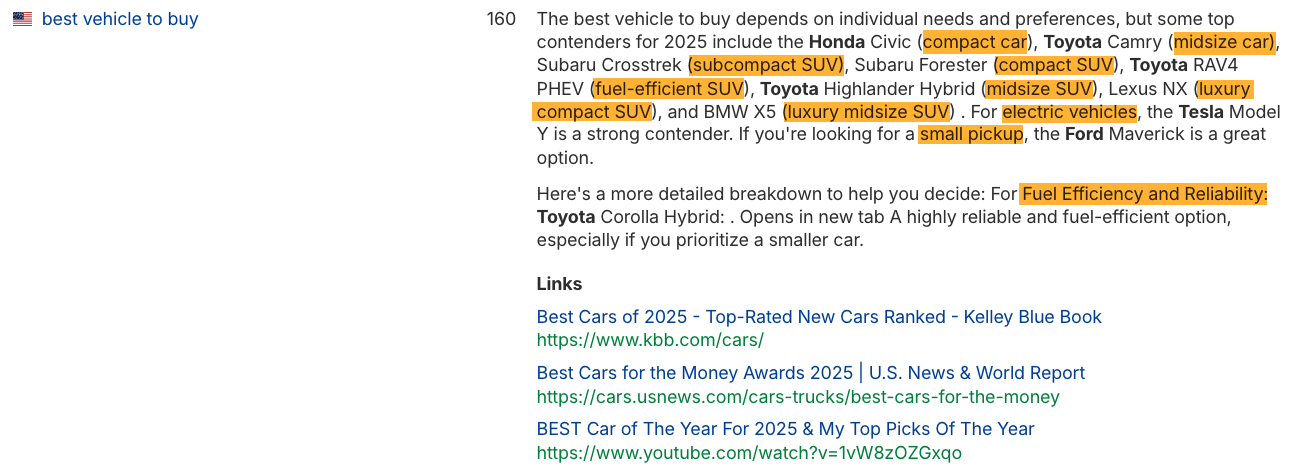
If you’re working with an existing brand, you can use Ahrefs’ Brand Radar to audit current visibility in search and AI. You’ll see where you’re mentioned, how you’re positioned, and what gaps exist.
Especially in AI responses that also mention competitors:
Next, document the seven components from the section above. It doesn’t matter whether you do this in Google Docs, Notion, or another platform. Store it wherever your team keeps core reference documents.
What matters is that you document each element systematically, pulling from your discovery interviews and audit findings. This becomes your reference document for every team that creates content or works on public brand communications, thereby unifying the messaging.
Then customize for your use case. Add variables specific to your needs:
- Agencies: Create separate kits for each client
- Publications: Build kits for each author with their style preferences
- Large sites: Create kits for different content silos or page types (e.g., product pages vs. blog posts)
Finally, implement it.
The challenge with brand guides is getting everyone to actually use them. This is where AI Content Helper’s automated brand kit helps. It turns your brand guide into automated rules that apply to AI-generated content.
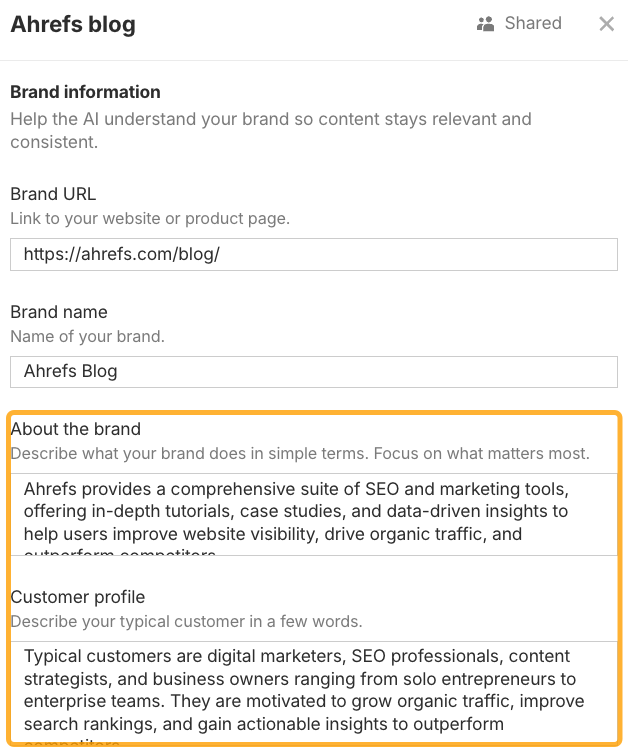
Input your website and example posts, review and edit the generated components, add your custom variables, then activate it for your team.
Your brand consistency is now built into your content creation process, not an afterthought.
Final thoughts
When search engines and LLMs understand your brand as a distinct entity with clear positioning, consistent voice, and documented expertise, you don’t just rank for queries. You become the answer people are looking for across your key topics.
That’s what brand SEO optimization achieves. A well-documented brand guide is how you get there.
Use the templates to guide your brand discovery. Flesh out the seven core components. Then scale with tools like Ahrefs’ Brand Kit to maintain consistency across your team, and Brand Radar to monitor how your brand actually shows up in search and AI results.
And if you’ve got any questions, reach out on LinkedIn any time 🙂
Similar Posts
The Great Diversification: How 8 Companies Are Evolving Their SEO Strategies
First, we had “the great decoupling”, now we’re seeing “the great diversification”. Brands are overhauling their strategies since losing clicks to Google. You’ve probably heard that Google’s AI search features are tanking organic traffic. In April, we reported that click-through rates dropped by 35% across 300,000 keywords. Now, a Pew Research study has revealed that…
Education SEO for Higher Education, EdTech and K-12 Schools
If you’re doing SEO for higher education institutions, schools, or EdTech startups, this is hands down the only education SEO guide you’ll ever need. Before I started SEO, I was an educator for about 10 years. To say education is close to my heart would be an understatement. But, the real value of this post comes…
How to Track AI Overviews: Mentions, Citations, Click Loss, and the Traffic Google Won’t Show You
How much traffic do AI Overviews drive? How much awareness do they create for your brand? And how can you track that over time? These questions aren’t easy to answer—especially since Google keeps AI Overview data under lock and key. But, if you keep reading, you might just find out… Ahrefs Web Analytics, our GA4 alternative. The source…
15 AEO Tools That Will Help You Optimize for LLMs
AI is reshaping search optimization—it’s no longer just about ranking in search results, but about earning visibility in AI-generated answers. We’re moving from chasing traffic, to competing for brand visibility. We’re thinking about how AI crawlers view our site–not just search engine bots. We’re trying to follow the breadcrumb trail through an entirely new kind…
You’ll need to share these details internally (for your team) and externally (for the media) to mention you consistently.
For example, here’s Ahrefs’ media kit, where we make it easy for others to reference our brand the same way we do.
2. Brand voice and personality
What it is: How your brand communicates. It includes the personality traits, tone, and specific language choices that make your content sound distinctly like you.
This includes what your brand is and isn’t, words to avoid, and your position on the formal-to-casual spectrum.
Why it matters for SEO: Consistent voice across all touchpoints is crucial for establishing brand authority. It differentiates you from competitors targeting the same keywords. It also helps AI tools and human writers stay on-brand without constant oversight, reducing revision cycles and improving content quality at scale.
How to document it:
- List 3-5 personality traits that define your brand with examples of what they mean in practice. For instance, “data-driven” means you support claims with statistics and research, while “practical” means you skip theory for actionable steps.
- Use the “We ARE / We AREN’T” framework to clarify boundaries (e.g., “We are direct and educational / We aren’t hype-driven or guru-ish”)
- Create a list of words and phrases to avoid (common offenders: AI-isms like “delve” and “unlock,” competitor-specific terms like proprietary framework names or trademarked phrases, overused jargon)
- Note your tone preferences using descriptors like professional, conversational, humorous, serious, motivating, and specify when to use each (e.g., conversational for blog posts, professional for whitepapers).
- Include 2-3 example sentences showing your voice in action
For instance, here’s a snapshot of Ahrefs’ tone of voice guide that our internal team all use when creating content.
Pro tip
You can automate much of this brand voice documentation using Ahrefs’ Brand Kit in AI Content Helper. It analyzes your existing content to identify your tone, personality traits, and writing patterns, then applies those rules automatically when generating new content.
3. Target audience and search personas
What it is: Profiles of the people actively searching for solutions like yours. These aren’t necessarily your current customers.
Search personas focus on who’s looking for answers before they even know your brand exists, what problems trigger their searches, and what information they need at each stage of their journey.
Why it matters for SEO: Search personas differ from buyer personas because they capture pre-purchase behavior.
Understanding them helps you create content that matches search intent, choose the right keywords, and appear in the places your audience actually looks for information (which might not be your website yet).
This is especially important as we move further into the “search everywhere” era of SEO and optimize for more touchpoints in the “messy middle”. For instance, consider all these touchpoints in my journey to buy a laser cutter:
Similarly, you need to understand your audience’s touchpoints.
How to document it:
- Create 2-3 search persona profiles based on common search patterns, not demographics
- List sample search queries each persona uses at different stages in the funnel (awareness, consideration, decision)
- Note their pain points, questions, and what triggers them to start searching
- Include their preferred platforms (Google, YouTube, Reddit, ChatGPT, etc.)
- Document their expertise level to guide content depth and terminology
Further reading
4. Unique selling points (USPs) and differentiation
What it is: The specific features, benefits, and proof points that set your brand apart from competitors.
This includes your core USPs, guarantees, awards, certifications, and any proprietary technology or processes that make you different.
Why it matters for SEO: USPs provide ready-made content for landing pages and create natural opportunities for internal linking.
They also strengthen your E-E-A-T signals (experience, expertise, authority, trust) and help search engines and AI understand what makes your brand uniquely relevant for specific queries.
How to document it:
Every business is in business for a reason. If you have customers and cash flow, you’re doing something that makes you the best choice in your area or industry. The trick is digging deep enough to find it.
I once worked with a turf company that thought they “just sold grass.” Boring, right?
Until we discovered they’d revolutionized a fire-resistant grass variety that survived some of the worst bushfires in recent history. A local pub was the only building on the block with a healthy lawn because of this company’s product. That made the news. That’s a brand story.
Sometimes your USP is solving the thing people hate most about your industry. “The Clean Plumber” started their business around not being messy. Simple, memorable, differentiating.
You can do this for your brand, too.
- List what makes customers choose you over competitors (talk to your sales team, read reviews, ask customers directly)
- For each USP, explain how and why you deliver it. Don’t just say “committed to quality,” show what your quality looks like compared to others
- Include supporting data, certifications, case studies, or news coverage
- Note which USPs matter most for specific products, services, or customer segments
- Document exact wording for taglines and key claims to use consistently across content
Example of USPs for SEO
USP: Fire-resistant turf variety that survived [Region] bushfires
How we deliver: Proprietary growing method developed over 15 years
Proof: Featured in [News Outlet], only lawn that survived on [Street Name]
Where to use: Homepage hero, about page, product pages, case studies, local SEO content
Keywords to target: “fire-resistant grass [region],” “bushfire-proof lawn, ” “heat-resistant turf”
5. Products, services, and offerings
What it is: A complete catalog of what you sell, including product names, descriptions, key features, technical specifications, and which offerings are most popular or profitable.
This section ensures everyone refers to your products and services consistently across all content.
Why it matters for SEO: Products are entities separate from your organization. They have their own IDs in knowledge graphs, such as Google’s Shopping Graph, and merchant centers in ChatGPT.
For example, Google shows product cards for many commercial queries that list the product’s photos and key attributes like available colors, sizes, and price:
It also shows retailers near the searcher who have the item in stock, can deliver it quickly, and/or are running a discount or offering the lowest price:
If relevant to the product, tech specs may also be visible. These can also be USPs in disguise. They’re searchable details that help you rank for specific, long-tail queries and differentiate from competitors:
Along with aggregate reviews pulled in from multiple retailers around the web:
Consistent product naming, descriptions, and technical specs help Google and AI systems that maintain product graphs to understand and reference your offerings correctly.
How to document it:
- Create a list or table with official product/service names and one-line descriptions
- Note the most popular or highest-converting offerings (prioritize content for these)
- Include technical specs, dimensions, materials, certifications, or other specific attributes that people search for
- List relevant use cases, industries, or customer segments for each offering
- Add keyword variations people use when searching for each product or service
Pro Tip
Not sure what specs and attributes of your products or services people care about? Check out Ahrefs’ Keywords Explorer.
Enter your main product or service category, and then look at the long-tail keywords with descriptive words and modifiers. For example, when looking for lawyers, many people value a firm’s ability to win without it racking up major expenses in the process:
For a plumbing service, they value a plumber who can help them at any time during an emergency:
You get the idea.
Look for the features and attributes that matter most to your brand and include them in your brand guide as points of differentiation for each product or service you offer.
6. Competitors and positioning
What it is: A list of your direct competitors in search, how you compare to them, and what makes you different.
This includes their strengths, common customer complaints, and your relative price positioning in the market.
Why it matters for SEO: Understanding your competitive landscape informs your comparison content strategy, helps you identify keyword gaps, and ensures your brand voice doesn’t accidentally mimic competitors.
It also guides messaging in competitive spaces where multiple brands target the same keywords.
How to document it:
- List 3-5 main competitors in your space
- Note what they do well (learn from their strengths). For example, “Competitor A has excellent video tutorials” or “Competitor B’s onboarding is seamless.”
- Document common customer complaints or pain points with competitors (opportunities for you to differentiate)
- Include your price positioning relative to the market (premium, mid-range, budget-friendly)
- Add specific ways you’re different in head-to-head comparisons. For example, “We offer 24/7 support while competitors only offer business hours” or “Our tool includes X feature that competitors charge extra for.”
Not sure which competitors to include? Use Ahrefs’ competitive intelligence features to find your organic competitors:
- Enter your domain in Site Explorer
- Go to “Organic Competitors”
- Review the list of sites ranking for similar keywords
This shows you who’s actually competing for your search visibility, not just who you think your competitors are.
Want to go deeper? Run a brand gap analysis to find gaps in your brand positioning, messaging, market perception, and visibility compared to competitors while protecting your branded search results.
7. Content structure and page design guidelines
What it is: The structural and design rules that ensure consistency across your content. This includes how you organize information, format headings, structure page layouts, place CTAs, handle internal links, and present visuals. In a nutshell, it’s the UX and technical SEO framework that makes your content work well for both users and search engines without sacrificing brand consistency.
Sidenote.
This point matters most to SEO teams that need to collaborate with UX designers or are working on client sites that have established design templates and layouts in place. It’s about merging the technical requirements of on-page SEO with what’s possible within the website’s existing design.
Why it matters for SEO: Consistent page structure creates predictable user experience signals that search engines reward. It also ensures proper on-page SEO elements (title tags, meta descriptions, heading hierarchy), maintains E-E-A-T signals across content, and helps with crawlability and indexation.
This is especially important when creating core webpages, brand pages, and landing pages that require more formatting than blog posts typically do.
As more teams use AI tools for content creation, documented formatting rules become even more critical. AI requires these guidelines upfront to generate on-brand content that requires minimal editing. For instance, you can provide wireframes:
Or an idea of content length and features for each section.
When working with UX teams, documented content rules also prevent a disconnect between design and final content.
How to document it:
- Define your standard page structure (heading hierarchy, intro placement, CTA locations, content block order)
- Create formulas for on-page SEO elements: title tags (60 chars), meta descriptions (155 chars), H1 structure
- Document internal linking strategy: priority pages to link to, anchor text patterns, contextual vs navigational links
- Specify visual standards: image dimensions, screenshot styles, chart/graph formatting, video placement
- Include page templates or wireframes for core page types (product pages, landing pages, blog posts, category pages)
For a deeper dive into aligning content structure with user experience and technical SEO requirements, check out our guide on UX and SEO.
questionnaire template to identify your brand identity, USPs, and voice.
If you’re working with an existing brand, you can use Ahrefs’ Brand Radar to audit current visibility in search and AI. You’ll see where you’re mentioned, how you’re positioned, and what gaps exist.
Especially in AI responses that also mention competitors:
Next, document the seven components from the section above. It doesn’t matter whether you do this in Google Docs, Notion, or another platform. Store it wherever your team keeps core reference documents.
What matters is that you document each element systematically, pulling from your discovery interviews and audit findings. This becomes your reference document for every team that creates content or works on public brand communications, thereby unifying the messaging.
Then customize for your use case. Add variables specific to your needs:
- Agencies: Create separate kits for each client
- Publications: Build kits for each author with their style preferences
- Large sites: Create kits for different content silos or page types (e.g., product pages vs. blog posts)
Finally, implement it.
The challenge with brand guides is getting everyone to actually use them. This is where AI Content Helper’s automated brand kit helps. It turns your brand guide into automated rules that apply to AI-generated content.
Input your website and example posts, review and edit the generated components, add your custom variables, then activate it for your team.
Your brand consistency is now built into your content creation process, not an afterthought.
Final thoughts
When search engines and LLMs understand your brand as a distinct entity with clear positioning, consistent voice, and documented expertise, you don’t just rank for queries. You become the answer people are looking for across your key topics.
That’s what brand SEO optimization achieves. A well-documented brand guide is how you get there.
Use the templates to guide your brand discovery. Flesh out the seven core components. Then scale with tools like Ahrefs’ Brand Kit to maintain consistency across your team, and Brand Radar to monitor how your brand actually shows up in search and AI results.
And if you’ve got any questions, reach out on LinkedIn any time 🙂
If you’re working with an existing brand, you can use Ahrefs’ Brand Radar to audit current visibility in search and AI. You’ll see where you’re mentioned, how you’re positioned, and what gaps exist.
Especially in AI responses that also mention competitors:
Next, document the seven components from the section above. It doesn’t matter whether you do this in Google Docs, Notion, or another platform. Store it wherever your team keeps core reference documents.
What matters is that you document each element systematically, pulling from your discovery interviews and audit findings. This becomes your reference document for every team that creates content or works on public brand communications, thereby unifying the messaging.
Then customize for your use case. Add variables specific to your needs:
- Agencies: Create separate kits for each client
- Publications: Build kits for each author with their style preferences
- Large sites: Create kits for different content silos or page types (e.g., product pages vs. blog posts)
Finally, implement it.
The challenge with brand guides is getting everyone to actually use them. This is where AI Content Helper’s automated brand kit helps. It turns your brand guide into automated rules that apply to AI-generated content.
Input your website and example posts, review and edit the generated components, add your custom variables, then activate it for your team.
Your brand consistency is now built into your content creation process, not an afterthought.
Final thoughts
When search engines and LLMs understand your brand as a distinct entity with clear positioning, consistent voice, and documented expertise, you don’t just rank for queries. You become the answer people are looking for across your key topics.
That’s what brand SEO optimization achieves. A well-documented brand guide is how you get there.
Use the templates to guide your brand discovery. Flesh out the seven core components. Then scale with tools like Ahrefs’ Brand Kit to maintain consistency across your team, and Brand Radar to monitor how your brand actually shows up in search and AI results.
And if you’ve got any questions, reach out on LinkedIn any time 🙂
Similar Posts
The Great Diversification: How 8 Companies Are Evolving Their SEO Strategies
First, we had “the great decoupling”, now we’re seeing “the great diversification”. Brands are overhauling their strategies since losing clicks to Google. You’ve probably heard that Google’s AI search features are tanking organic traffic. In April, we reported that click-through rates dropped by 35% across 300,000 keywords. Now, a Pew Research study has revealed that…
Education SEO for Higher Education, EdTech and K-12 Schools
If you’re doing SEO for higher education institutions, schools, or EdTech startups, this is hands down the only education SEO guide you’ll ever need. Before I started SEO, I was an educator for about 10 years. To say education is close to my heart would be an understatement. But, the real value of this post comes…
How to Track AI Overviews: Mentions, Citations, Click Loss, and the Traffic Google Won’t Show You
How much traffic do AI Overviews drive? How much awareness do they create for your brand? And how can you track that over time? These questions aren’t easy to answer—especially since Google keeps AI Overview data under lock and key. But, if you keep reading, you might just find out… Ahrefs Web Analytics, our GA4 alternative. The source…
15 AEO Tools That Will Help You Optimize for LLMs
AI is reshaping search optimization—it’s no longer just about ranking in search results, but about earning visibility in AI-generated answers. We’re moving from chasing traffic, to competing for brand visibility. We’re thinking about how AI crawlers view our site–not just search engine bots. We’re trying to follow the breadcrumb trail through an entirely new kind…