Going into this study, I suspected that domain-level link metrics would not be a good predictor for mentions. I was expecting Google AI Overviews to show more of a correlation since they may use some of the traditional search signals, whereas the other systems may not. For traditional search, usually the page-level metrics are more predictive of rankings than domain-level ones.
I looked at the top 50 websites mentioned in Ahrefs Brand Radar for Google AI Overviews, ChatGPT, and Perplexity. This is across ~76.7M AI Overviews, 957k ChatGPT prompts, and 953.5k Perplexity prompts for the month of June 2025.
I compared the website mentions to their Ahrefs Rank (AR) in Ahrefs. Ahrefs Rank (AR) ranks all the websites in our database in order, by the size and quality of their followed referring domains.
Sidenote.
Brand Radar isn’t just another LLM visibility monitor, we track a large amount of queries across all of these systems and you can query for any product, service, or brand and compare vs competitors. It’s more like Site Explorer than it is Rank Tracker. Plus we have the web visibility index so that you can see how you’re talked about online and the search demand index to see how popular you are in searches.
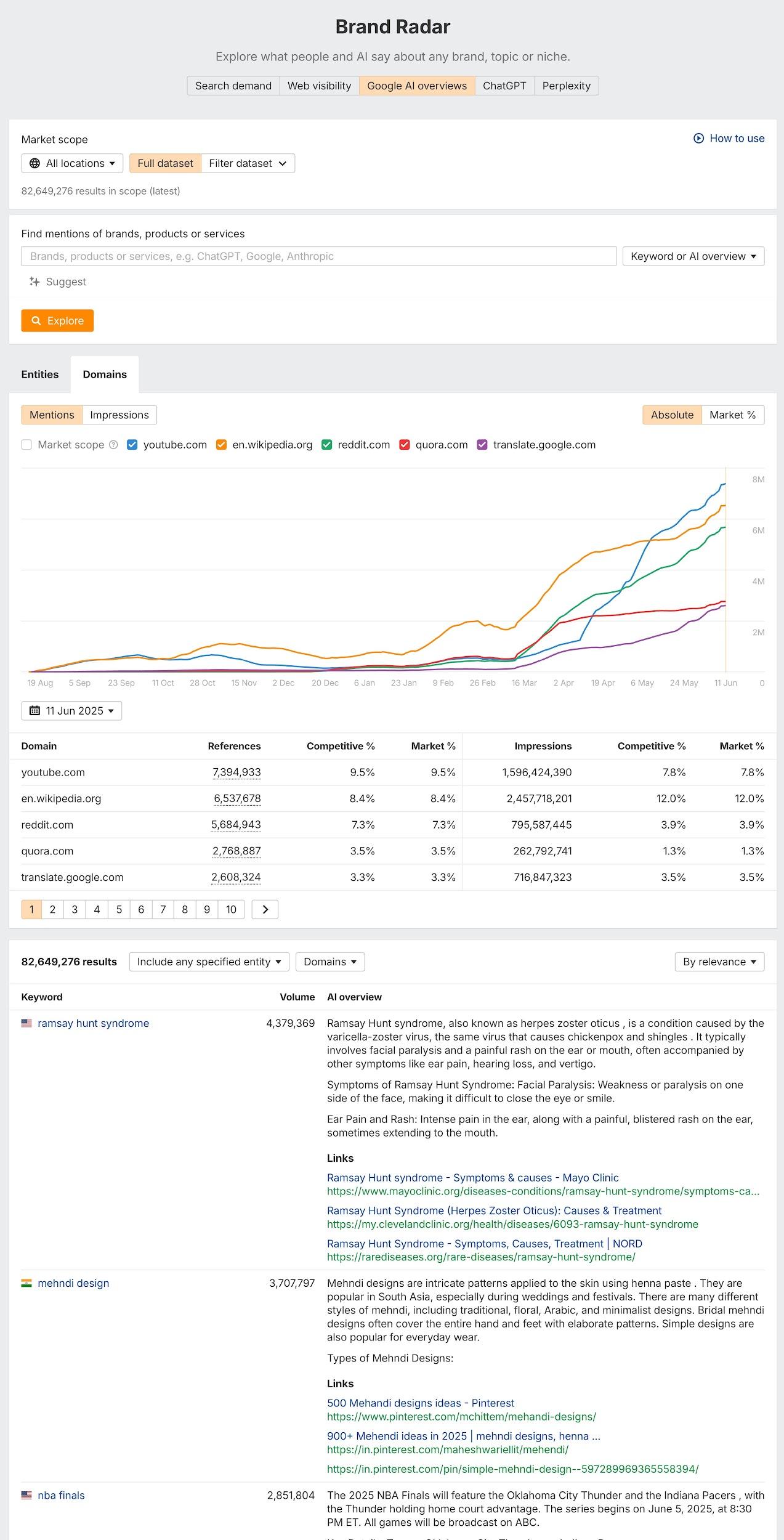
Here’s what Brand Radar looks like.
Let’s dig in.
Similar Posts
How to Earn LLM Citations to Build Traffic & Authority
Ask ChatGPT, “How much does SEO cost?” and you’ll likely see Ahrefs cited as a source. Ask Claude about email marketing benchmarks, and Mailchimp’s data appears. Search Perplexity for project management tips, and Asana’s guides get referenced. At first glance, it looks like only big brands get cited in AI answers. In the top 10…
LLMs Don’t Reward Originality, They Flatten It
Originality is idealized, especially in tech and marketing. We’re told to “think different,” to coin new terms, to pioneer ideas no one’s heard before and share our thought leadership. But in the age of AI-driven search, originality is not the boon we think it is. It might even be a liability… or, at best, a…
How Long Does It Take to Rank in Google? And How Old Are Top Ranking Pages?
Back in 2017, we conducted a study to answer a simple yet important question: How old are the top-ranking pages in Google? The results were eye-opening and became one of our most-referenced data studies. Clients and stakeholders often ask, “How long till my website (page) ranks on top of Google?” You could say “it depends”…
The SEO Bots That ~140 Million Websites Block the Most
Ever wonder which SEO bots are the most blocked? This can impact the quality of the data the tools provide. Blocking these bots will mostly impact the link index of the tools. They won’t be able to crawl the pages, so they can’t check where those pages are linking. It doesn’t matter for traffic estimates,…
Are AI Mode and AI Overviews Just Different Versions of the Same Answer? (730K Responses Studied)
Google’s AI Mode generates responses that are 4x longer than AI Overviews (on average). When we first noticed this, the natural assumption was that AI Mode simply expands on the same information, taking AI Overview’s concise answer and adding more detail from the same sources. But after analyzing 730,000 response pairs, we found something unexpected:…
My Exact 7-Step Framework for Brand SEO (With Templates)
Branding wasn’t something SEOs traditionally thought much about. The real wins were in non-branded keywords, where the traffic and conversions lived. However, that changed when Google and OpenAI turned most of these queries into zero-click searches. For the remaining queries, search platforms directly reward authoritative and popular brands, so branding can no longer be ignored…