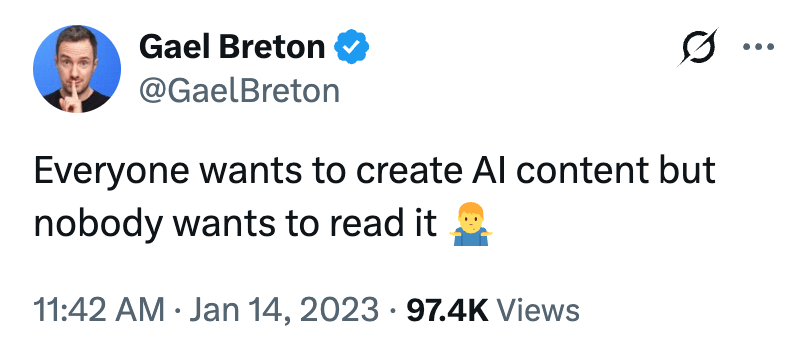
For the first time ever, anyone can make content in seconds.
With just a couple of prompts, an LLM can generate an entire blog post that you can publish on your website. A solopreneur or a marketing team of one can pump out newsletters, social media content, ad copy, and blog posts without breaking a sweat.
This should be revolutionary. But it has created a new problem.
Nobody can find anything worth reading.
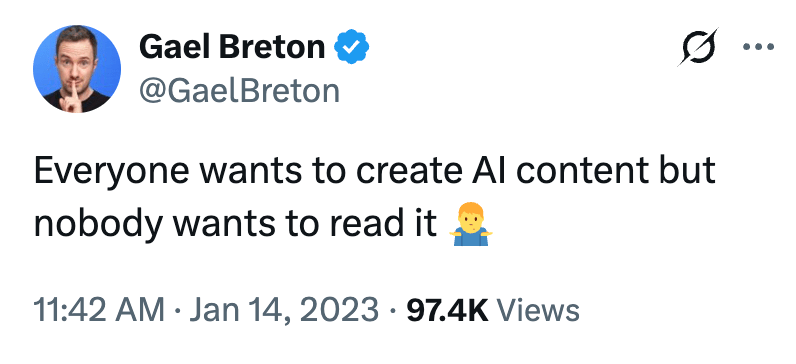
When anyone can create, creation alone isn’t valuable anymore. Instead, something else becomes invaluable: the ability to know what’s actually worth making.
We call this taste.
More importantly, it shows up in every member of your content marketing team.
I sincerely believe one of the reasons why our blog is well-known is because each member of the content team makes excellent taste-driven decisions.
We’re not looking for an assembly line where each content marketer fills in the blanks to hit a goal of producing as many articles as possible. We genuinely want to make great content, and we know that great content builds brand and awareness, and therefore we hyper-invest in it.
We look for content marketers who have taste and distinctive points of view, are able to defend their choices, and who’ve developed clear expertise. We hire for judgment and not just execution. And we trust each individual to make taste-driven decisions and stand for themselves.
As you’re consuming, think about asking yourself these questions:
- Why does this work?
- What do I like about it?
- How would I improve upon it?
- What does the “me” version look like?
Put in your reps
Notice I said that “taste” is compressed experience. And guess what? If you want experience, you have to do.
There’s no way around it. You have to make a lot of editorial decisions (some good, some bad, but mostly bad) before your taste becomes reliable.
Every time you do, every time you analyze your work, you’re practicing and building taste.
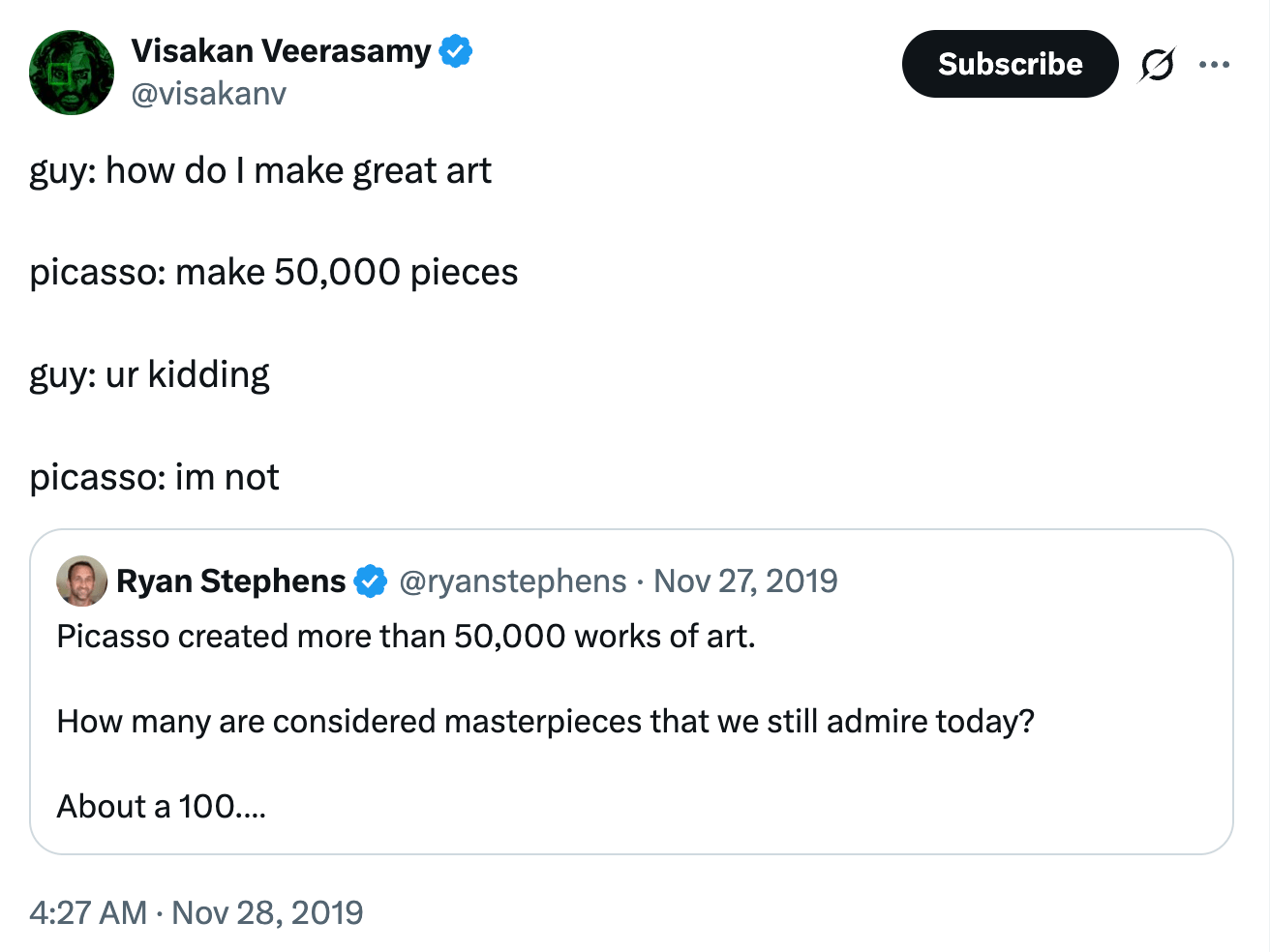
Judgment only improves with volume. You want to do 100 things. Write 100 essays. Make 100 YouTube videos. Post 100 times on LinkedIn. Create 100 TikTok videos.
As Scott Young writes:
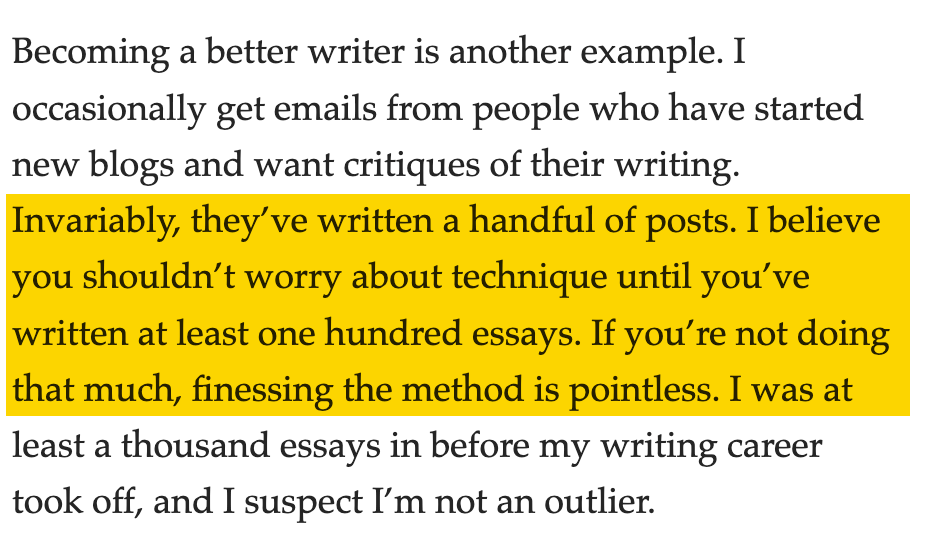
When you’ve done 100, do more. I’m 154 articles in and I feel like I’m only getting started.

My taste is developing but it’s nowhere good yet. But trust the process, put in the reps, and it’ll come.
Create feedback loops with your audience
Even if you’re gratifying your own taste, your work ultimately needs to be seen and accepted by an audience. So don’t work in a silo and don’t work in stealth.
Put your work out there, then talk to people. Have conversations. Online and offline. What do they reference back to you? What do they share with others? What makes them reply “this is exactly what I needed”?
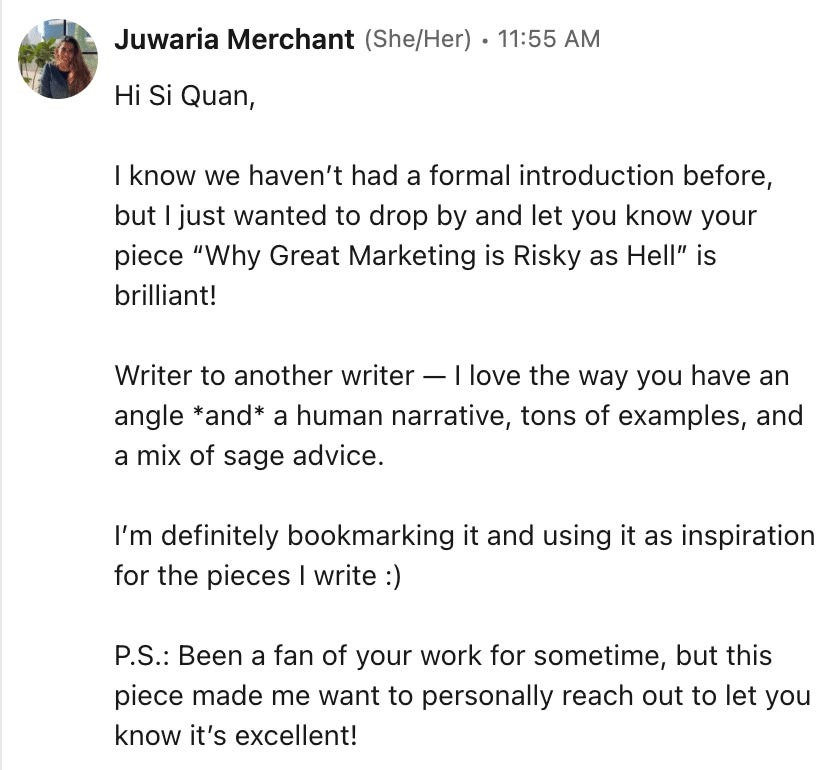
Having taste and a point of view isn’t to massage your ego; it is to serve your audience and help them move forward.
Accept that taste alienates as much as it attracts
“The best art divides the audience, where if you put out a record, and half the people who hear it absolutely love it, and half the people who hear it absolutely hate it, you’ve done well because it’s pushing that boundary. If everyone thinks, oh that’s pretty good, why bother making it? It doesn’t mean as much.” — Rick Rubin
If everyone loves your work, you’re probably not making strong enough choices. A distinctive point of view naturally repels people who don’t share it.
Polarisation is a feature, not a bug.
But too many people take this to mean they should intentionally create polarisation. No. Polarisation happens because you’re gratifying your taste and your genuine and sincere understanding of why something should be that way sometimes grinds others’ gears.
Not because you’re saying something controversial (even though you don’t believe it) or ragebaiting people online.
Final thoughts
The Internet removed the gatekeepers of publishing content. Today, AI has removed the gatekeepers of creating content. Production is no longer the bottleneck.
The new, scarce skill is the skill of knowing what’s worth making.
In a world where everyone can create, the only sustainable differentiation is judgment about what should be created.
Here’s the opportunity for you: most brands will use AI to chase efficiency and cut costs. They’re more than happy to sacrifice a modicum of quality and abandon taste in order to save more money. They’ll produce rivers of acceptable content that nobody remembers.
The brands that win will be the ones that slow down, that develop point of view, that make strong choices.
They’ll publish less and matter more.
Similar Posts
AI’s Impact on SEO: 13 Things That Changed, 4 Things That Stayed The Same
AI assistants like ChatGPT, Gemini, and Perplexity have become the new places people turn to for answers—handling millions of prompts every day. Even Google now uses AI to generate summaries right at the top of search results. This shift happened fast. In 2024, AI Overviews rolled out to millions of searches, ChatGPT climbed into the…
Why .store Is the Perfect Domain Extension for Your Online Shop
In the vast, ever-evolving eCommerce landscape, filled to the brim with new digital marketplaces, standing out is vital for online shop owners. And you shouldn’t underestimate the impact your top-level domain can have on your brand’s online presence. Over the last 12 months, the .store registry commissioned Contrast Digital to run a TLD experiment to…
The AI Bots That ~140 Million Websites Block the Most
AI bots power some of the most advanced technologies we use today, from search engines to AI assistants. However, their increasing presence has led to a growing number of websites blocking them. There’s a cost to bots crawling your websites and there’s a social contract between search engines and website owners, where search engines add…
Google Made It So You Can’t Track Clicks From AI Mode
Google just rolled out AI Mode to US users. I was testing if the clicks would show in Google Search Console, but they aren’t showing up. A post by Tom Critchlow on LinkedIn made me wonder how a click on a link in AI Mode would be recorded in analytics. The tl;dr is that clicks…
13 of the Best SEO Blogs (Beyond the Usual Suspects)
AI may be killing search clicks, but we’re still reading content—especially the good stuff. At Ahrefs, we read and share articles all the time for marketing and SEO inspiration. In fact, SQ puts a call-out for the best SEO blogs every week, to curate the Ahrefs’ Digest. Below you’ll find our favorites–the blogs that have made…
How to Lock or Unlock Your Domain: A Guide to What a Domain Lock Is and What it Does
Welcome to our guide on locking and unlocking your domain name. Your domain name is your business’ virtual address. If you’re creating a website for your business, it’s important to understand how to secure your domain name. In this guide, we’ll explore the world of domain locks and explain what they are, why they matter,…