

As a marketer, I want to know if there are specific things I should do to improve our LLM visibility that I am not currently doing as part of my routine marketing and SEO efforts.
So far, it doesn’t seem like it.
There seems to be massive overlap in SEO and GEO, such that it doesn’t seem useful to consider them distinct processes.
The things that contribute to good visibility in search engines also contribute to good visibility in LLMs. GEO seems to be a byproduct of SEO, something that doesn’t require dedicated or separate effort. If you want to increase your presence in LLM output, hire an SEO.
Sidenote.
GEO is “generative engine optimization”, LLMO is “large language model optimization”, AEO is “answer engine optimization”. Three names for the same idea.
“There’s only so many ways you can shake a stick at aggregating a group of information, ranking it, and then disseminating your best approximation of what the best and most accurate result/info would be.”
Most people agreed with my sentiment, but others shared nuances between LLMs and search engines that are worth understanding—even if they don’t (in my opinion) warrant creating the new discipline of GEO:
LLMs operate differently. They derive their understanding of a brand’s authority from words on the page, from the prevalence of particular words, the co-occurrence of different terms and topics, and the context in which those words are used. Unlinked content will further an LLM’s understanding of your brand in a way that won’t help a search engine.
As Gianluca Fiorelli writes in his excellent article:
“Brand mentions now matter not because they increase ‘authority’ directly but because they strengthen the position of the brand as an entity within the broader semantic network.
When a brand is mentioned across multiple (trusted) sources:
The entity embedding for the brand becomes stronger.
The brand becomes more tightly connected to related entities.
The cosine similarity between the brand and related concepts increases.
The LLM ‘learn’ that this brand is relevant and authoritative within that topic space.”

Many companies already value off-site mentions, albeit with the caveat that those mentions should be linked (and dofollow). Now, I can imagine brands relaxing their definition of a “good” off-site mention, and being happier with unlinked mentions in platforms that pass little traditional search benefit.
As Eli Schwartz puts it,
“In this paradigm, links don’t need to be hyperlinked (LLMs read content) or restricted to traditional websites. Mentions in credible publications or discussions sparked on professional networks (hello, knowledge bases and forums) all enhance visibility within this framework.”

Track brand mentions with Brand Radar
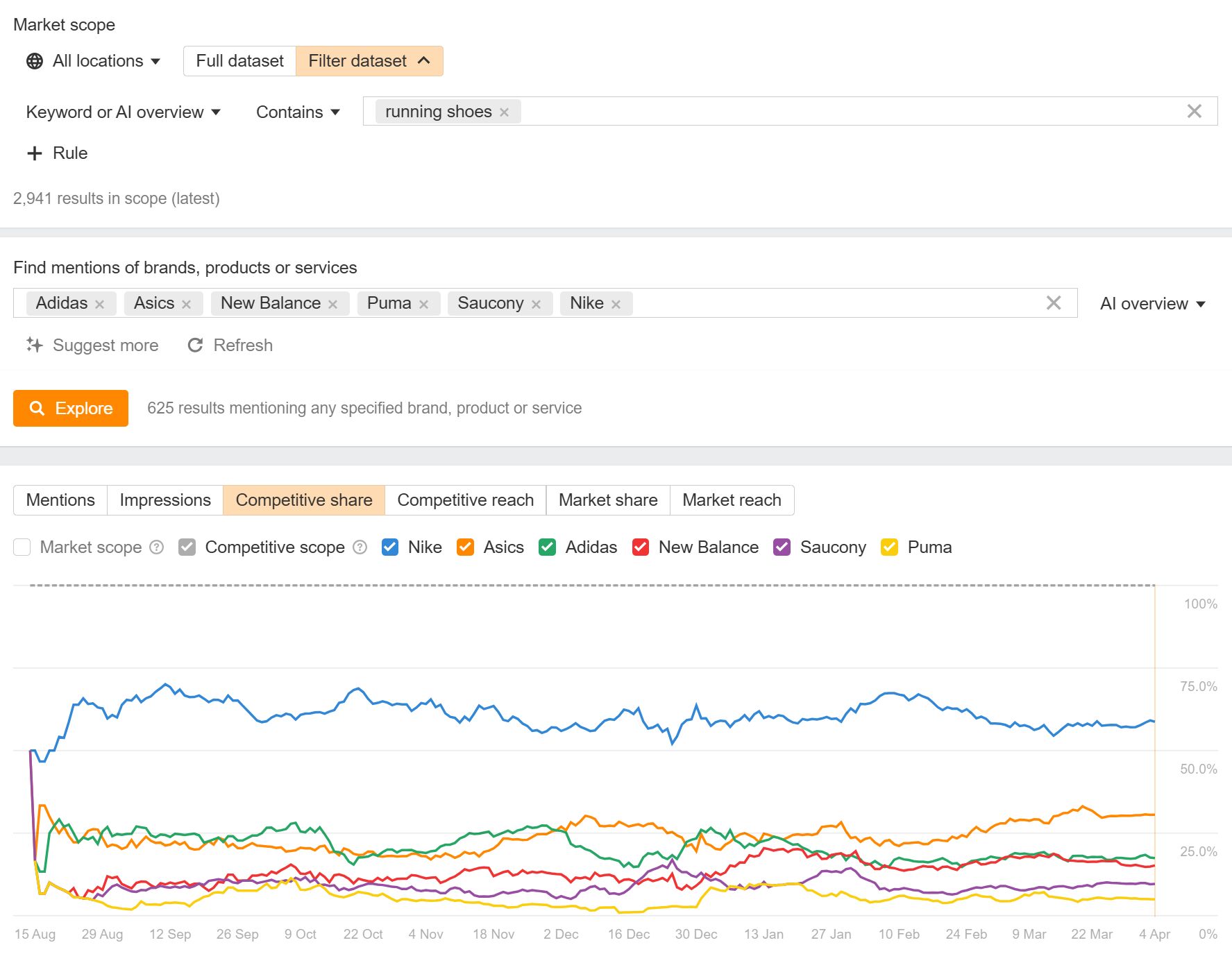
You can use our new tool, Brand Radar, to track your brand’s visibility in AI mentions, starting with AI Overviews.
Enter the topic you want to monitor, your brand (or your competitors’ brands), and see impressions, share of voice, and even specific AI outputs mentioning your brand:
These tactics offer enough SEO benefit that many people still deem them worthwhile, but they will offer even less benefit for LLM visibility. Without any relevant context surrounding these links or articles, they will do nothing to further an LLM’s understanding of the brand or boost the likelihood of it appearing in outputs.
“It’s 2025 and most content is still written for humans instead of LLMs. 99.9% of attention is about to be LLM attention, not human attention.
E.g. 99% of libraries still have docs that basically render to some pretty .html static pages assuming a human will click through them. In 2025 the docs should be a single your_project.md text file that is intended to go into the context window of an LLM.
Repeat for everything.”

This is an inversion of the SEO adage that we should write for humans, not robots: there may be a benefit to focusing our energy on making information accessible to robots, and relying on the LLMs to render the information into more accessible forms for users.
In this way, there are specific information structures that can help LLMs correctly understand the information we provide.
For example, Snowflake refers to the idea of “global document context”. (H/T to Victor Pan from HubSpot for sharing this article.)
LLMs work by breaking text into “chunks”; by adding extra information about the document throughout the text (like company name and filing date for financial text), it’s easier for the LLM to understand and correctly interpret each isolated chunk, “boosting QA accuracy from around 50%-60% to the 72%-75% range.”
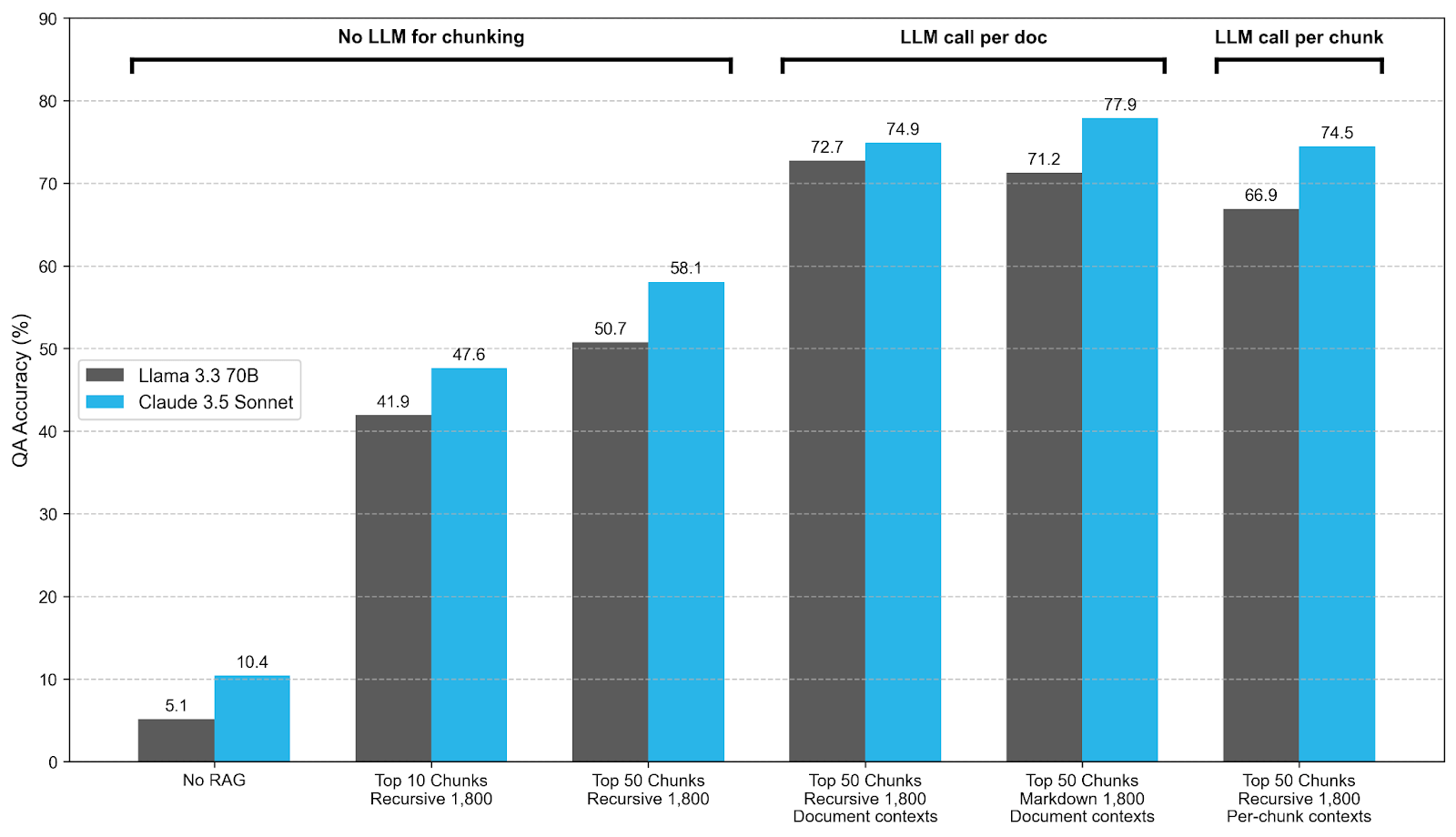
Understanding how LLMs process text offers small ways for brands to improve the likelihood that LLMs will interpret their content correctly.
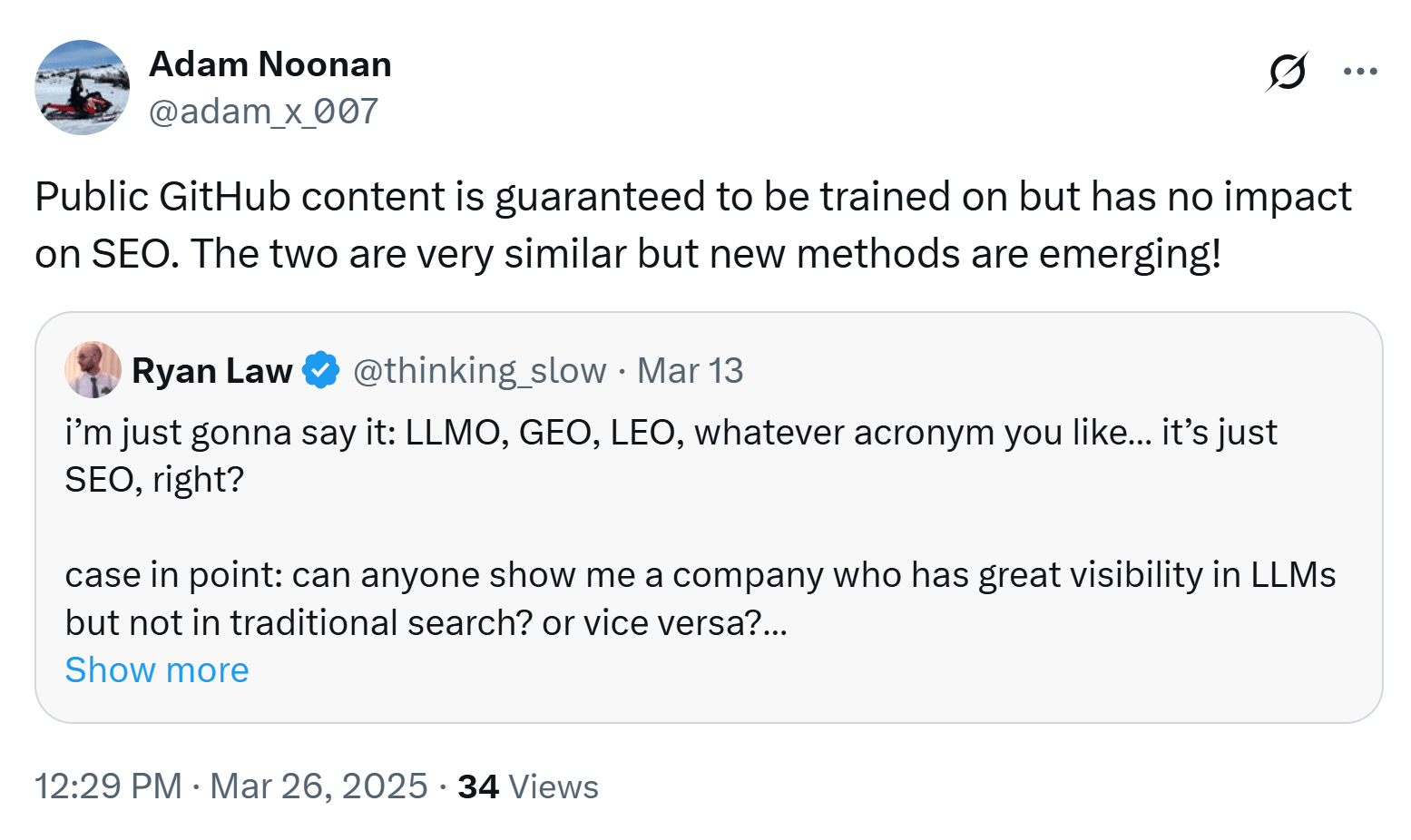
Coding is arguably the most successful use case for LLMs, and developers must make up a sizeable portion of total LLM users.
For some companies, especially those selling to developers, there may be a benefit to “optimizing” the content these developers are most likely to interact with—knowledgebases, public repos, and code samples—by including extra context about your brand or products.
“Most AI crawlers do not render JavaScript. There’s no renderer. Popular AI crawlers like those used by OpenAI and Anthropic do not even execute JavaScript. That means they won’t see content that is rendered client-side through JavaScript.”

This is more of a footnote than a major difference, for the simple reason that I don’t think this will remain true for very long. This problem was solved by many non-AI web crawlers, and will be solved by AI web crawlers in short order.
But for now, if you rely heavily on JavaScript rendering, a good portion of your website’s content may be invisible to LLMs.
Final thoughts
But here’s the thing: managing indexing and crawling, structuring content in machine-legible ways, building off-page mentions… these all feel like the classic remit of SEO.
And these unique differences don’t seem to have manifested in radical differences between most brands’ search visibility and LLM visibility: generally speaking, brands that do well in one also do well in the other.
Even if GEO does eventually evolve to require new tactics, SEOs—people who spend their careers reconciling the needs of machines and real people—are the people best-placed to adopt them.
So for now, GEO, LLMO, AEO… it’s all just SEO.
Further reading
Similar Posts
16 Top Search Engines in 2025 (Including Google Alternatives)
What are the top search engines in the world? It depends on what you’re looking for. Slowly disappearing are the days when just one search engine dominates over the rest. The Internet is fragmenting, and people may choose a search engine over others because of specific use cases. So, here are the top search engines, classified…
AI Overviews Reduce Clicks by 34.5%
Google says AI Overviews increase clicks. Cold, hard logic disagrees, and so does our research. We analyzed 300,000 keywords and found that the presence of an AI Overview in the search results correlated with a 34.5% lower average clickthrough rate (CTR) for the top-ranking page, compared to similar informational keywords without an AI Overview. Thanks…
How Do AI Content Detectors Work? Answers From a Data Scientist
There are tons of tools promising that they can tell AI content from human content, but until recently, I thought they didn’t work. AI-generated content isn’t as simple to spot as old-fashioned “spun” or plagiarised content. Most AI-generated text could be considered original, in some sense—it isn’t copy-pasted from somewhere else on the internet. But…
5 Smart Ways to Spy On Your Competitors’ Ads
Most marketers approach competitor analysis with the wrong mindset. They see a successful ad and think, “I should do exactly that!” This is a recipe for mediocrity. Competitors don’t always know what they’re doing. Their campaigns might be underperforming, and blindly following them could land you in the same hole. You also don’t want to…

Link Masking: A Guide to What Link Cloaking Is, How To Mask URLs In 5 Steps
URLs are vital to your online brand identity. But when and how should you be using link masking? Allow us to explain. Table of Contents Link masking is used by heaps of websites to show content on the web under a different URL than the one that actually hosts it. There are tonnes of reasons…