AI Overviews are AI-generated content, which means they can contain hallucinations.
Google uses “grounding” to improve their accuracy, but according to our research, AI Overviews are more likely to cite AI-generated content than human-written content.
Here’s what we found:
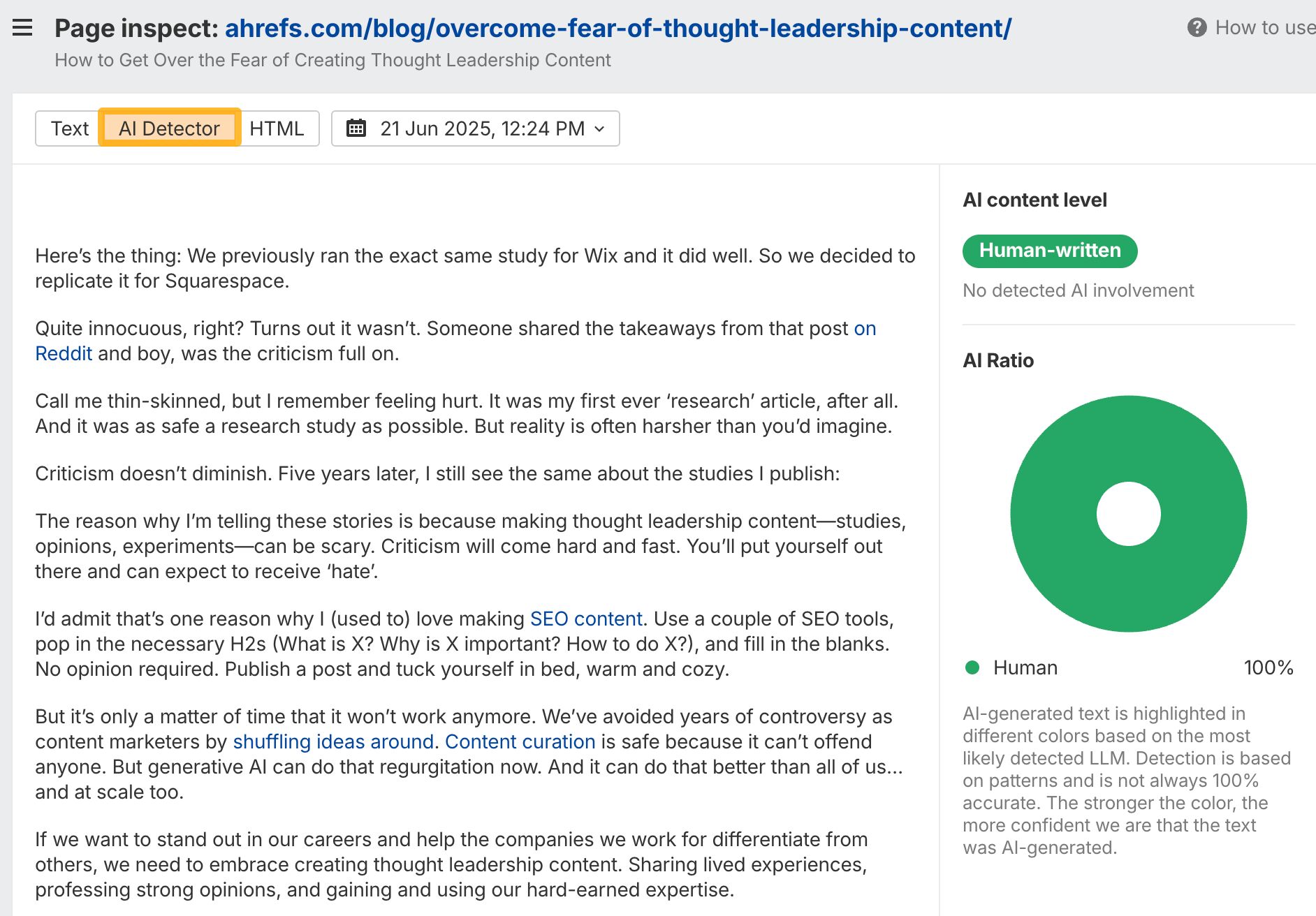
We ran each URL through our own AI content detector, which is part of Page Inspect in Site Explorer.
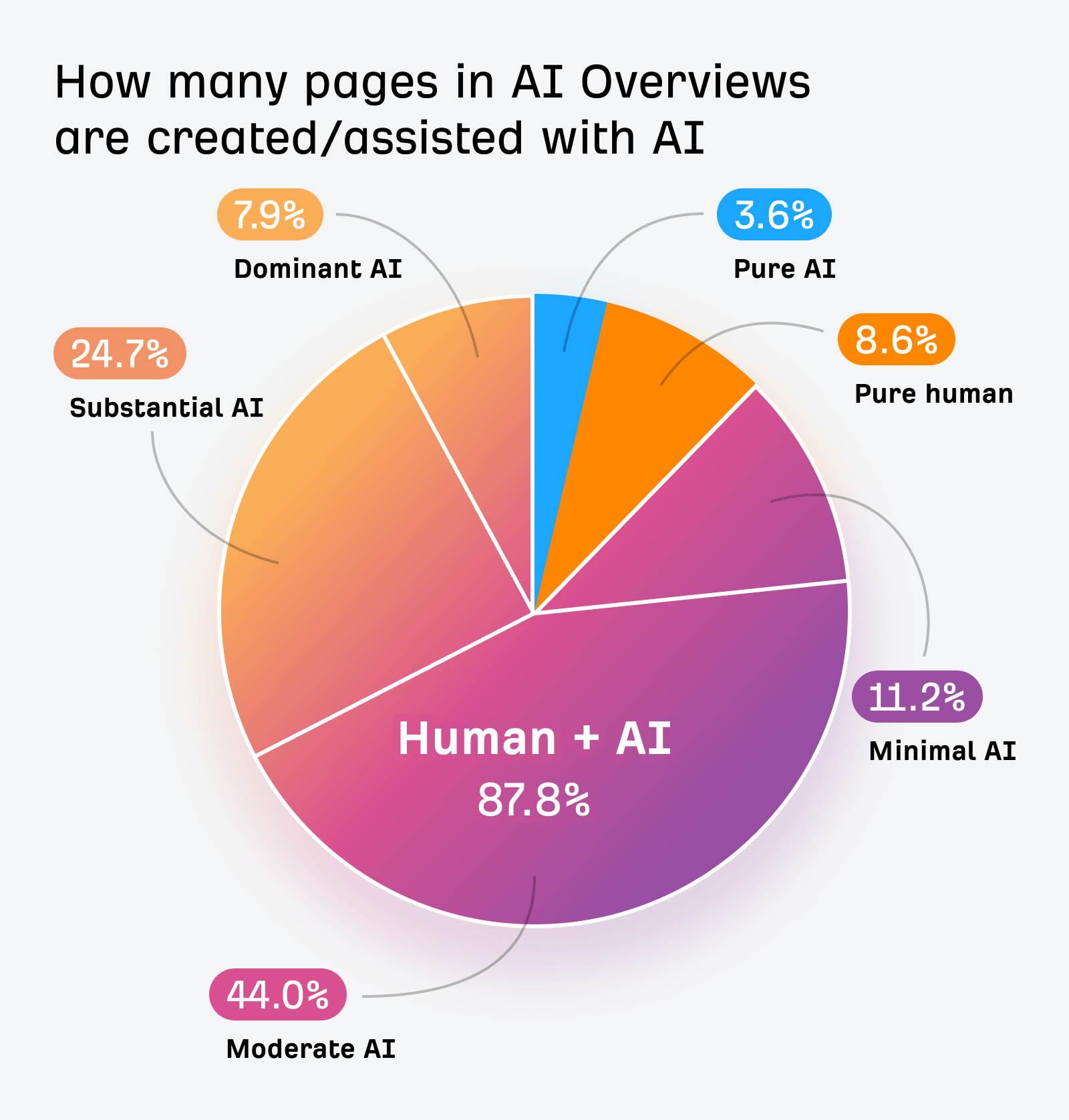
Here’s what our content detector found:
- 3.6% of pages cited in AI Overviews were categorized as “pure AI.”
- 8.6% were categorized as “pure human.”
- 87.8% were categorized as a mix of two.
Of the ones that were a mix of both human and AI:
- 11.2% showed minimal AI use (1-10% of the page content was categorized as AI)
- 44% showed moderate AI use (11-40%)
- 24.7% showed substantial AI use (41%-70%)
- 7.9% showed dominant AI use (71%-99%)
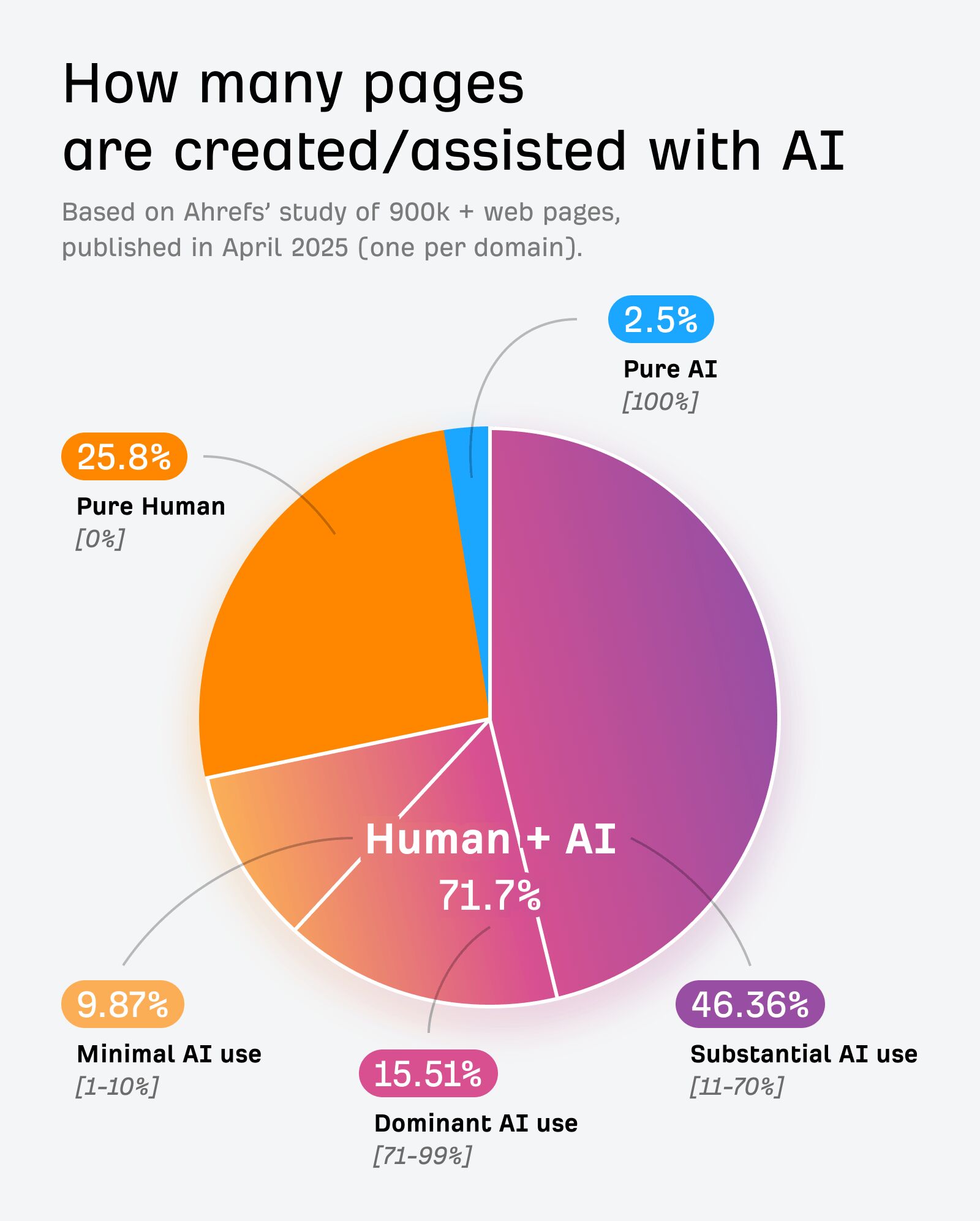
These findings become even more striking when compared to our previous research on AI content across the web. In our analysis of 900,000 new pages, we found that:
- 2.5% of pages were categorized as “pure AI.”
- 25.8% were categorized as “pure human.”
- 71.7% were categorized as a mix of the two.
Even though this research looked only at new pages (and not all cited URLs in AI Overviews will be new), this suggests that Google’s AI Overviews might show a bias toward citing AI-generated or AI-assisted content compared to the general distribution of content on the web.
Sidenote.
No AI content detector is perfect. Like LLMs, AI detectors are statistical models. They deal in probabilities, not certainty. They can be incredibly accurate, but they always carry the risk of false positives. You can learn more about how AI detectors work, and why they’re useful, in these articles:
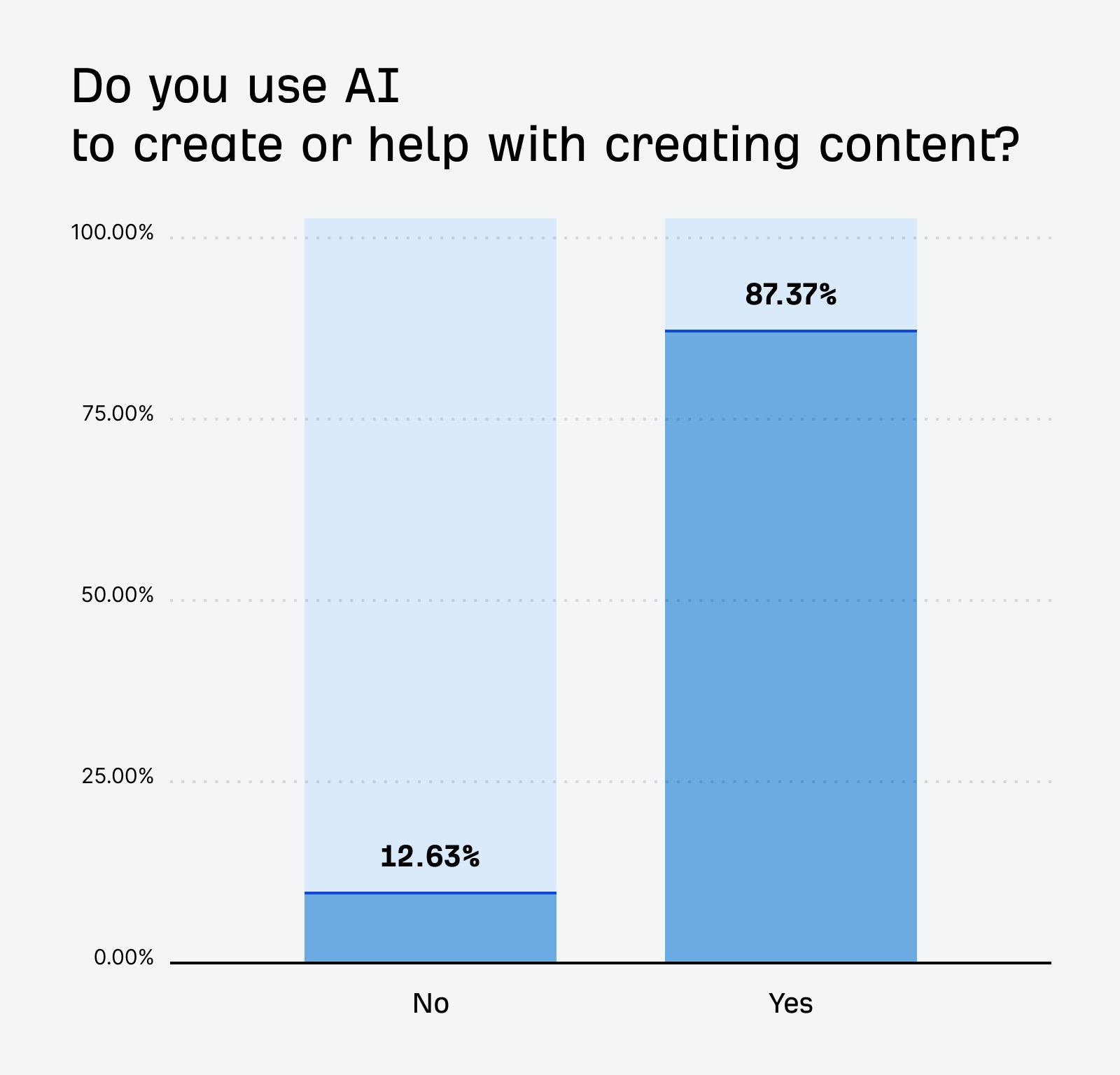
Google depends on creators for content. But creators are increasingly using AI to create or assist with content creation. For example, in our State of AI in Content Marketing report, where we surveyed 879 marketers, 87% of respondents use AI to help create content.
And even though Google’s trying to improve accuracy through retrieval-augmented generation (RAG), we’ve also found that 86.5% of top-ranking pages contain some amount of AI-generated content.
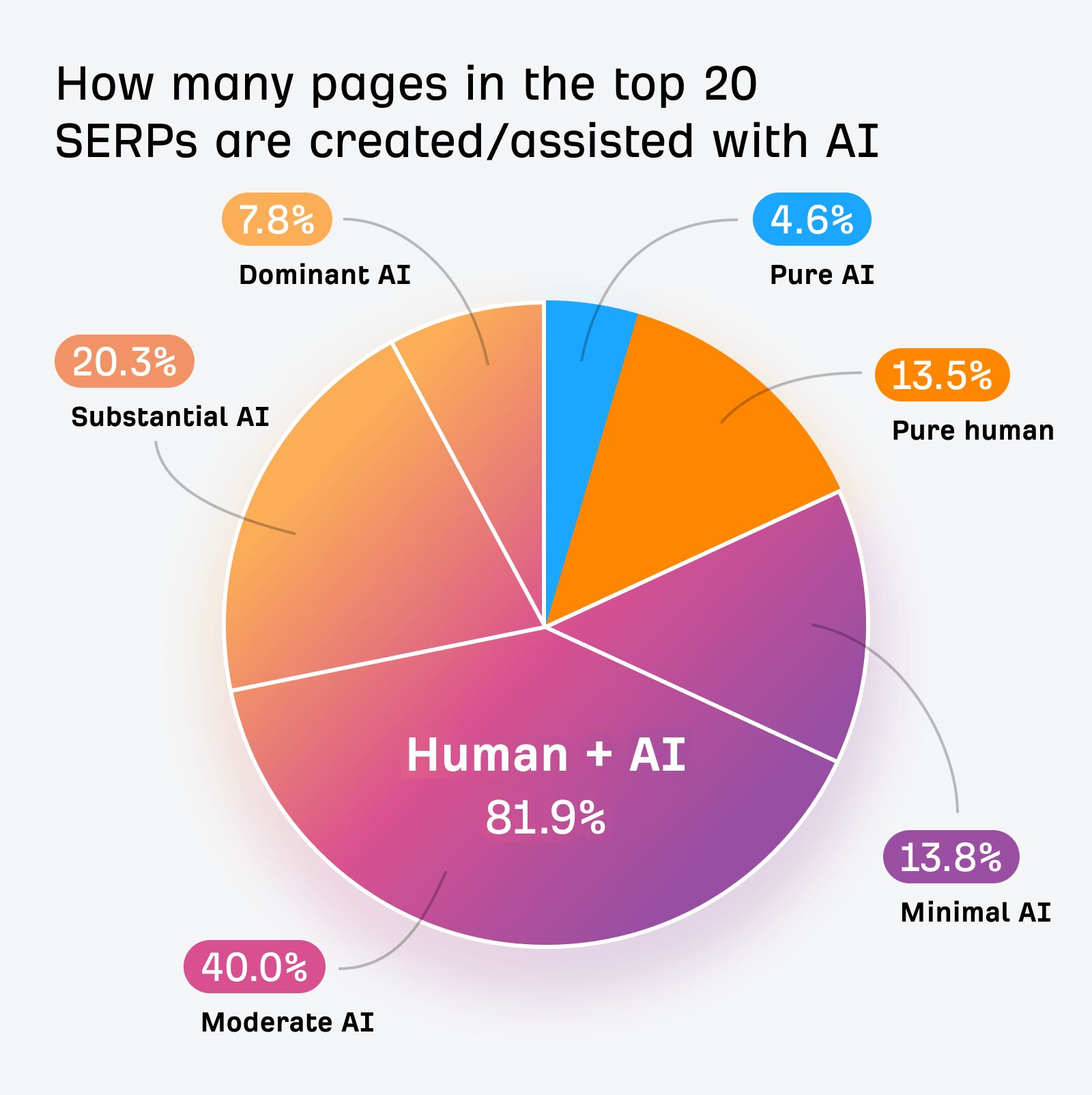
This means AI Overviews are drawing from a content ecosystem that’s increasingly AI-generated. We’re potentially witnessing the emergence of an AI content ecosystem where machines talk to machines.
Start using AI Content Detector
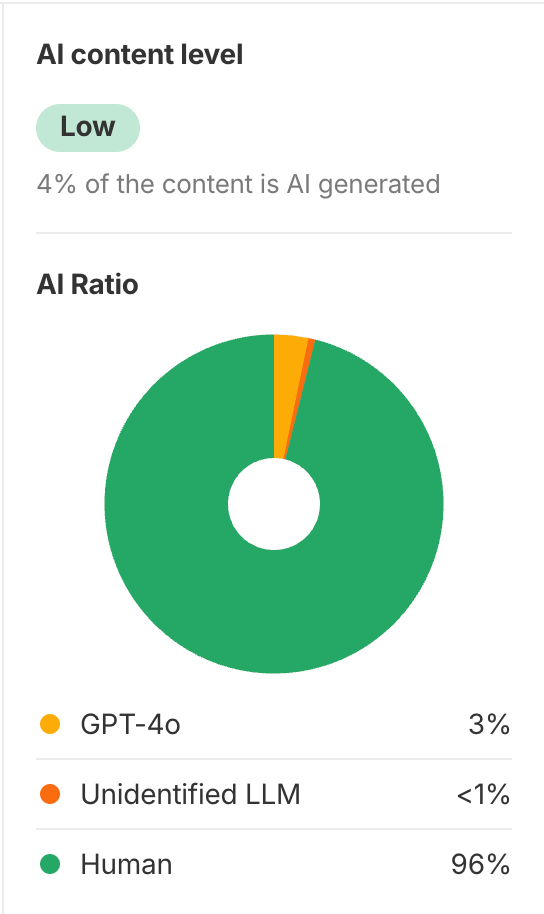
Ahrefs’ AI Content Detector is part of Site Explorer. Just enter any URL, go to Page inspect, then click on the AI Detector tab.
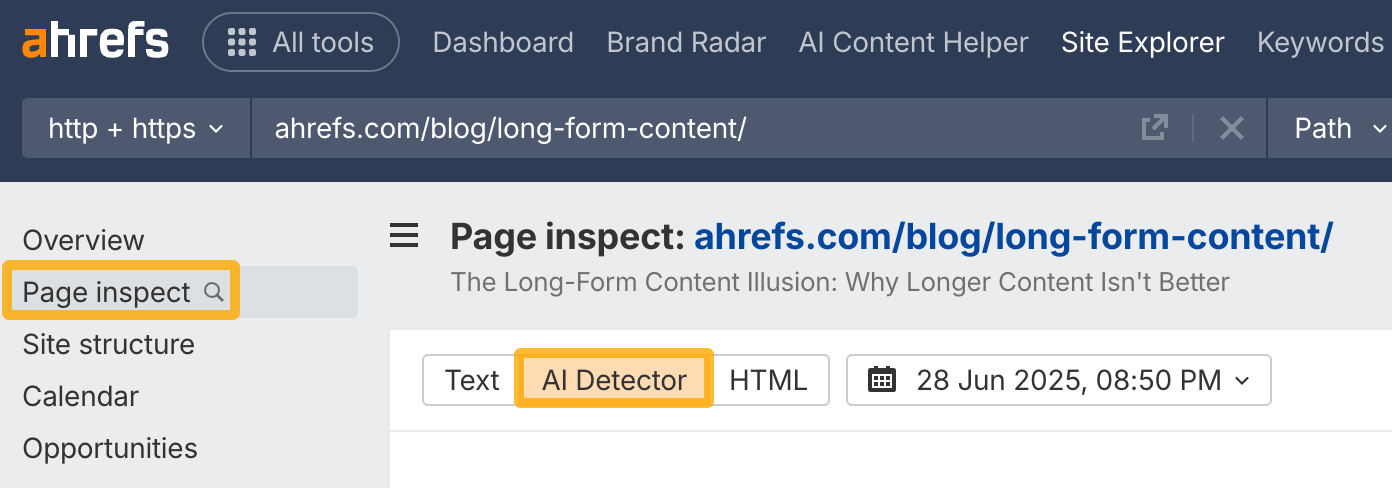
It’ll tell you what percentage of the content is AI-generated and which LLM was used.
Similar Posts
GEO, LLMO, AEO… It’s All Just SEO
As a marketer, I want to know if there are specific things I should do to improve our LLM visibility that I am not currently doing as part of my routine marketing and SEO efforts. So far, it doesn’t seem like it. There seems to be massive overlap in SEO and GEO, such that it doesn’t…
.com vs .ai: What Domain Name Is Best For You?
Are you currently facing the tough decision of choosing between a .com and a .ai domain? Is that why you clicked on this link? It must be, I can’t think of any other reason you’d be here. Well, good news, we’re here to help you make an informed choice and register the best domain for…
Search Engine Ads Explained in 10 Minutes (with Expert Tips)
Search engine advertising (also called pay-per-click, PPC or SEA) offers a direct path to website visitors, but is it the right choice for you? This guide breaks down what beginners need to know before investing in search ads. SEO), which take time to build, search ads appear almost instantly at the top of search results…
The AI Bots That ~140 Million Websites Block the Most
AI bots power some of the most advanced technologies we use today, from search engines to AI assistants. However, their increasing presence has led to a growing number of websites blocking them. There’s a cost to bots crawling your websites and there’s a social contract between search engines and website owners, where search engines add…
Does Being Mentioned on High Traffic Pages Influence AI Mentions?
Get the week’s best marketing content Does being seen more on the web lead to more mentions in AI assistants? I’m defining “being seen” or web visibility as the estimated total monthly organic search traffic to all pages that mention the entity. These are prominent pages on the web, with a lot of visibility. Having…