Clients and stakeholders often ask, “How long till my website (page) ranks on top of Google?” You could say “it depends” and give a lecture on all the variables like quality of the content, website strength, resources, competition… or you can use the data below.
I want to give a huge thanks to our data scientist Xibeijia Guan for doing all the hard data parts of this study, and to our CMO Tim Soulo for his input. Let’s dig in.
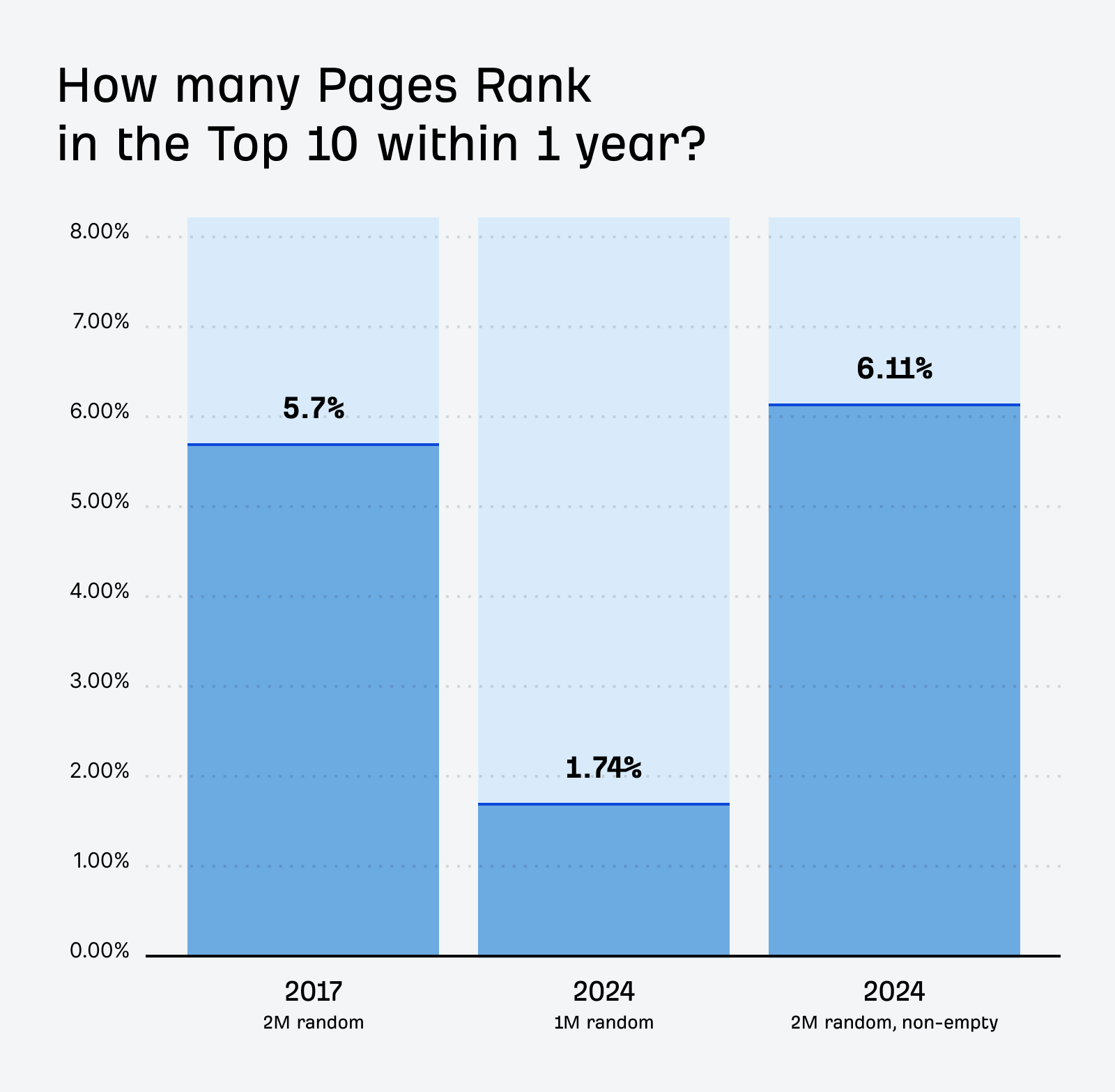
We took 1M random URLs seen by our crawler in September 2023 and looked if any of them made it to the top 10 within a year.
Only 1.74% of them did. 98.26% of them did not. That’s way down from 5.7% in 2017.
Filtering a different way and looking at 2M random URLs created in October 2023 and only non-empty English content, 6.11% of them made it to the top 10 within 1 year. This might be a more fair number to use.
If a page was going to rank for a higher search volume term, it was more likely to do it in the 1st month. Lower search volume terms were more evenly distributed.
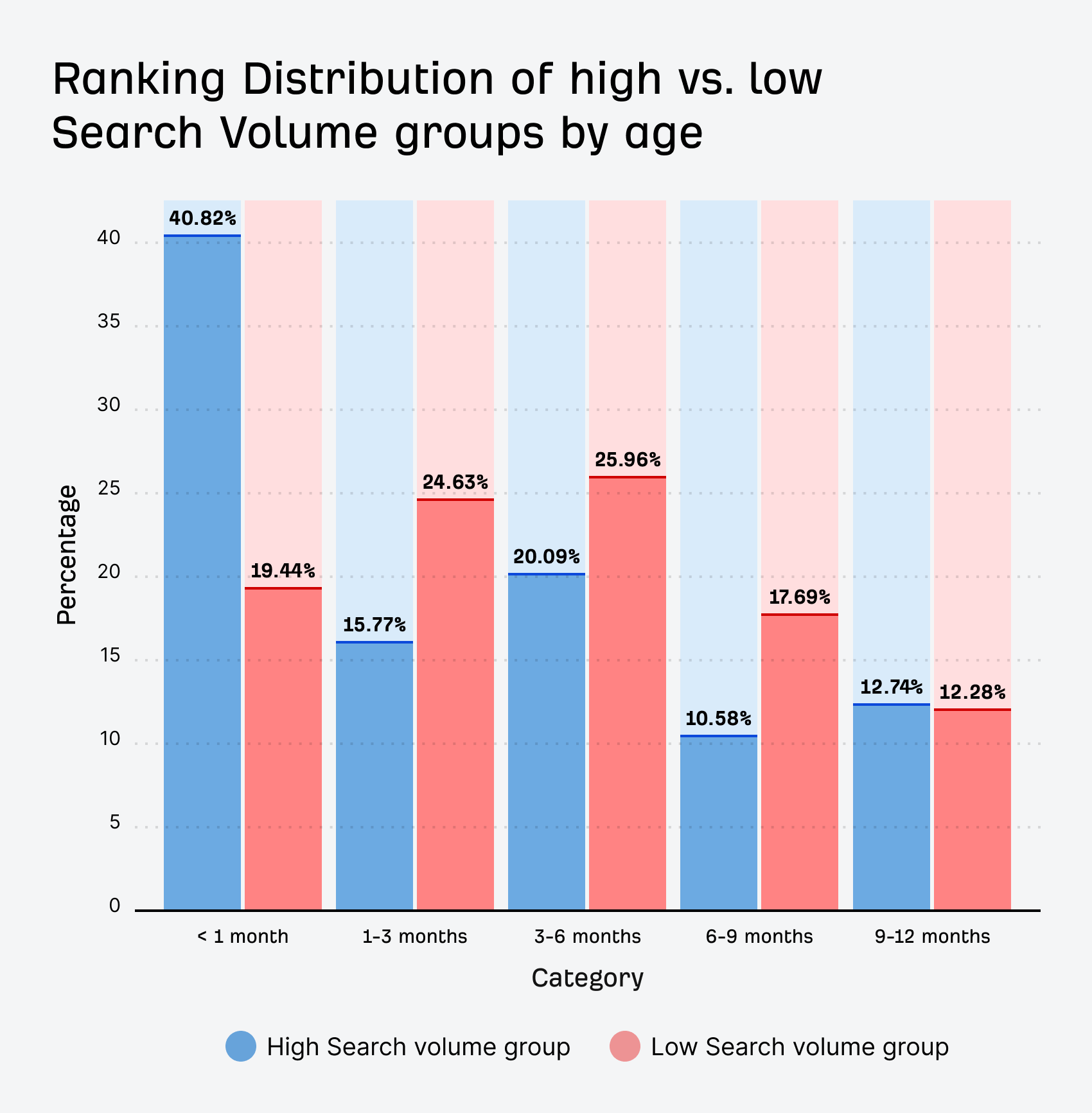
After ~6 months, you may want to look at updating your content if you’re still not in the top 10. Your chances are pretty low after that unless you make some changes.
If we look at the shortest amount of time it took for these pages to rank in the top 10, the data shows it takes longer to rank for high-volume keywords compared to low-volume keywords.
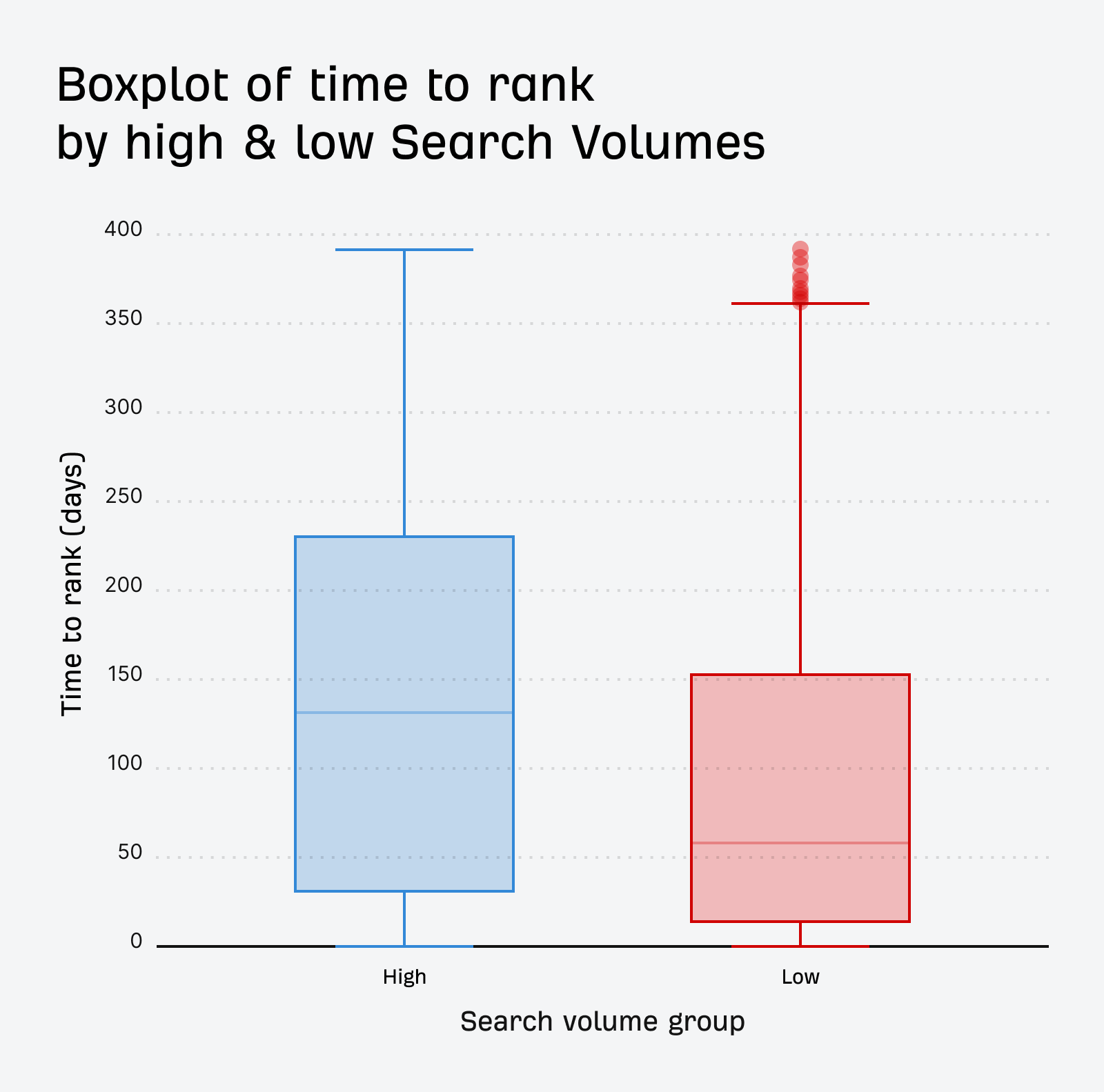
Interestingly, it’s faster now to rank for high volume keywords than it was in 2017, but keep in mind that 94% of the pages never actually ranked for high volume keywords at all.
To answer this question we took 1.3 million random keywords (in the US) and looked at the top 10 ranking URLs. We looked up each of those URLs in Ahrefs, to find the date when this URL was first seen by Ahrefs crawler.
The SERPs are dominated by older pages. 72.9% of pages in the Top 10 are more than 3 years old vs 59% in 2017.
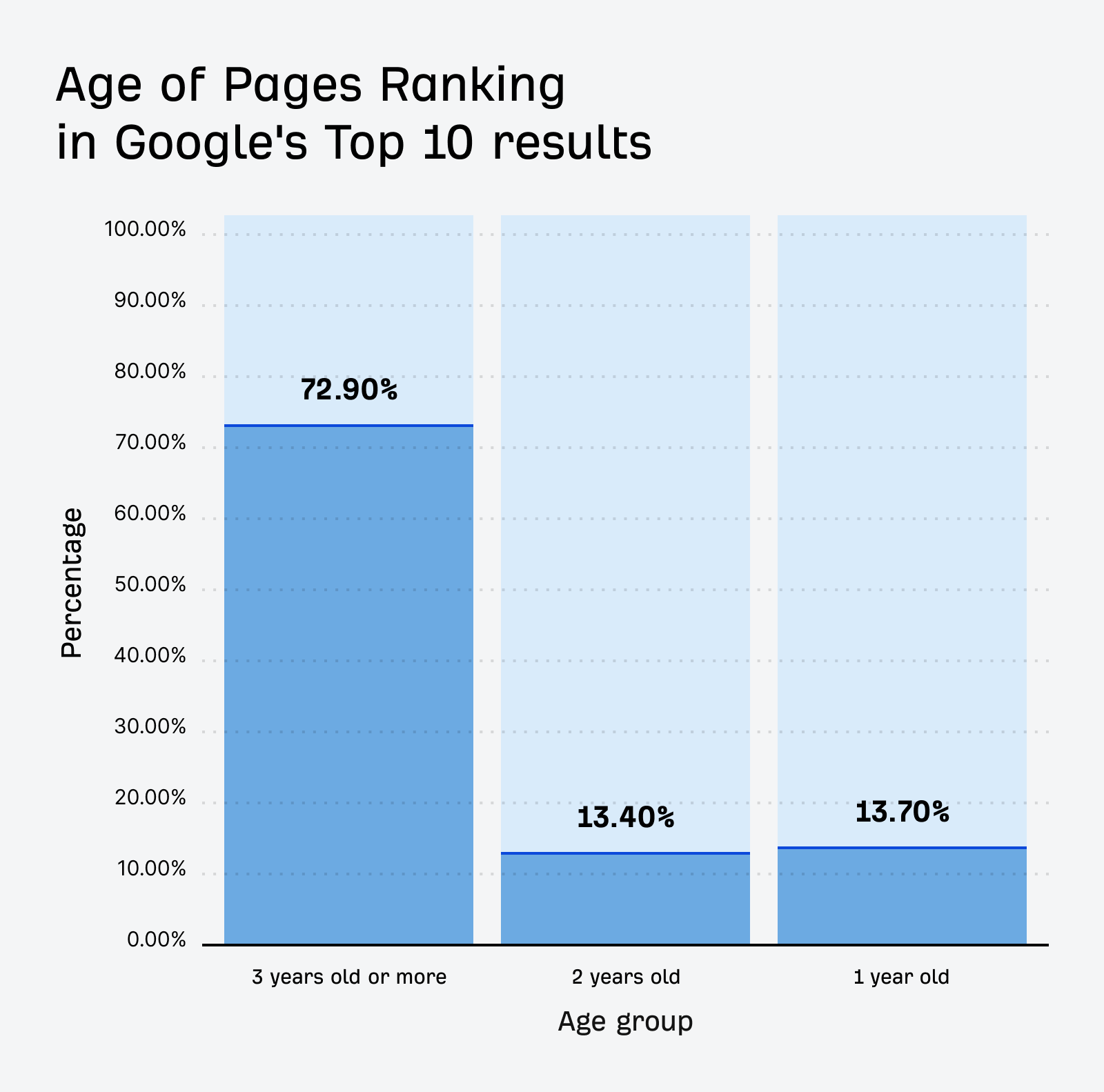
13.7% of the pages seen in the top 10 were under 1 year old, which is down from 22% in the 2017 study. It seems it may be harder for new pages to break into the top 10, but some of the difference here could just be due to the sampled data.
We also saw a clear correlation between the age of the page and how high it ranks in Google:
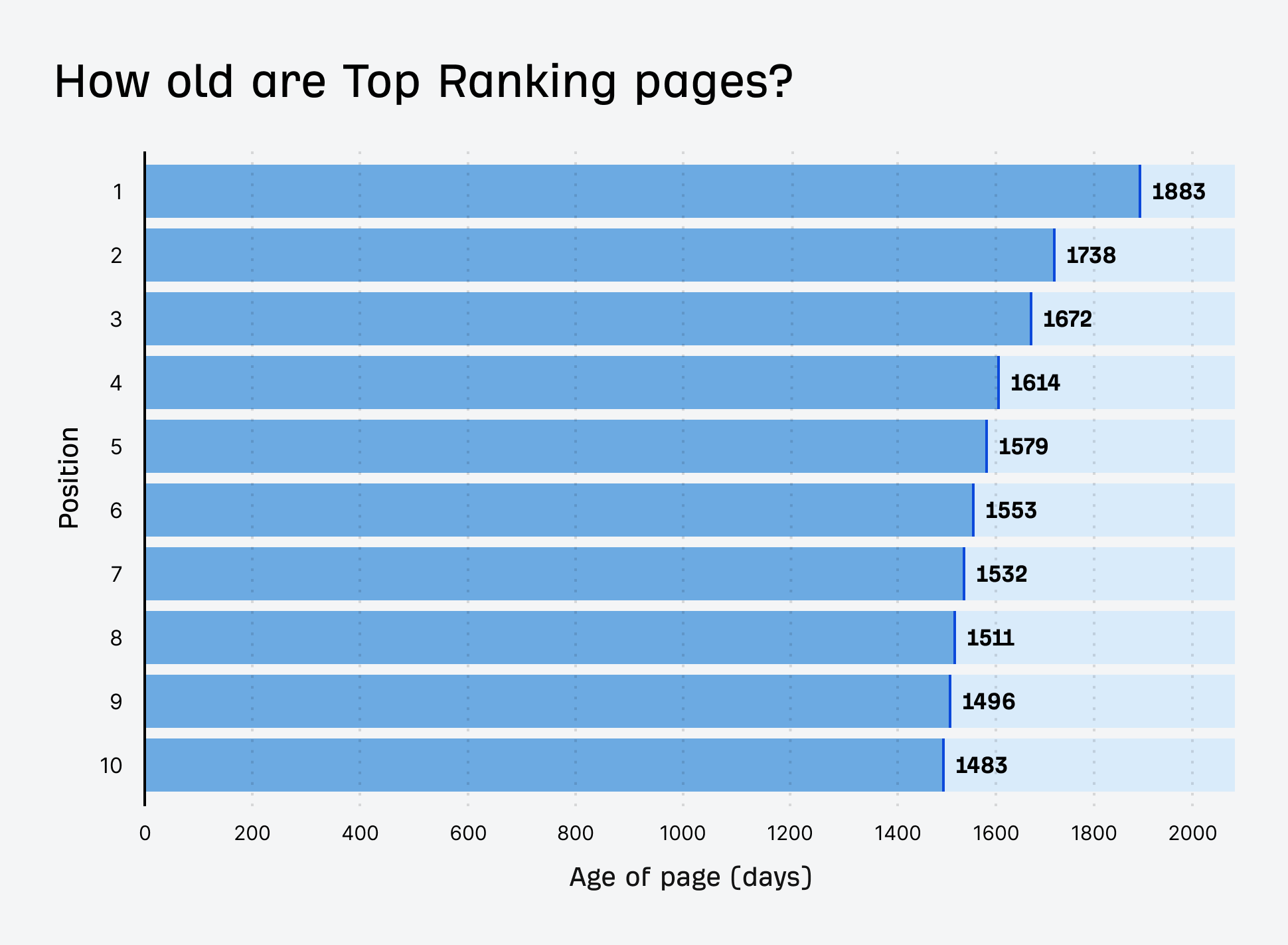
On average, the #1 ranking page in Google is 5 years old. Back in 2017, this was just 2 years old.
Final thoughts
Older content dominates. If you want to rank in Google’s top 10, focus on creating evergreen content that can stand the test of time and plan to update it. It likely took a lot of effort for the 1.74% of new pages ranking in the top 10 to get there. Don’t expect to put out mediocre content and rank for competitive terms.
Similar Posts
Do AI Assistants Link When Mentioning Brands? For Ahrefs, Only 28% of the Time
AI assistants mention brands constantly but they rarely include links. When I tracked brand mentions for Ahrefs across six AI platforms, I found they linked to Ahrefs as rarely as 10% of the time for AI Overviews, and as often as 50% of the time for Perplexity. But here’s what matters more: in our case,…
16 of the Best AI Marketing Tools We’ve Tried & Spied in 2025
We’ve shared, discussed, tested out, and invested in a whole tech stack’s worth of different AI marketing tools lately. Below, you’ll find some we love and use every day, and others we’re keeping a keen eye on in 2025. ad targeting, according to research from SurveyMonkey. The best AI marketing tools help users save time and…
LLMO Is in Its Black Hat Era
We’ve seen this before. A new technology rises. Visibility becomes a new currency. And people—ahem, SEOs—rush to game the system. That’s where we are with optimizing for visibility in LLMs (LLMO), and we need more experts to call out this behavior in our industry, like Lily Ray has done in this post: If you’re tricking, sculpting,…
The Ultimate 82-Point Checklist for SEO & AI Visibility
Get the week’s best marketing content You don’t need another debate about whether optimizing for AI counts as SEO. You need to know what to actually do. This checklist combines proven SEO essentials with the new steps that matter for AI search. No fluff, no fuss. It will help you strengthen your SEO foundation, adapt to…
AI Overviews Change Every 2 Days (But Never Change Their Mind)
Just how stable are AI Overviews? If you manage to get your brand mentioned or cited in them, can you take the rest of the month off? Or do you have to fight for ongoing visibility? To find the answers, our data scientist, Xibeijia Guan, analyzed over 43,000 keywords—each with at least 16 recorded AI…
The Best AI Content Optimization Tools for 2025
Content optimization tools make writing and ranking top-quality content a whole lot easier. That goes double for the latest generation of AI-powered tools. Great optimization tools can identify missing topics and keywords, suggest and refine headers and titles, generate meta-data, and show tons of useful information about your competitors’ articles. If you aren’t using an…